Public trust in drinking water safety is low globally

Low confidence in water quality is associated with perceptions of public corruption

Source:Northwestern University

Summary:A new study finds more than half of adults surveyed worldwide expect to be seriously harmed by their water within the next two years. The study sought to understand public perceptions of drinking water safety. Because perceptions shape attitudes and behaviors, distrust in water quality has a negative impact on people’s health, nutrition, psychological and economic well-being — even when the water meets safety standards.Share:


FULL STORY


A new study finds more than half of adults surveyed worldwide expect to be seriously harmed by their water within the next two years. Led by global health experts at Northwestern University and the University of North Carolina at Chapel Hill, the study sought to understand public perceptions of drinking water safety.

Because perceptions shape attitudes and behaviors, distrust in water quality has a negative impact on people’s health, nutrition, psychological and economic well-being — even when the water meets safety standards.

“If we think our water is unsafe, we will avoid using it,” said Sera Young, professor of anthropology and global health at Northwestern and senior author of the new study.

“When we mistrust our tap water, we buy packaged water, which is wildly expensive and hard on the environment; drink soda or other sugar-sweetened beverages, which is hard on the teeth and the waistline; and consume highly processed prepared foods or go to restaurants to avoid cooking at home, which is less healthy and more expensive,” Young said. “Individuals exposed to unsafe water also experience greater psychological stress and are at greater risk of depression.”

Young is a Morton O. Schapiro Faculty Fellow at the Institute for Policy Research, a faculty fellow at the Paula M. Trienens Institute for Sustainability and Energy, and co-lead of the Making Water Insecurity Visible Working Group at the Buffett Institute for Global Affairs.

Using nationally representative data from 148,585 adults in 141 countries from the 2019 Lloyd’s Register Foundation World Risk Poll, the authors found a high prevalence of anticipated harm from water supply, with the highest in Zambia, the lowest in Singapore and an overall mean of 52.3%.

They also identified key characteristics of those who thought they would be harmed by their drinking water. Women, city dwellers, individuals with more education, and those struggling on their current income were more likely to anticipate being harmed by their drinking water.

The researchers found that, surprisingly, higher corruption perception index scores were the strongest predictor of anticipated harm from drinking water, more so than factors like infrastructure and Gross Domestic Product.

Further, even within countries with consistent access to basic drinking water services, doubts about the safety of water were widespread. This includes the U.S. where 39% of those polled anticipated serious harm from drinking water in the short term.

“Our research highlights that it is imperative both to deliver safe drinking water and to make sure that people have confidence in their water source,” said Joshua Miller, a doctoral student at the UNC Gillings School of Global Public Health and the study’s first author.

The researchers note that it is difficult for consumers to judge the hazards and safety of their water supply because many contaminants are invisible, odorless and tasteless. Without adequate information, many are left to evaluate the safety of their water based on prior experiences, media reports, and personal values and beliefs.

“It’s also possible that people correctly judge the safety of their water,” Young said. “The good people of Flint didn’t trust their water and they were spot on.”

The co-authors suggest actions officials can take to improve public trust around drinking water, including efforts to make testing more readily available, translate test results, replace lead pipes and provide at-home water filters when contaminants are detected, as well as provide improved access to safe drinking water.

“This is the kind of work that can catalyze greater attention and political will to prioritize these services in national development plans and strategies, and get us closer to achieving universal access to safe drinking water,” said Aaron Salzberg, director of the Water Institute at the UNC Gillings School of Global Public Health.

Salzberg previously served as the special coordinator for water resources in the U.S. Department of State, where he was responsible for managing the development and implementation of U.S. foreign policy on drinking water and sanitation, water resources management and transboundary water issues.

CLICK HERE FOR MORE INFORMATION

https://www.sciencedaily.com/releases/2024/08/240826182932.htm

Drinking water contaminated with Pfas probably increases risk of infant mortality, study finds

This article is more than 2 months old

Study of 11,000 births in New Hampshire shows residents’ reproductive outcomes near contaminated sites

Tom Perkins 15.00 ESTShare

Prefer the Guardian on Google

Drinking water contaminated with Pfas chemicals probably increases the risk of infant mortality and other harm to newborns, a new peer-reviewed study of 11,000 births in New Hampshire finds.

The first-of-its-kind University of Arizona research found drinking well water down gradient from a Pfas-contaminated site was tied to an increase in infant mortality of 191%, pre-term birth of 20%, and low-weight birth of 43%.

It was also tied to an increase in extremely premature birth and extremely low-weight birth by 168% and 180%, respectively.

The findings caught authors by surprise, said Derek Lemoine, a study co-author and economics professor at the University of Arizona who focuses on environmental policymaking and pricing climate risks.

“I don’t know if we expected to find effects this big and this detectable, especially given that there isn’t that much infant mortality, and there aren’t that many extremely low weight or pre-term births,” Lemoine said. “But it was there in the data.”

The study also weighed the cost of societal harms in drinking contaminated water against up-front cleanup costs, and found it to be much cheaper to address Pfas water pollution.

Extrapolating the findings to the entire US population, the authors estimate a nearly $8bn negative annual economic impact just in increased healthcare costs and lost productivity. The cost of complying with current regulations for removing Pfas in drinking water is estimated at about $3.8bn.

“We are trying to put numbers on this and that’s important because when you want to clean up and regulate Pfas, there’s a real cost to it,” Lemoine said.

Pfas are a class of at least 16,000 compounds often used to help products resist water, stains and heat. They are called “forever chemicals” because they do not naturally break down and accumulate in the environment, and they are linked to serious health problems such as cancer, kidney disease, liver problems, immune disorders and birth defects.

Pfas are widely used across the economy, and industrial sites that utilize them in high volume often pollute groundwater. Military bases and airports are among major sources of Pfas pollution because the chemicals are used in firefighting foam. The federal government estimated that about 95 million people across the country drink contaminated water from public or private wells.

Previous research has raised concern about the impact of Pfas exposure on fetuses and newborns.

Among those are toxicological studies in which researchers examine the chemicals’ impact on lab animals, but that leaves some question about whether humans experience the same harms, Lemoine said.

Other studies are correlative and look at the levels of Pfas in umbilical cord blood or in newborns in relation to levels of disease. Lemoine said those findings are not always conclusive, in part because many variables can contribute to reproductive harm.

The new natural study is unique because it gets close to “isolating the effect of the Pfas itself, and not anything around it”, Lemoine said.

Researchers achieved this by identifying 41 New Hampshire sites contaminated with Pfoa and Pfos, two common Pfas compounds, then using topography data to determine groundwater flow direction. The authors then examined reproductive outcomes among residents down gradient from the sites.

Researchers chose New Hampshire because it is the only state where Pfas and reproductive data is available, Lemoine said. Well locations are confidential, so mothers were unaware of whether their water source was down gradient from a Pfas-contaminated site. That created a randomization that allows for causal inference, the authors noted.

The study’s methodology is rigorous and unique, and underscores “that Pfas is no joke, and is toxic at very low concentrations”, said Sydney Evans, a senior science analyst with the Environmental Working Group non-profit. The group studies Pfas exposures and advocates for tighter regulations.

The study is in part effective because mothers did not know whether they were exposed, which created the randomization, Evans said, but she noted that the state has the information. The findings raise questions about whether the state should be doing a similar analysis and alerting mothers who are at risk, Evans said.

Lemoine said the study had some limitations, including that authors don’t know the mothers’ exact exposure levels to Pfas, nor does the research account for other contaminants that may be in the water. But he added that the findings still give a strong picture of the chemicals’ effects.

Granular activated carbon or reverse osmosis systems can be used by water treatment plants and consumers at home to remove many kinds of Pfas, and those systems also remove other contaminants.

The Biden administration last year put in place limits in drinking water for six types of Pfas, and gave water utilities several years to install systems.

The Trump administration is moving to undo the limits for some compounds. That would probably cost the public more in the long run. Utility customers pay the cost of removing Pfas, but the public “also pays the cost of drinking contaminated water, which is bigger”, Lemoine said.

CLICK HERE FOR MORE INFORMATION

https://www.theguardian.com/us-news/2025/dec/08/drinking-water-pfas-infant-mortality-study

Tap vs. Bottled Water: Scientists Reveal Which Contained More Chemical Byproducts

Researchers tested spring, groundwater, and purified bottled waters against local tap to see how treatment shapes the byproducts that emerge — and the differences were striking.

By 

Stacey Leasca

How to Make Lemony White Bean DipClose

A plastic bottle of water placed on a surface in sunlight
Credit: Ekaterina Goncharova / Getty Images
  • A new study found that bottled water contains lower levels of disinfection byproducts (DBPs) than chloraminated tap water, averaging less than half the amount found in typical U.S. tap samples.
  • Researchers detected DBPs—including trihalomethanes and haloacetic acids—in all 10 bottled water brands tested, though levels remained relatively low.
  • Spring and groundwater brands tended to have fewer DBPs than purified bottled waters, making them the better choice for minimizing chemical byproducts.

The news hasn’t been great for bottled water fans lately. In January, Food & Wine reported on a new study showing that the more bottled water you drink, the more microplastics you consume, and another study showing that bottled water may contain more bacteria than you might expect. And don’t even get us started on what happens when you leave bottled water in a hot car for too long.

Now, a new study published in the journal Water Research is giving bottled water the silver lining it desperately needs. 

In the new March issue, researchers from the University of South Carolina published findings measuring levels of disinfection byproducts (DBPs) in bottled water compared to chloraminated tap water. The study noted that bottled water often begins as municipal tap water, which is sometimes further disinfected. This process, the researchers added, can form DBPs, chemical compounds created when disinfectants react with natural organic matter.

This Is the Bottled Water Brand Americans Reach for Most, According to New Data

The researchers noted that some of these DBPs are already regulated in bottled water by the U.S. Food and Drug Administration (FDA); however, many more fly under the unregulated radar. To find out which ones may be lurking in your water, the researchers purchased 10 popular brands of bottled water from local stores, including lower-cost “grocery” brands, mid-tier “name” brands, and higher-end “designer” brands. Some of the water was labeled as “purified” (often just code for treated tap water), while others were labeled as spring or groundwater. They also collected a sample of local tap water (treated with chloramine) for comparison with the bottled brands.

The researchers then tested for 64 different DBPs, including 50 unregulated DBPs that had not previously been measured in bottled water. They found that every bottled water sample they tested contained some level of disinfection byproducts, but at relatively low levels, ranging from 0.01 to 22.4 micrograms per liter, or up to about 22 millionths of a gram in roughly 34 ounces of water. By comparison, the tap water sample they analyzed contained 47.3 micrograms per liter, and previous studies suggest U.S. tap water averages closer to 52 micrograms per liter, about double the highest bottled water level measured in this study.

Bottled water vs. tap water: How do DBP levels compare?
Water Type DBP Levels in This Study How It’s Treated What to Know 
Purified bottled water 0.01–22.4 µg/L (some samples near the higher end of the bottled range) Often municipal tap water that has been further treated (e.g., reverse osmosis, distillation, or carbon filtration) May still contain DBPs formed during disinfection. Levels varied by lot. 
Spring/groundwater bottled water Generally lower overall DBPs than purified brands Sourced from underground aquifers; may be disinfected but often undergoes less treatment than purified water Showed lower DBP levels in this study, but not DBP-free. 
Chloraminated tap water (sample) 47.3 µg/L Treated with chloramine to kill pathogens Higher DBPs than any bottled sample tested, but within federal regulatory limits. 
Average U.S. tap water (prior research) ~52 µg/L Typically chlorinated or chloraminated Federal EPA limit for total trihalomethanes is 80 µg/L. 

Here’s how disinfection byproduct (DBP) levels in bottled water brands stack up against chloraminated tap water samples and prior U.S. averages.

And a hot tip: If you’re hoping to score the bottled water with the lowest levels of DBPs, go for spring and groundwater, which showed lower overall DBPs than purified brands.

As for which byproducts they identified, the team reported that trihalomethanes and haloacetic acids had the highest concentrations. Both are common DBPs that form when chlorine reacts with organic matter in water. (However, some studies have linked long-term exposure at high levels to an increased risk of certain cancers.) The researchers also found several unregulated DBPs, including dibromoacetonitrile, which is carcinogenic. 

https://www.foodandwine.com/embed?url=https%3A%2F%2Fwww.youtube.com%2Fwatch%3Fv%3DL7qnquywcZU&id=mntl-sc-block_20-0-iframe&options=e30%3D&docId=11909742

The one thing the team couldn’t do was say with certainty that there is a “safest” brand of water, because DBP levels varied from lot to lot, making brand-level comparisons impossible. As for what’s next, the team hopes their work can inform future studies tracking these DBPs over time to see how they develop as water sits on the shelf.

Tap Water Disinfection May Form Far More Chemical Byproducts Than Regulators Track, Study Finds

Bottom line: Bottled water isn’t DBP-free — but it may contain lower levels than some tap water. If you’re concerned, spring water and proper storage are your best bets. And as always, balance convenience, cost, and environmental impact before stocking up.

CLICK HERE FOR MORE INFORMATION

https://www.foodandwine.com/tap-vs-bottled-water-disinfection-byproducts-usc-study-2026-11909742

Vol. 2024 No. 5

From Wells to Wellness: An Introduction to Drinking Water Systems in Florida: FE1156, 10/2024

Food and Resource Economics

Published 2024-10-08

EDIS Cover Volume 2004 Number 5 fruits and vegetables image

Keywords

drinking water
water policy
water supply

Categories

How to Cite

Weng, Weizhe, Andrea Albertin, and Yilin Zhuang. 2024. “From Wells to Wellness: An Introduction to Drinking Water Systems in Florida: FE1156, 10 2024”. EDIS 2024 (5). Gainesville, FL. https://doi.org/10.32473/edis-fe1156-2024.

Abstract

Safe drinking water is a fundamental requirement for human health and well-being. This publication is part of an EDIS series that aims to illuminate the critical issues surrounding drinking water quality and Florida’s drinking water system. In this article, we begin with a brief introduction to the different categories of Florida’s drinking water system. Then, we discuss relevant federal and state level regulations for each category. Information sources and channels are provided for readers to access drinking water information in their communities. The content is designed to benefit a diverse audience, including researchers, communications and outreach experts, environmental professionals, healthcare providers, and policymakers. It seeks to clarify the facts and regulatory framework governing drinking water systems, identify areas that require targeted extension programs, and aid in the development of outreach materials to ensure the provision of safe drinking water.

CLICK HERE FOR MORE INFORMATION

https://journals.flvc.org/edis/article/view/134819

County-level associations between drinking water PFAS contamination and COVID-19 mortality in the United States

Journal of Exposure Science & Environmental Epidemiology volume 35, pages478–485 (2025)Cite this article

Abstract

Background

Epidemiologic and animal studies both support relationships between exposures to per- and polyfluoroalkyl substances (PFAS) and harmful effects on the immune system. Accordingly, PFAS have been identified as potential environmental risk factors for adverse COVID-19 outcomes.

Objective

Here, we examine associations between PFAS contamination of U.S. community water systems (CWS) and county-level COVID-19 mortality records. Our analyses leverage two datasets: one at the subnational scale (5371 CWS serving 621 counties) and one at the national scale (4798 CWS serving 1677 counties). The subnational monitoring dataset was obtained from statewide drinking monitoring of PFAS (2016–2020) and the national monitoring dataset was obtained from a survey of unregulated contaminants (2013–2015).

Methods

We conducted parallel analyses using multilevel quasi-Poisson regressions to estimate cumulative incidence ratios for the association between county-level measures of PFAS drinking water contamination and COVID-19 mortality prior to vaccination onset (Jan-Dec 2020). In the primary analyses, these regressions were adjusted for several county-level sociodemographic factors, days after the first reported case in the county, and total hospital beds.

Results

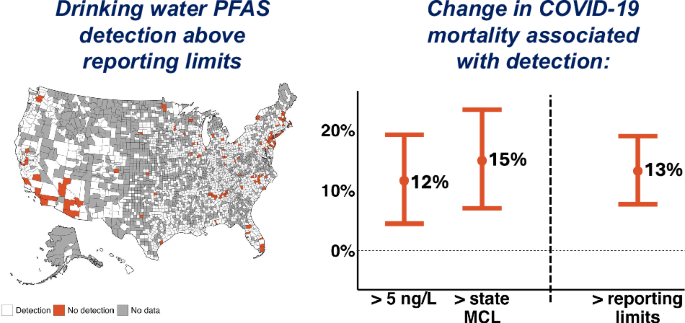
In the subnational analysis, detection of at least one PFAS over 5 ng/L was associated with 12% higher [95% CI: 4%, 19%] COVID-19 mortality. In the national analysis, detection of at least one PFAS above the reporting limits (20–90 ng/L) was associated with 13% higher [95% CI: 8%, 19%] COVID-19 mortality.

Impact Statement

  • Our findings provide evidence for an association between area-level drinking water PFAS contamination and higher COVID-19 mortality in the United States. These findings reinforce the importance of ongoing state and federal monitoring efforts supporting the U.S. Environmental Protection Agency’s 2024 drinking water regulations for PFAS. More broadly, this example suggests that drinking water quality could play a role in infectious disease severity. Future research would benefit from study designs that combine area-level exposure measures with individual-level outcome data.

CLICK HERE FOR MORE INFORMATION

https://www.nature.com/articles/s41370-024-00723-5?

New solutions to keep drinking water safe as pesticide use skyrockets worldwide

Source:University of South Australia

Summary:Water scientists have proposed a more effective method of removing organic pesticides from drinking water, reducing the risk of contamination and potential health problems.Share:


FULL STORY


Water scientists from Australia and China have proposed a more effective method of removing organic pesticides from drinking water, reducing the risk of contamination and potential health problems.

A 62% rise in global pesticide use in the past 20 years has escalated fears that many of these chemicals could end up in our waterways, causing cancer.

Powdered activated carbon (PAC) is currently used to remove organic pesticides from drinking water, but the process is costly, time consuming and not 100% effective.

University of South Australia water researcher Professor Jinming Duan has collaborated with his former PhD student, Dr Wei Li of Xi’an University of Architecture & Technology and Chinese colleagues in a series of experiments to improve the process.

The researchers found that reducing the PAC particles from the existing commercial size of 38 μm (one millionth of a metre) to 6 μm, up to 75% less powder was needed to remove six common pesticides, achieving significant water treatment savings.

At 6 μm, the PAC particles are still large enough to be filtered out after the adsorption process, ensuring they do not end up in the drinking water after toxic pesticides are removed.

Prof Duan says pollutants in our waterways are projected to increase in coming decades as the world’s population and industrial development grows.

“It’s therefore critical that we develop cost-effective treatment processes to ensure our waterways remain safe,” he says.

Their findings have been published in the journal Chemosphere.

“Pesticides cannot be removed using conventional water treatment processes such as flocculation, sedimentation and filtration. Powdered activated carbon does the job, but the existing methods have limitations. Our study has identified how we can make this process more efficient.”

Approximately 3.54 million metric tons of pesticides were applied to agricultural crops worldwide in 2021, according to the Statista Research Department.

Worryingly, despite efforts to increase their efficiency, it is estimated that only 10% of pesticides reach their target pests, with most of the chemicals remaining on plant surfaces or entering the environment, including the soil, waterways and atmosphere.

Toxicological studies have suggested that long-term exposure to low levels of pesticides — primarily through diet or drinking water — could increase the risks of cancer and other diseases.

“This is why it is important to reduce their levels to as low as feasibly possible,” Prof Duan says.

The researchers also hope to explore how super-fine activated carbon could be used to remove toxic polyfluoroalkyl substances (PFAS) and perfluorinated compounds (PFCs) found in many consumer products, which have been linked to adverse health impacts.

CLICK HERE FOR MORE INFORMATION

https://www.sciencedaily.com/releases/2024/07/240711111526.htm

Active pharmaceutical contaminants in drinking water: myth or fact?

You have full access to thisopen accessarticle

Download PDF

Save article

DARU Journal of Pharmaceutical SciencesAims and scopeSubmit manuscript

Active pharmaceutical contaminants in drinking water: myth or fact?

Download PDF

Abstract

Global water availability has been affected by a variety of factors, including climate change, water pollution, urbanization, and population growth. These issues have been particularly acute in many parts of the world, where access to clean water remains a significant challenge. In this context, preserving existing water bodies is a critical priority. Numerous studies have demonstrated the inadequacy of conventional water treatment processes in removing active pharmaceutical ingredients (APIs) from the water. These pharmaceutical active compounds have been detected in treated wastewater, groundwater, and even drinking water sources. The presence of APIs in water resources poses a significant threat not only to aquatic organisms but also to human health. These emerging contaminants have the potential to disrupt endocrine systems, promote the development of antibiotic-resistant bacteria, and bioaccumulate in the food chain, ultimately leading to unacceptable risks to public health. The inability of current conventional treatment methods to effectively remove APIs from water has raised serious concerns about the safety and reliability of water supplies. This issue requires immediate attention and the development of more effective treatment technologies to safeguard the quality of water resources and protect both aquatic ecosystems and human health. Other treatment methods, such as nanotechnology, microalgal treatment, and reverse osmosis, are promising in addressing the issue of API contamination in water resources. These innovative approaches have demonstrated higher removal efficiencies for a wide range of APIs compared to conventional methods, such as activated sludge and chlorination, which have been found to be inadequate in the removal of these emerging contaminants. The potential of these alternative treatment technologies to serve as effective tertiary treatment. To address this critical challenge, governments and policymakers should prioritize investment in research and development to establish effective and scalable solutions for eliminating APIs from various water sources. This should include comprehensive studies to assess the performance, cost-effectiveness, and environmental sustainability of emerging treatment technologies. The emerging contaminants should be included in robust water quality monitoring programs (Aus der Beek et al. in Environ Toxicol Chem 2016;35(4):823-835), with strict regulatory limits enforced to protect public health and the environment. By doing so, the scientific community and regulatory authorities can work together to develop a multi-barrier approach to safeguarding the water resources and ensuring access to safe, clean water for all. This review explores the potential of alternative treatment technologies to serve as viable solutions in the fight against API contamination. Innovative approaches, including nanotechnology, microalgal treatment, and reverse osmosis, have demonstrated remarkable success in addressing this challenge, exhibiting higher removal efficiencies compared to traditional methods.

CLICK HERE FOR MORE INFORMATION

https://link.springer.com/article/10.1007/s40199-024-00536-9

Assessing exposure and health consequences of chemicals in drinking water in the 21st Century

Journal of Exposure Science & Environmental Epidemiology volume 34, pages1–2 (2024)Cite this article

Populations worldwide are exposed to a myriad of chemicals via drinking water, yet only a handful of chemicals have been extensively evaluated with regard to human exposures and health impacts [12]. Many chemicals are generally “invisible” in that they do not alter the color or odor of drinking water, and many of the associated effects are not observable for decades, making linkages between exposure and disease difficult. The articles included in the Journal of Exposure Science and Environmental Epidemiology Special Topic “Assessing Exposure and Health Consequences of Chemicals in Drinking Water in the 21st Century” cover a range of topics, including: (i) new exposure and health research for regulated and emerging chemicals, (ii) new methods and tools for assessing exposure to drinking water contaminants, (iii) issues of equity and environmental justice, (iv) drinking water issues within the context of a changing climate. This Special Topic includes articles authored by experts across multiple disciplines including environmental engineering, hydrology, exposure science, epidemiology, toxicology, climate science, and others. Many of these papers emerged from an international symposium organized by ISGlobal and Yale scientists held in Barcelona in September 2022 [3].

Regulated chemicals

Chemicals that have been the focus of environmental health research include disinfection by-products (DBPs), nitrate, and metals. Although many of these chemicals are regulated, there is concern about low-dose exposures at concentrations below standards and guidelines, and risks of health endpoints not yet studied. Kaufman et al. explore new ways to assess DBP exposure, considering concentrations and specific toxicity potential in relation to birth defects risk [4]. Long-term exposure to DBPs and nitrate is addressed by Donat-Vargas et al. in relation to chronic lymphocytic leukaemia in Spain [5]. Friedman et al. examine temporal and spatial variability of manganese concentrations in a case study in the United States (US) [6]. Hefferon et al. evaluated sociodemographic inequalities in fluoride concentrations across the US [7]. Spaur et al. evaluate the contribution of water arsenic to biomarker levels in a prospective study in the US [8].

Chemicals of emerging concern

Many emerging chemicals, such as per- and polyfluoroalkyl substances (PFAS), microplastics, and 1,4-dioxane, have drinking water as the dominant exposure pathway for many populations. Yet, these remain largely unregulated or have standards and guidelines that vary widely across states and countries. Because only small percentages of the universe of contaminants are regulated in drinking water, routine monitoring data for many chemicals of emerging concern is frequently absent or very limited. To advance understanding of drinking water exposures to PFAS, Cserbik et al. [9]. and Kotlarz et al. [10]. evaluate and compare PFAS in drinking water and blood serum samples in two different settings: an urban setting not impacted by PFAS pollution in Spain [9] and among well water users living near a fluorochemical facility in the US [10], respectively.

New methods and tools for exposure assessment

There is a need for improved tools, methods, and data to evaluate drinking water related exposures. These tools and techniques remain somewhat limited and lag behind those of other stressors (e.g., air pollution). Also, despite water contaminants occurring in mixtures, most of the evaluations (and policies and regulations) are conducted chemical by chemical, ignoring potential interactions. Schullehner et al. present case studies of three approaches of exposure assessment of drinking water quality: use of country-wide routine monitoring databases, wide-scope chemical analysis, and effect-based bioassay methods [11]. Luben et al. elaborate and compare different exposure assessment metrics to trihalomethanes in epidemiological analyses of reproductive and developmental outcomes [12]. Escher et al. present in vitro assays to evaluate biological responses of including neurotoxicity, oxidative stress, and cytotoxicity in different types of drinking water samples (tap, bottled, filtered) [13] Isaacs et al. present newly developed automated workflows to screen contaminants of concern based on toxicity and exposure potential [14]. Dorevitch et al. develop a novel method to improve detection of particulate lead spikes [15].

Issues of equity, environmental justice, and vulnerable populations

A substantial portion of the population (e.g., 20% in the United States) have private water supplies (e.g., a household domestic drinking water well), which are not subject to any federal regulatory oversight or monitoring [16]. This presents an equity issue in access to data on drinking water quality, as discussed in Levin et al. [2]. and heterogeneity in state-based policies for drinking water prevention, as discussed by Schmitt et al. [17]. Spaur et al. [8], observed that water from unregulated private wells and regulated municipal water supplies contributes substantially to overall exposures (as measured by urinary arsenic and uranium concentrations) in both rural, American Indian populations and urban, racially/ethnically diverse populations nationwide. Hefferon et al. evaluated environmental justice issues with respect to fluoride and found that 2.9 million US residents are served by public water systems with average fluoride concentrations exceeding the World Health Organization’s guidance limit [7]. Friedman et al. show that manganese in drinking water frequently exceeds current guidelines in the US, and occur at concentrations shown to be associated with adverse health outcomes, especially for vulnerable and susceptible populations like children [6].

Chemical contamination may also pose a serious threat in the developing world. Today, around 2.2 billion people – or 1 in 4 – still lack safely managed drinking water at home [18]. In most of the world, microbial contamination is the biggest challenge. Because it has been understudied, the chemical risks remain obscure [19], and regulators often require local data to take action. Praveena et al. reviews the quality of different drinking water types in Malaysia (tap water, ground water, gravity feed system) and its implications on policy, human health, management, and future research [20].

Water quality in a changing climate

There is an urgent need to anticipate and prepare for current and future challenges in a rapidly changing world. We also need to foresee new challenges to address issues of water scarcity (e.g., increasing desalination, use of treated wastewater in densely populated urban areas to meet water use demands), and aging infrastructure for many middle- and high-income countries constructed in the nineteenth and twentieth centuries. The impacts of climate change on the water cycle are direct and observable, such as more frequent droughts and floods, sea level rise, and ice/snow melt. These events will challenge drinking water quality and availability through direct and indirect mechanisms [21]. There is still very limited knowledge on how climate events will affect the quality of finished drinking water. In our special issue, Oliveras et al. conducts a new analysis on the impacts of drought and heavy rain surrogates on the quality of drinking water in Barcelona, Spain [22].

Conclusion

Chemical contamination of drinking water is widespread. Although our knowledge on chemical risks in drinking water is increasing, there are knowledge gaps that make a slow translation to public health protection. We hope this issue highlights, elevates, and motivates research on chemical exposures via drinking water.

CLICK HERE FOR MORE INFORMATION

https://www.nature.com/articles/s41370-024-00639-0

Warming drinking water distribution systems in the context of climate change: a scoping review on health-related microbial and chemical water quality effects

Jesse Limaheluw 1 2Monique van der Aa 3

Affiliations Expand

Abstract

Background: Warming caused by climate change can impact human health risks associated with drinking water. This review aimed to synthesize the evidence about the effects of increasing temperatures in the drinking water distribution system (DWDS) on health-related chemical and microbial water quality parameters. We also identified adaptation options. Methods: We conducted a scoping review of quantitative peer-reviewed studies published up to March 2023, and research reports published up to April 2024, specifically looking at a DWDS or comparable experimental conditions. Results: We included 28 studies in this review. Evidence focused on chlorinated systems in higher-income countries. Warming has variable effects on microbial communities within the DWDS. Accumulation and release of heavy metals may increase at higher temperatures, depending on pipe materials. Warming also speeds up the decay of chlorine and chloramine, affecting the formation of disinfectant byproducts and the potential of microbial (re)growth. Multiple effects can occur simultaneously, requiring an integrated adaptation approach. Technical and institutional adaptation options, such as improved removal of dissolved organic carbon during treatment covering the entire DWDS were identified. Discussion: With increasing climate change, the identified effects can become more prominent without adaptation. However, no included studies quantified how these effects would translate into human health impacts.

CLICK HERE FOR MORE INFORMATION

https://pubmed.ncbi.nlm.nih.gov/40878655/

New research reveals what’s really hiding in bottled water

Scientists estimate that bottled water drinkers swallow up to 90,000 more microplastic particles per year than those who stick to tap water.

Source:Concordia University

Summary:A chance encounter with plastic waste on a tropical beach sparked a deep investigation into what those fragments mean for human health. The research reveals that bottled water isn’t as pure as it seems—each sip may contain invisible microplastics that can slip through the body’s defenses and lodge in vital organs. These tiny pollutants are linked to inflammation, hormonal disruption, and even neurological damage, yet remain dangerously understudied.Share:


FULL STORY


What’s Really Hiding in Bottled Water
Recent research has revealed that people may be unknowingly ingesting tens of thousands of microplastic particles every year. On average, individuals consume between 39,000 and 52,000 particles annually, with bottled water drinkers taking in an additional 90,000 microplastic fragments compared to those who drink tap water. Credit: Shutterstock

Thailand’s Phi Phi Islands are known for their crystal-clear waters and white sand, not for launching advanced scientific research. Yet for one environmental scientist, the contrast between natural beauty and pollution sparked a major career shift from business to environmental science.

“I was standing there looking out at this gorgeous view of the Andaman Sea, and then I looked down and beneath my feet were all these pieces of plastic, most of them water bottles,” she says.

“I’ve always had a passion for waste reduction, but I realized that this was a problem with consumption.”

Armed with years of experience as co-founder of ERA Environmental Management Solutions, a company specializing in environmental, health and safety software, she returned to Concordia University to pursue a PhD on plastic waste. Her recent paper in the Journal of Hazardous Materials explores how single-use plastic water bottles pose potential health risks that remain largely overlooked in scientific research.

Hidden Hazards of Bottled Water

In an extensive review of more than 140 studies, the research reveals that people consume between 39,000 and 52,000 microplastic particles every year, and those who drink bottled water take in roughly 90,000 more than tap water users.

These microplastics are tiny fragments, often invisible to the eye. A typical particle measures between one micron (a thousandth of a millimeter) and five millimeters, while nanoplastics are even smaller. The contamination begins during manufacturing, transportation, and storage, when low-quality plastics release microscopic fragments — especially when exposed to sunlight and fluctuating temperatures. Unlike microplastics from food sources, those in bottled water are ingested directly.

Inside the Human Body

Once consumed, these particles can travel throughout the body. Studies indicate that microplastics can cross biological barriers, enter the bloodstream, and accumulate in organs. This may cause chronic inflammation, oxidative stress, hormonal disruption, reproductive impairment, neurological issues, and even some cancers. However, the long-term impact remains uncertain due to limited standardized testing and measurement techniques.

The researcher highlights that current detection tools vary in precision and capability. Some methods can spot smaller particles but cannot identify their composition, while others analyze chemical makeup but miss the tiniest plastics. The most advanced systems are both expensive and difficult to access, hindering consistent global study.

Rethinking Plastic Use Through Education

Despite growing environmental laws aimed at reducing plastic pollution, most regulations target items like shopping bags, straws, and packaging. Single-use water bottles often escape similar scrutiny.

“Education is the most important action we can take,” she says. “Drinking water from plastic bottles is fine in an emergency but it is not something that should be used in daily life. People need to understand that the issue is not acute toxicity — it is chronic toxicity.”

Chunjiang An, associate professor, and Zhi Chen, professor, in the Department of Building, Civil and Environmental Engineering at the Gina Cody School of Engineering and Computer Science contributed to this paper.

This research was supported by the Natural Sciences and Engineering Research Council of Canada and Concordia University.

CLICK HERE FOR MORE INFORMATION

https://www.sciencedaily.com/releases/2025/10/251006051131.htm