The Federal Climate Information Website Will No Longer Be Updated

In June, the Trump administration announced that the government’s 15-year-old website, climate.gov, which was the primary source of information about climate change and science, would no longer be updated. Links to the old site redirect viewers to an address at the National Oceanic and Atmospheric Administration (NOAA). As of 2021, the old website was receiving 900,000 visits per month and was a trusted source of information about the climate, according to NPR. The jobs of those who authored stories, created photos, and designed materials were eliminated.

Climate change effects include wildfire, ocean acidification, desertification, and coastal flooding caused by storms and sea level rise. |  Credit: CalFire

However, as the Guardian reports, a group of climate communications experts is rebuilding the climate.gov content at climate.us through a new nonprofit. The organization will offer services about climate to others such as local governments that are trying to adapt to global warming. The website is in development, and the organization has a presence on social media accounts like BlueSky and Facebook

According to Rebecca Lindsey, who was the managing editor of the government’s old site, the new entity includes several of her former federal colleagues, many of whom are grieving over losing not only a job but also a vocation. Lindsey added that there is a need for content that helps people develop climate literacy. Being outside of government gives the new group new opportunities to have fun by using platforms like TikTok.

The organization has launched a crowdfunding effort and hopes to get more permanent operating support from a foundation. Lindsey said that all of the climate information released prior to July 1 is still up on a government site, but you have to know where to look for it.

Meanwhile, the National Weather Service is trying to rapidly hire 450 people, including some meteorologists to fill jobs that were cut by DOGE, or the Department of Government Efficiency. Hundreds of forecasters were cut at NOAA after Trump took office, and there were warnings that there could be dangerous consequences if weather predictions were slowed.

However, applicants for the new meteorologist positions are being asked how they would promote Trump’s agenda by identifying one or two of his executive orders that they find significant, and how they would implement them if hired. Some experts are alarmed that the ideology of a potential weather forecaster could be considered. One told the Associated Press that he questioned whether forecasts would be made better based upon someone’s ideology.

CLICK HERE FOR MORE INFORMATION

https://h2oradio.org

The Polluted Tijuana River Is Polluting the Air in San Diego

Some people who reside in the southern portion of San Diego County, California, say it stinks to live there. Literally. For years, residents have complained that odors emanating from the polluted Tijuana River, which flows from Mexico into the U.S. toward the Pacific Ocean, are causing eye, nose and throat irritation, respiratory problems, fatigue, and headaches.

A new study shows that turbulence in polluted waters of the Tijuana River transfers contaminants to the air. In this photo, culverts at the Saturn Boulevard river crossing generate high turbulence, enhancing the transfer of toxic wastewater pollutants. The location was identified by members of the local community as a source of particularly strong odors.  |  Credit: Beatriz Klimeck / UC San Diego

Now, a new study from scientists at UC, San Diego Scripps Institution of Oceanography; UC, Riverside; San Diego State University; the National Science Foundation; and National Center for Atmospheric Research (NCAR) says the residents are not imagining things. The research found that the contaminated river is contaminating the air—releasing large quantities of the toxic gas hydrogen sulfide—commonly known as “sewer gas” because of its rotten egg smell.

In September 2024, the team had set up air quality monitors in San Diego’s Nestor community in the South Bay. One location was where water tumbles from a culvert, which as it falls, creates enough turbulence to send aerosolized particles of pollutants from the river into the air.

The scientists measured peak concentrations of hydrogen sulfide that were some 4,500 times what is typical for an urban area. In addition, they identified hundreds of other gases released into the air by the river and its ocean outflow, showing for the first time, a direct link between poor water quality and bad air quality—a connection lead investigator Kimberly Prather says had not been made before.

Untreated sewage and industrial waste have plagued the Tijuana River for decades, causing long-term closures of beaches. In July, the U.S. and Mexico signed a memorandum of understanding that requires both nations to expedite stormwater and sewage infrastructure projects on each side of the border.  

Last week, EPA announced the completion of a ten-million-gallon-per-day expansion of the South Bay International Wastewater Treatment Plant in San Diego, which could help mitigate the issue, but as inewsource reports, it’s unclear as to when it will be operating at its new capacity.

The paper was published in the journal Science.

CLICK HERE FOR MORE INFORMATION

https://h2oradio.org

States With the Most Lead Drinking Water Pipes

Nearly a tenth of the nation’s drinking water service lines contain lead, new data shows.

By Chris Gilligan

U.S. News & World Report

States With the Most Lead Pipes

More

A piece of old lead pipe is seen in 2016 in Chicago. (Abel Uribe/Chicago Tribune/Tribune News Service via Getty Images)

TNS

A piece of old lead pipe is seen in 2016 in Chicago.

https://cdn.instaread.co/player?article=states-with-the-most-lead-drinking-water-pipes&publication=usnews.com&article_url=https%3A%2F%2Fwww.usnews.com%2Fnews%2Fbest-states%2Farticles%2Fstates-with-the-most-lead-pipes&version=1759878000000

In a first-of-its-kind report, the Environmental Protection Agency has released a comprehensive assessment on lead pipe infrastructure across the United States, revealing that an estimated total of 9.2 million lead pipes serviced American homes in 2021.

According to the report, lead service lines are estimated to make up over 9% of the entire national service line infrastructure, exposing much of America’s drinking water to lead contamination.

The EPA says there are no safe levels of lead in children’s blood, as lead exposure has been tied to an array of adverse health effects in children, including behavioral problems, lower IQ and slowed growth. In adults, lead exposure is linked with decreased cardiovascular health and kidney function, and lead exposure in pregnant women is linked to premature births.

The bulk of the nation’s lead pipe infrastructure is concentrated in a handful of states, including many of the Rust Belt states in the Great Lakes region. Florida has the most lead service lines in the country, with its 1.16 million lines accounting for 12.6% of the country’s total. Over 50% of the national service lines are concentrated in six states: Florida, Illinois (11.4%), Ohio (8.1%), Pennsylvania (7.5%), Texas (7.1%) and New York (5.4%).

Lead service lines are far less common west of the Mississippi River, with Texas as the lone exception. Notably, California’s service line infrastructure, which serves the largest state population over the third-largest area, has less than 13,500 lead service lines, or about 0.15% of the national total.

Federal law prohibits installing new lead plumbing because of its dangers to health. In 2021, the Biden Administration announced an aggressive plan to replace all lead service lines in the next decade as part of the Bipartisan Infrastructure Law, and earlier this year the EPA announced that $1.2 billion had already been distributed to 23 states to address that goal. But the costs associated with such an effort are significant. Over the next two decades, the EPA report estimates that $625 billion is needed to address the challenges with drinking water infrastructure.

[ EXPLOREMore on Public Water System Violations ]

Lead exposure does not impact all American demographics evenly. The Centers for Disease Control and Prevention published a study in 2021 indicating that non-Hispanic Black or African American children were at particular risk, as well as children living in areas with higher poverty rates.

Although the Safe Drinking Water Act, which was enacted 1974 and amended most recently in 1996, aims to ensure the public’s access to contaminant-free water, large-scale issues with drinking water distribution systems are still prevalent. Spikes in the rates of lead in children’s blood in 2015 sparked the start of a years-long water crisis in Flint, Michigan. The city of Jackson, Mississippi, which endured days with a full water outage last August and September, has ongoing projects to reduce elevated levels of lead in its water supply, and lead contamination has led to crises in Newark, New JerseyChicago and Washington, D.C., among other communities.

These are the states with the most lead pipes, according to the EPA:

  1. Florida
  2. Illinois
  3. Ohio
  4. Pennsylvania
  5. Texas
  6. New York
  7. Tennessee
  8. North Carolina
  9. New Jersey
  10. Wisconsin

CLICK HERE FOR MORE INFORMATION

https://www.usnews.com/news/best-states/articles/states-with-the-most-lead-pipes

Questions Over Water Rights Could Halt Construction at Thacker Pass Lithium Mine

A dispute over water could jeopardize ongoing construction of what will eventually be the world’s largest lithium mine

By Associated Press

U.S. News & World Report

Questions Over Water Rights Could Halt Construction at Thacker Pass Lithium Mine

More

https://cdn.instaread.co/player?article=questions-over-water-rights-could-halt-construction-at-thacker-pass-lithium-mine&publication=usnews.com&article_url=https%3A%2F%2Fwww.usnews.com%2Fnews%2Fbest-states%2Fnevada%2Farticles%2F2025-07-01%2Fquestions-over-water-rights-could-halt-construction-at-thacker-pass-lithium-mine&version=1759878000000

A dispute over water could jeopardize ongoing construction of what will eventually be the world’s largest lithium mine.

Lithium Americas Corporation filed an emergency motion Monday seeking clarification about whether it needs to stop pumping water to its Thacker Pass lithium mining project in Northern Nevada.

Local rancher Edward Bartell has sued over the project, claiming the company’s water pumping will harm his cattle operation. Nevada’s state engineer had previously found that the company could move forward with its plans to pump water, but a judge partially reversed that finding. Then, last week, the state engineer issued a cease and desist letter to the Canada-based mining company.

In lieu of a legal clarification of the previous decision, Lithium Americas is asking for a limited stay — or temporary suspension — that would allow it to proceed with construction.

“The ruling never mentions … that pumping needs to be halted,” said Tim Crowley, vice president of government and external affairs at Lithium Americas. “We don’t think the judge intended that result.”

Thacker Pass is the largest known lithium resource and reserve in the world. The company needs about 200 acre-feet of water per year during construction, which will continue through 2027. An acre-foot of water is enough to cover roughly a football field with water 1 foot deep or to supply roughly two urban households with indoor and outdoor water needs for a year.

about:blank

Once in production, the company will require about 2,600 acre-feet of water per year.

If the emergency motion is denied, the company said in its filing that it will be “irreparably harmed,” as will the people who are, and plan to be, employed by the company. During construction, the company expects to employ close to 2,000 people.

“We need water to move forward with construction,” Crowley said, noting that construction has been at “full bore” on the $3 billion project since receiving its final investment decision in April, with plans to “go vertical with steel” as soon as August. Construction costs total more than $1 million per day.

Read: Passengers Flee Smoking Jet on Emergency Slide After Apparent Landing Gear Problem at Denver Airport

The company is asking for the court to issue its decision by July 7, as that’s when the state engineer expects compliance with the cease and desist letter. The company is also working on ways to secure water temporarily, Crowley said, although he declined to provide details.

READ: The 10 Oldest U.S. Presidents

“We are confident we are not going to have to stop construction,” he said.

Bartell, the rancher who filed the suit that led to the order for the company to stop pumping, told The Nevada Independent in a brief call that “obviously we’re going to challenge (the company’s emergency motion).”

Timeline

Thacker Pass is in a mountainous area northwest of Winnemucca; extraction companies have eyed Thacker Pass since the 1970s, when lithium was found at the site. In 2007, the company that is now Lithium Americas renewed exploration at the site, and in 2020, the company submitted its environmental impact statement to the Bureau of Land Management (BLM).

That same year, Lithium Americas filed an application seeking to move permitted water rights it had previously obtained in the Quinn River Valley closer to the mine site, which sits to the west of the valley.

Bartell protested, claiming the change application would conflict with his existing water rights.

The BLM approved permits for Thacker Pass in 2021 during the final days of President Donald Trump’s first administration, allowing the mining project to move forward, and ultimately, the state engineer granted Lithium America’s request to relocate its water rights, as long as it kept them within the Quinn River Valley.

Lithium Americas adapted to that limitation by constructing an 8-mile-long pipeline to move the water uphill from the valley to the mine site.

In March 2023, Bartell filed a petition for judicial review; the matter didn’t receive an oral hearing until February of this year.

On April 10, the Sixth Judicial District Court of Nevada issued an order reversing the state engineer’s decision on two of the five water rights claims brought forth in the matter, returning them to application status. In the ruling, the court pointed out that the state engineer’s determination that the company’s effects to Bartell’s water rights and cattle operation “is not rooted in scientific fact” because it had “assumed” — rather than scientifically determining — there was enough water in two of the five contested claims.

On April 28, the state engineer issued a letter to Lithium Americas alerting the company that permits for two wells had been returned to application status following the ruling. The state engineer asked the company for additional information that would help “develop a more thorough understanding of the water sources” related to the claims, including data such as flow measurements or pumping test data.

On June 4, staff from the Nevada Division of Water Resources (DWR) found during an investigation of Lithium America’s property that the company was still pumping water.

On June 17, DWR received a letter from Bartell containing photographs showing the company continued to pump water following the June 4 investigation. Meter readings on file with the division confirm that water was pumped from the well since the April ruling.

On June 20, DWR issued a letter to the company stating that “the State Engineer hereby directs LNC to immediately CEASE AND DESIST any further pumping from the Quinn #1 well. The State Engineer likewise hereby notifies LNC that it is prohibited from pumping water from any other well that is proposed as a point of diversion under the above-mentioned applications, including but not limited to the Quinn #2 well.”

Crowley confirmed to The Nevada Independent that the company continues to pump water from the wells while it comes up with an alternative.

“Our interpretation of the cease and desist order is we have 14 days to comply, and no one from the state has suggested that we’re wrong,” Crowley said.

Ongoing legal challenges

The cease and desist order is the latest in a line of legal challenges that has plagued the lithium project.

In 2021, a slew of environmental groups filed a joint lawsuit alleging the BLM violated various federal acts by approving the mine’s environmental impact statement and another suit filed by the Reno-Sparks Indian Colony and other Indigenous people alleged the BLM violated the National Historic Preservation Act.

Bartell also sued, alleging the BLM violated the Endangered Species Act by failing to consider the mine’s effects on Lahontan cutthroat trout and other various environmental concerns.

The suit stood in apparent opposition to a suit he’d filed just two years earlier — not related to the mine — against a project aimed at preserving the trout. In that suit, he objected to the agency’s 2017 decision to allow the Nevada Department of Wildlife to apply rotenone, a type of fish poison, to eradicate non-native brook trout in a portion of Falls Canyon Creek in an effort to restore threatened Lahontan cutthroat trout.

The three suits were dismissed. In 2023, the Reno-Sparks Indian Colony and two other tribes filed a new suit alleging the BLM didn’t consult with them before the project and withheld historical information. That suit also was dismissed.

___

This story was originally published by The Nevada Independent and distributed through a partnership with The Associated Press.

Copyright 2025 The Associated Press. All rights reserved. This material may not be published, broadcast, rewritten or redistributed.

CLICK HERE FOR MORE INFORMATION

https://www.usnews.com/news/best-states/nevada/articles/2025-07-01/questions-over-water-rights-could-halt-construction-at-thacker-pass-lithium-mine

Is it ‘Zero Day’ for California Water?

Long before talk of climate change, California planned a system of canals and reservoirs to carry water to its dry areas. It’s no longer enough.

By The Conversation

U.S. News & World Report

Is it ‘Zero Day’ for California Water?

More

FRESNO, CA - JULY 8: A portion (looking south) of the 152-mile Friant-Kern Canal, an aqueduct to convey water to augment agriculture irrigation on the east side of the San Joaquin Valley, is viewed on July 8, 2021, thirty minutes east of Fresno, California. Due to a lack of rain and snow in the Sierra Nevada during the past two years, California is experiencing one of the driest and hottest periods of weather in recorded history, forcing municipalities and farmers in the Central Valley to rethink their uses of water. As of this date, Governor Gavin Newsom declared a water "State of Emergency" for most state counties and has asked residents to reduce their use of water by 15%. (Photo by George Rose/Getty Images)

George Rose|Getty Images

A portion (looking south) of the 152-mile Friant-Kern Canal, an aqueduct to convey water to augment agriculture irrigation on the east side of the San Joaquin Valley, is viewed on July 8, 2021, thirty minutes east of Fresno, Calif.

https://cdn.instaread.co/player?article=is-it-zero-day-for-california-water&publication=usnews.com&article_url=https%3A%2F%2Fwww.usnews.com%2Fnews%2Fbest-states%2Farticles%2F2021-12-10%2Fcalifornia-faces-unprecedented-water-restrictions&version=1759878000000

By Lara B. Fowler

On Dec. 1, 2021, California triggered headlines heard around the world when officials announced how much water suppliers would be getting from the State Water Project. “California water districts to get 0% of requested supplies in an unprecedented decision,” one headline proclaimed. “No state water for California farms,” read another.

MORE: Solar Panels Over California’s Canals and Climate Payoff

The headlines suggested a comparison with the “Zero Day” announcement in Cape Town, South Africa, during a drought in 2018. That was the projected date when water would no longer be available at household taps without significant conservation. Cape Town avoided a water shutoff, barely.

While California’s announcement represents uncharted territory and is meant to promote water conservation in what is already a dry water year, there is more to the story.

California’s drought solution

California is a semi-arid state, so a dry year isn’t a surprise. But a recent state report observed that California is now in a dry pattern “interspersed with an occasional wet year.” The state suffered a three-year drought from 2007 to 2009, a five-year drought from 2012 to 2016, and now two dry years in a row; 2020 was the fifth-driest year on record, and 2021 was the second-driest.

Coming into the 2022 water year – which began Oct. 1 – the ground is dry, reservoirs are low and the prediction is for another dry year.

Over a century ago, well before climate change became evident, officials began planning ways to keep California’s growing cities and farms supplied with water. They developed a complex system of reservoirs and canals that funnel water from where it’s plentiful to where it’s needed.

Part of that system is the State Water Project.

First envisioned in 1919, the State Water Project delivers water from the relatively wetter and, at the time, less populated areas of Northern California to more populated and drier areas, mostly in Southern California. The State Water Project provides water for 27 million people and 750,000 acres of farmland, with about 70% for residential, municipal and industrial use and 30% for irrigation. There are 29 local water agencies – the state water contractors – that helped fund the State Water Project and in return receive water under a contract dating to the 1960s.

While the State Water Project is important to these local water agencies, it is usually not their only source of water. Nor is all water in California supplied through the State Water Project. Most water agencies have a portfolio of water supplies, which can include pumping groundwater.

What does 0% mean?

Originally, the State Water Project planned to deliver 4.2 million acre-feet of water each year. An acre-foot is about 326,000 gallons, or enough water to cover a football field in water 1 foot deep. An average California household uses around one-half to 1 acre-foot of water per year for both indoor and outdoor use. However, contractors that distribute water from the State Water Project have historically received only part of their allocations; the long-term average is 60%, with recent years much lower.

Based on water conditions each year, the state Department of Water Resources makes an initial allocation by Dec. 1 to help these state water contractors plan. As the year progresses, the state can adjust the allocation based on additional rain or snow and the amount of water in storage reservoirs. In 2010, for example, the allocation started at 5% and was raised to 50% by June. In 2014, the allocation started at 5%, dropped to 0% and then finished at 5%.

This year is the lowest initial allocation on record. According to the state Department of Water Resources, “unprecedented drought conditions” and “reservoirs at or near historic lows” led to this year’s headline-producing 0% allocation.

READ: California Water Supply Looks Promising in 2020, State Officials Say

That’s 0% of each state water contractor’s allocation; however, the department committed to meet “unmet minimum health and safety needs.” In other words, if the contractors cannot find water from other sources, they could request up to 55 gallons per capita per day of water to “meet domestic supply, fire protection and sanitation needs.” That’s about two-thirds of what the average American uses.

The department is also prioritizing water for salinity control in the Sacramento Bay Delta area, water for endangered species, water to reserve in storage and water for additional supply allocations if the weather conditions improve.

Under the current plan, there will be no water from the State Water Project for roughly 10% of California’s irrigated land. As a result, both municipal and agricultural suppliers will be seeking to conserve water, looking elsewhere for water supplies, or not delivering water. None are easy solutions.

The problem with pumping groundwater

To weather previous droughts, many water suppliers relied on groundwater, which led to increased costs for wells, declines in groundwater levelsland subsidence and degraded water quality. California’s Sustainable Groundwater Management Act was enacted in 2014 to help address overpumping of groundwater, but it hasn’t turned these conditions around.

Those who can afford to dig deeper wells have done so, while others have no water as their wells have gone dry. During the 2012-2016 drought, the Public Policy Institute of California found that a majority of affected households that lost water access from their wells were in “small rural communities reliant on shallow wells – many of them communities of color.”

Gov. Gavin Newsom called on residents to voluntarily conserve 15% of their water during summer 2021. Statewide reductions were only 1.8% in July but jumped to 13.2% in October. This year’s snowpack, which acts as a natural reservoir, is far below normal.

Irrigators who depend on the federal Central Valley Project are facing similar drought conditions. Imports from the Colorado River system are also limited, as this basin is also facing its first-ever shortage declaration due to drought.

MORE: Western States Maintain Best Air Quality Levels

What’s next?

As someone who has worked in California and the Western U.S. on complex water issues, I am familiar with both drought and floods and the challenges they create. However, the widespread nature of this year’s drought – in California and beyond – makes the challenge even harder.

This “zero allocation” for California’s State Water Contractors is an unprecedented early warning, and likely a sign of what’s ahead.

A recent study warned that the snowpack in Western states like California may decline by up to 45% by 2050, with low- and no-snow years becoming increasingly common. Thirty-seven cities in California have already issued moratoriums on development because of water supply concerns.

If voluntary conservation does not work, enacting mandatory conservation measures like San Jose’s tough new drought rules may be needed. The state is now weighing emergency regulations on water use, and everyone is hoping for more precipitation.

Lara B. Fowler, Senior Lecturer in Law and Assistant Director for Outreach and Engagement, Penn State Institutes of Energy and the Environment, Penn State

This article is republished from The Conversation under a Creative Commons license. Read the original article.

CLICK HERE FOR MORE INFORMATION

https://www.usnews.com/news/best-states/articles/2021-12-10/california-faces-unprecedented-water-restrictions

Local News

Water restored in Novi area after transmission line break, many still under boil water advisory

By Paula Wethington,

 Nick Lentz

Water service was restored by Friday morning to the communities affected by a massive water main break Thursday morning in and near Novi, Michigan, the Great Lakes Water Authority says. 

But disruptions to daily routines, including boil water advisories, school closures and the road closing along 14 Mile Road continue for thousands of people who live, work or go to school in Commerce, Walled Lake and parts of Novi. The Great Lakes Water Authority has sent water trucks into the affected neighborhoods to help provide residents and businesses with water, and in some cases, businesses arranged for water bottles and portable toilets as a temporary step.

Repairs continue 

Great Lakes Water Authority, which is the regional water system in charge of the 42-inch transmission line that broke on 14 Mile Road, said utility crews worked all day Thursday and into the night to pressurize a 24-inch line and get water service restored. 

Service was returned to all affected communities by Friday morning, GLWA said, although utility crews will remain on site until repairs are complete on the 42-inch transmission line.

The City of Novi said its residents should be noticing improved water pressure, although it may not yet be at full strength. “The system is stable, but it’s a good idea to fill your bathtub or other containers with water as a backup supply in case service is interrupted again,” the city of Novi said Friday morning. 

City officials say it will take several weeks for repairs to be finished. Crews completed isolating the broken water main on Friday afternoon and are now flushing the system before water quality testing can start. 

Once flushing is complete, Great Lakes Water Authority crews will begin collecting water samples. Per state regulations, two consecutive clean samples must be taken 24 hours apart before a boil water advisory can be lifted. Novi officials said the first sample could be collected on Sunday “if all goes as planned.” 

Officials said on Saturday that it’s hopeful the advisory can be lifted on Tuesday, but asked residents to be prepared for it to remain in place until Wednesday in case more testing is needed. 

Currently, 14 Mile Road between Welch Road and M-5 will remain closed to through traffic. 

Boil water advisories 

The Great Lakes Water Authority lifted a boil water alert that was issued as a precaution for the City of Wixom late Thursday. 

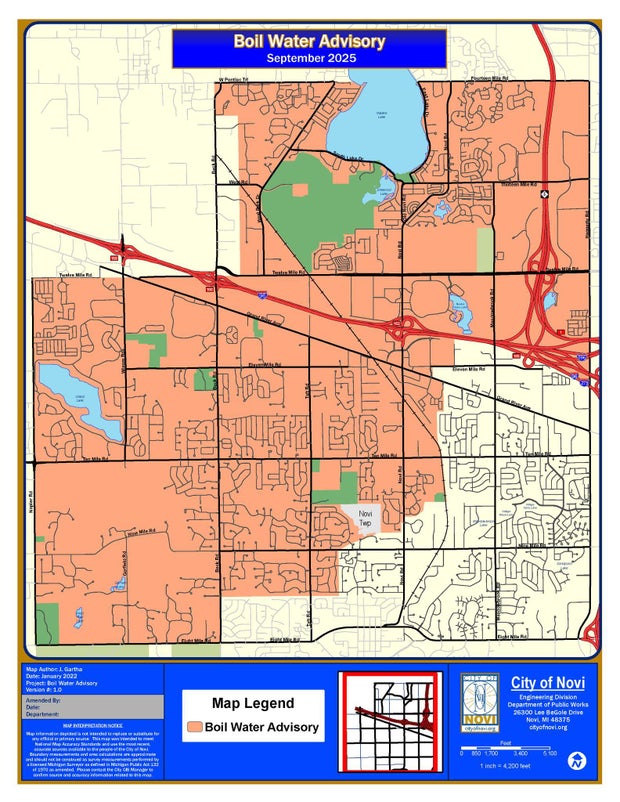
boil-water-map-0926.jpg
The city of Novi, Michigan, posted this map of a boil water advisory region on Sept. 26, 2025, the day after a massive water main break on 14 Mile Road.City of Novi, Michigan

But the boil water advisories for Walled Lake and the Novi neighborhoods that lost water remain in effect until further notice. The city of Novi said Friday morning that it expects the boil water advisory for its residents to remain in effect until Sunday.

Outdoor water use 

An outdoor water use restriction was posted for Novi and for nearby West Bloomfield, with residents asked to turn off irrigation systems to help ease water demand in the region.

GLWA didn’t specifically mention outdoor water use in its Friday morning report, but the water authority is asking all residents in the affected communities “to conserve water resources over the weekend to limit any additional stress on the system.”

School closures

Several schools in the affected communities were closed Thursday. The announcements for Friday include:

  • Novi Christian Academy announced it will be closed Friday. 
  • Detroit Catholic Central High School will be in session, but students are asked to bring their own water bottles.

CLICK HERE FOR MORE INFORMATION

https://www.cbsnews.com/detroit/news/water-main-break-novi-michigan-day-2/?intcid=CNM-00-10abd1h

Local News

Florida’s springs face pollution, climate threats as iconic waters risk losing natural beauty

Seen from the air, a Florida freshwater spring is a bit of liquid heaven, luring humans and wildlife to enjoy its aquamarine cool. With at least 1,000 of them — more than any other state — the springs serve as beaches for large swaths of central and northwestern Florida far from the ocean, with teenagers backflipping from docks and snorkelers peering into the crystalline depths.

But these treasures are under threat from agricultural pollution, rapid development and climate change.

Florida’s fragile freshwater springs under growing strain

Some places, such as fast-growing Zephyrhills in west-central Florida, have paused some construction as it struggles to stay within limits on the drinking water it can withdraw from a vast underground aquifer. Zephyrhills is home to Crystal Springs, source of the bottled water named after the town and several other brands.

“We really had to do something,” said Steven Spina, a member of the town council. “A lot of residents thought it was a good thing. People were happy to see us take a breath.”

The Floridan Aquifer: lifeline for 90% of the state’s drinking water

Covering an estimated 100,000 square miles (250,000 square kilometers), the underground Floridan Aquifer is the source of 90% of Florida’s drinking water. Because of the porous nature of the state’s bedrock, millions of gallons of water find their way to the surface in the form of clear, clean springs that, in turn, feed into rivers.

The highest concentration of springs are in central and northern Florida, including most of the 30 “first magnitude” springs — those that discharge at least 65 million gallons of water every day. All but four of them are considered polluted.

“We just have too much pollution going into the ground and too much water coming out of the ground,” said Ryan Smart, executive director of the nonprofit Florida Springs Council. “And when you get that combination, you end up with springs that are no longer blue and vibrant and full of life.”

Runoff, farming and algae blooms choke spring ecosystems

In rural Florida, runoff from fertilizers and pesticides used in farm fields is a major part of the problem. Fertilizers containing phosphates and nitrogen promote algae blooms that can suffocate a spring. Livestock waste contributes, too.

“When that algae covers everything, then you lose all of the seagrasses. The seagrasses are the forests of the water,” Smart said. “Then you begin to lose the biodiversity. And it even puts our drinking water at risk.”

Development and tourism add pressure to Florida’s springs

Elsewhere in Florida, rampant development is the threat. With over 1,000 people moving to Florida every day, more housing subdivisions are sprouting, along with the roads, strip malls, restaurants, golf courses and everything else that comes with them.

That means more paved surfaces that keep rainwater from percolating down into the aquifer and more pollutant-laden runoff from lawn fertilizers, parking lots, ever-widening roads and sometimes septic tanks. It also means more and more people, many of whom enjoy tubing, paddleboarding, kayaking and swimming in the springs.

It gets so busy in summer at some springs located in state and local parks that entry is halted by late morning. At Ichetucknee Springs State Park north of Gainesville, the daily limit of 750 tubers on the upper river is often reached within an hour after the park opens.

Kaelin Gibbs, on vacation in June with his family from Georgia, was swimming in the Blue Hole Spring along the Ichetucknee River.

“This is simply incredible; the water is cool and clear,” said Gibbs. “We’ve been to Florida’s beaches and to Orlando. There is no comparison to how beautiful this spring is.”

But that’s in peril, said Dennis Jones, a Republican former legislator deeply involved in springs issues. He said the volume of permits being issued for water use isn’t sustainable.

“You cannot keep taking water out of the aquifer because it’s not an endless supply,” Jones said.

Mining, climate change and saltwater intrusion worsen threats

Phosphate mining has also taken a toll on springs. Their operations require a great deal of water, which reduces water pressure available for springs. Some have died almost completely from mining and other factors, including White Sulphur Springs in north Florida, which was a sacred place for Native Americans and later a tourist resort that attracted famous visitors such as Henry Ford and Theodore Roosevelt.

A more subtle threat to the health of springs involves Earth’s changing climate. It is altering rainfall patterns around the globe, threatening the balance that feeds Florida’s springs.

In addition, some springs along the coasts are facing an intrusion of salt water, according to the Southwest Florida Water Management District. Four major springs are becoming increasingly brackish because of sea level rise and declining rainfall.

“As a result, freshwater vegetation has a hard time surviving in this saltier environment and unwanted vegetation moves in,” the district said in a website post.

State funding, lawsuits and grassroots activism aim to save springs

Florida spends billions every year on water quality projects, including about $800 million this year for Everglades restoration work. State funding for springs runs about $50 million a year, according to state documents.

Two state efforts at improving springs’ quality, both around a decade old, remain bottled up in court and administrative challenges. One would strengthen rules for permits to draw water from the major springs. The other would enhance rules to reduce the amount of nutrients such as nitrogen and phosphates that goes into springs that are considered impaired.

Jones, the former legislator, said lobbying by powerful agricultural interests and related political pressures have blocked progress on the nitrogen reduction plan that was expected to take about 20 years.

“We’ve burned up almost 10 years and they haven’t got on stage one. We got more nitrates now than when we started,” Jones said.

In Congress, U.S. Rep. Randy Fine recently filed a bill that would create a Florida Springs National Park across several counties, centered around the Ocala National Forest. Fine said in a statement the designation would protect the springs and increase funding. “Our Florida springs are something unique, not just to Florida but to the country,” Fine said.

It costs bottling companies just $115 for a permit allowing them to withdraw millions of gallons of water in perpetuity. But they do pay local taxes.

Blue Triton, the company that bottles Zephyrhills water, pays about $600,000 a year in taxes for things like schools, public safety and so forth, said Spina of the city council.

“They are one of our largest taxpayers,” he said.

Though they have challenges, Florida’s freshwater springs have energetic friends, too.

Michelle Jamesson loves the springs; she grew up swimming in one and is determined to help protect them for future generations. She volunteers for SpringsWatch Citizen Science Program, coordinating and working with other volunteers for monthly tests on the Wekiva River, north of Orlando.

They test water quality, take photos of underwater vegetation, count birds and more, seeking to spot any big changes that may require action. The Wekiva is fairly stable, she said, though it carries a lot of excess nutrients.

“The wildlife and the ecology, and all of it — it’s so full of life,” Jamesson said.

___

The Associated Press receives support from the Walton Family Foundation for coverage of water and environmental policy. The AP is solely responsible for all content. For all of AP’s environmental coverage, visit https://apnews.com/hub/climate-and-environment.

CLICK HERE FOR MORE INFORMATION

https://www.cbsnews.com/miami/news/florida-springs-water-pollution-climate-change-report/?intcid=CNM-00-10abd1h

CBS Evening News

Why thousands of people in rural West Virginia lack reliable drinking water

By Tom Hanson

Rhodell, West Virginia — For as long as Roman Patsey of Raleigh County, West Virginia, remembers, the Appalachian Mountains have provided virtually everything he’s needed to survive, from his income as a coal miner, to his tap water.

“I don’t know if it’s safe or not to tell you the truth,” Patsey told CBS News of his tap water source. “But, you know, what are you going to do? You’ve got to drink water.” 

He took CBS News to his only source of drinking water for nearly 50 years: an abandoned coal mine near his home. Like so many here, he dug his own trenches and laid his own water lines hundreds of feet up a mountainside.

He says no part of him wondered why access to water should be this difficult.  

“No, I just accepted it,” Patsey said. “It was something you had to do. I worried about running out of water, really, for years.”

He said he has never conducted regular tests on the water for possible contaminants

About 250,000 West Virginia residents rely on untreated sources of water, like natural springs or aquifers from coal mines, according to the Environmental Protection Agency. 

The median income in this area is around $30,000 per year, according to U.S. Census data, a far cry from the prosperity that the coal industry once created.

Coal companies used to fund and operate many town water systems in rural West Virginia. But when the industry declined, so did the water infrastructure it used to maintain. Patsey wanted to see this firsthand. So he, with a CBS News crew in tow, went to a water treatment plant in nearby Kimball, a town of more than 300 people in McDowell County. The plant’s windows are boarded up, the roof is completely missing, and there is rusted metal. Yet, this facility is supposed to clean tap water for the entire community.

Just 20 minutes up the road in Rhodell, a community in Raleigh County, the water treatment plant is also crumbling, with rust covering the pipes and a ceiling that is caved in.

“It’s in pretty bad shape as you can see,” said Shane Bragg with the Raleigh County Public Service District. “The fear is what you can’t see underground and what’s in the mines. We have no way of accessing the pumps in the mines, so when they go, the town will lose water.”

Raleigh County is racing to replace water systems before that happens with help from the nonprofit DigDeep, which works to bring clean tap water to the more than 2.2 million Americans who it says are living without it.

“We’re dealing with a lot of systems that are very expensive to maintain,” said Travis Foreman, director of DigDeep’s Appalachia Water Project. “And the local public service districts, they don’t have the manpower to keep up.”

In Rhodell, DigDeep is bringing clean water to the community for the first time in 10 years. 

“It is a human right to have access to water,” Foreman said. “…Everyone deserves to have that access.”

For Patsey, it’s a source of hope straight from the tap.

“Not long ago at 4 o’clock in the morning, I turned this on like this, not a drop,” Patsey said while standing at his kitchen sink. “It’s such a peace knowing I’m going to have water here.”

CLICK HERE FOR MORE INFORMATION

https://www.cbsnews.com/news/thousands-of-people-rural-west-virginia-lack-reliable-drinking-water/

Number of people suffering extreme droughts will double

Source:Michigan State University

Summary:A global research effort offers the first worldwide view of how climate change could affect water availability and drought severity in the decades to come. By the late 21st century, global land area and population facing extreme droughts could more than double — increasing from 3% during 1976-2005 to 7%-8%, according to a professor of civil and environmental engineering.Share:


FULL STORY


Michigan State University is leading a global research effort to offer the first worldwide view of how climate change could affect water availability and drought severity in the decades to come.

By the late 21st century, global land area and population facing extreme droughts could more than double — increasing from 3% during 1976-2005 to 7%-8%, according to Yadu Pokhrel, associate professor of civil and environmental engineering in MSU’s College of Engineering, and lead author of the research published in Nature Climate Change.

“More and more people will suffer from extreme droughts if a medium-to-high level of global warming continues and water management is maintained at its present state,” Pokhrel said. “Areas of the Southern Hemisphere, where water scarcity is already a problem, will be disproportionately affected. We predict this increase in water scarcity will affect food security and escalate human migration and conflict.”

The research team, including MSU postdoctoral researcher Farshid Felfelani, and more than 20 contributing authors from Europe, China and Japan are projecting a large reduction in natural land water storage in two-thirds of the world, also caused by climate change.

Land water storage, technically known as terrestrial water storage, or TWS, is the accumulation of water in snow and ice, rivers, lakes and reservoirs, wetlands, soil and groundwater — all critical components of the world’s water and energy supply. TWS modulates the flow of water within the hydrological cycle and determines water availability as well as drought.

“Our findings are a concern,” Pokhrel said. “To date, no study has examined how climate change would impact land water storage globally. Our study presents the first, comprehensive picture of how global warming and socioeconomic changes will affect land water storage and what that will mean for droughts until the end of the century.”

Felfelani said the study has given the international team an important prediction opportunity.

“Recent advances in process-based hydrological modeling, combined with future projections from global climate models under wide-ranging scenarios of socioeconomic change, provided a unique foundation for comprehensive analysis of future water availability and droughts,” Felfelani said. “We have high confidence in our results because we use dozens of models and they agree on the projected changes.”

The research is based on a set of 27 global climate-hydrological model simulations spanning 125 years and was conducted under a global modeling project called the Inter-Sectoral Impact Model Intercomparison Project. Pokhrel is a working member of the project.

“Our findings highlight why we need climate change mitigation to avoid the adverse impacts on global water supplies and increased droughts we know about now,” Pokhrel said. “We need to commit to improved water resource management and adaptation to avoid potentially catastrophic socio-economic consequences of water shortages around the world.”

CLICK HERE FOR MORE INFORMATION

https://www.sciencedaily.com/releases/2021/01/210111125605.htm

Drought Depletes Turkey’s Tekirdag Reservoirs, Forcing Emergency Water Curbs

By Reuters

Reuters

Reuters

A drone view shows the receding waterline and exposed lakebed in the dried basin of Turkmenli Dam, as drought conditions continue to affect water levels, in Marmara Ereglisi, in the northwestern Tekirdag province, Turkey, August 11, 2025. REUTERS/Murad Sezer

By Ali Kucukgocmen

TEKIRDAG, Turkey (Reuters) -A drought in Turkey’s northwestern province of Tekirdag has left the area’s main dams without potable water, straining infrastructure and leaving some homes without water for weeks, due to a sharp drop in precipitation in the country this year.

Authorities say drought is a critical issue, with several provinces warning of limited fresh water supply this summer.

Various areas in Izmir, Turkey’s third-most populous province, have experienced frequent water cuts this month, while the municipality in the western province of Usak was told over the weekend it would have access to water just six hours a day, with the main water reservoir depleted.

Rainfall slumped 71% in July across the country from a year ago, according to Turkey’s Meteorological Service. In the Marmara region, which includes Tekirdag and Istanbul, it shrank 95% below the monthly norm in July.

In the ten months to August, precipitation sank 32% in Marmara compared to the norm, while it fell 26% across Turkey to the lowest in 52 years.

ALTERNATIVES

The water level in Tekirdag’s Naip Dam, which has not seen any rainfall in June and July, fell to zero percent in August.

MORE: Places the U.S. Government Warns Not to Travel Right Now

That has forced authorities to find alternatives like delivering irrigation water for domestic use and building a pump system for delivery into urban areas.

The dam’s water level was 21% this time last year, according to the State Hydraulic Works.

Mehmet Ali Sismanlar, head of Tekirdag’s Water and Sewerage Administration (TESKI), said rainfall in Tekirdag has reduced dramatically over the past decade, and severe drought over the last two years has spurred frequent water cuts in some areas this summer.

“We are the area and the province that has been affected the most by the drought in Turkey,” he said, attributing it to climate change.

The water in Turkmenli dam, usually used for irrigation, was used to supply water to Tekirdag’s Marmaraereglisi district, where some neighbourhoods faced water cuts.

TESKI was working to open new wells to use ground water, not usually a preferred measure, Sismanlar said. He said ground water had sunk to twice its original depth over the years.

Mehmet, 70, a resident who lives in the Dereagzi neighbourhood with his family, said their home has had no water for two months, leaving them unable to shower or perform chores, and they were fetching water from nearby areas in large bottles.

“I have been living in filth for the past two months,” he said, standing among dirty piles of dishes in the kitchen, and adding that he last showered when he went to Istanbul, around 130 kilometres (81 miles) away.

His wife, Fatma, 65, said the family stayed up at night to fill up bottles in case water supply is resumed.

Remzi Karabas, 71, said he takes his laundry to Istanbul to be washed, but was done with living in Tekirdag. 

“We’ll leave some day soon. What can we do here? Water does not flow at all.”

(Editing by Tuvan Gumrukcu and Bernadette Baum)

CLICK HERE FOR MORE INFORMATION

https://www.usnews.com/news/world/articles/2025-08-19/drought-depletes-turkeys-tekirdag-reservoirs-forcing-emergency-water-curbs