Epidemiologic and animal studies both support relationships between exposures to per- and polyfluoroalkyl substances (PFAS) and harmful effects on the immune system. Accordingly, PFAS have been identified as potential environmental risk factors for adverse COVID-19 outcomes.
Objective
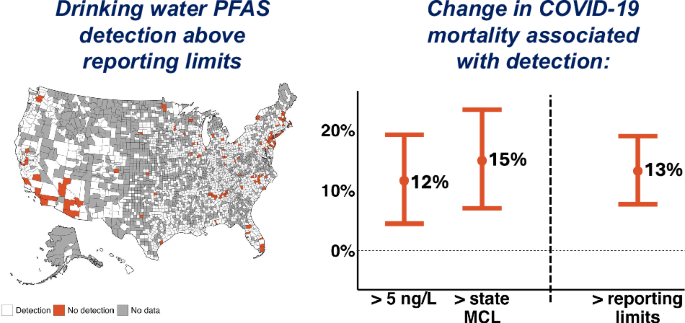
Here, we examine associations between PFAS contamination of U.S. community water systems (CWS) and county-level COVID-19 mortality records. Our analyses leverage two datasets: one at the subnational scale (5371 CWS serving 621 counties) and one at the national scale (4798 CWS serving 1677 counties). The subnational monitoring dataset was obtained from statewide drinking monitoring of PFAS (2016–2020) and the national monitoring dataset was obtained from a survey of unregulated contaminants (2013–2015).
Methods
We conducted parallel analyses using multilevel quasi-Poisson regressions to estimate cumulative incidence ratios for the association between county-level measures of PFAS drinking water contamination and COVID-19 mortality prior to vaccination onset (Jan-Dec 2020). In the primary analyses, these regressions were adjusted for several county-level sociodemographic factors, days after the first reported case in the county, and total hospital beds.
Results
In the subnational analysis, detection of at least one PFAS over 5 ng/L was associated with 12% higher [95% CI: 4%, 19%] COVID-19 mortality. In the national analysis, detection of at least one PFAS above the reporting limits (20–90 ng/L) was associated with 13% higher [95% CI: 8%, 19%] COVID-19 mortality.
Impact Statement
Our findings provide evidence for an association between area-level drinking water PFAS contamination and higher COVID-19 mortality in the United States. These findings reinforce the importance of ongoing state and federal monitoring efforts supporting the U.S. Environmental Protection Agency’s 2024 drinking water regulations for PFAS. More broadly, this example suggests that drinking water quality could play a role in infectious disease severity. Future research would benefit from study designs that combine area-level exposure measures with individual-level outcome data.
In 2021, over 2 billion people live in water-stressed countries, which is expected to be exacerbated in some regions as result of climate change and population growth (1).
In 2022, globally, at least 1.7 billion people use a drinking water source contaminated with faeces. Microbial contamination of drinking-water as a result of contamination with faeces poses the greatest risk to drinking-water safety.
Safe and sufficient water facilitates the practice of hygiene, which is a key measure to prevent not only diarrhoeal diseases, but acute respiratory infections and numerous neglected tropical diseases.
Microbiologically contaminated drinking water can transmit diseases such as diarrhoea, cholera, dysentery, typhoid and polio and is estimated to cause approximately 505 000 diarrhoeal deaths each year.
In 2022, 73% of the global population (6 billion people) used a safely managed drinking-water service – that is, one located on premises, available when needed, and free from contamination.
Overview
Safe and readily available water is important for public health, whether it is used for drinking, domestic use, food production or recreational purposes. Improved water supply and sanitation, and better management of water resources, can boost countries’ economic growth and can contribute greatly to poverty reduction.
In 2010, the UN General Assembly explicitly recognized the human right to water and sanitation. Everyone has the right to sufficient, continuous, safe, acceptable, physically accessible and affordable water for personal and domestic use.
Drinking-water services
Sustainable Development Goal target 6.1 calls for universal and equitable access to safe and affordable drinking water. The target is tracked with the indicator of “safely managed drinking water services” – drinking water from an improved water source that is located on premises, available when needed, and free from faecal and priority chemical contamination.
In 2022, 6 billion people used safely managed drinking-water services – that is, they used improved water sources located on premises, available when needed, and free from contamination. The remaining 2.2 billion people without safely managed services in 2022 included:
1.5 billion people with basic services, meaning an improved water source located within a round trip of 30 minutes;
292 million people with limited services, or an improved water source requiring more than 30 minutes to collect water;
296 million people taking water from unprotected wells and springs; and
115 million people collecting untreated surface water from lakes, ponds, rivers and streams.
Sharp geographic, sociocultural and economic inequalities persist, not only between rural and urban areas but also in towns and cities where people living in low-income, informal or illegal settlements usually have less access to improved sources of drinking-water than other residents.
Water and health
Contaminated water and poor sanitation are linked to transmission of diseases such as cholera, diarrhoea, dysentery, hepatitis A, typhoid and polio. Absent, inadequate, or inappropriately managed water and sanitation services expose individuals to preventable health risks. This is particularly the case in health care facilities where both patients and staff are placed at additional risk of infection and disease when water, sanitation and hygiene services are lacking.
Out of every 100 patients in acute-care hospitals, 7 patients in high-income countries (HICs) and 15 patients in low- and middle-income countries (LMICs) will acquire at least one health care-associated infection during their hospital stay.
Inadequate management of urban, industrial and agricultural wastewater means the drinking-water of hundreds of millions of people is dangerously contaminated or chemically polluted. Natural presence of chemicals, particularly in groundwater, can also be of health significance, including arsenic and fluoride, while other chemicals, such as lead, may be elevated in drinking-water as a result of leaching from water supply components in contact with drinking-water.
Some 1 million people are estimated to die each year from diarrhoea as a result of unsafe drinking-water, sanitation and hand hygiene. Yet diarrhoea is largely preventable, and the deaths of 395 000 children aged under 5 years could be avoided each year if these risk factors were addressed. Where water is not readily available, people may decide handwashing is not a priority, thereby adding to the likelihood of diarrhoea and other diseases.
Diarrhoea is the most widely known disease linked to contaminated food and water but there are other hazards. In 2021, over 251.4 million people required preventative treatment for schistosomiasis – an acute and chronic disease caused by parasitic worms contracted through exposure to infested water.In many parts of the world, insects that live or breed in water carry and transmit diseases such as dengue fever. Some of these insects, known as vectors, breed in clean, rather than dirty water, and household drinking water containers can serve as breeding grounds. The simple intervention of covering water storage containers can reduce vector breeding and may also reduce faecal contamination of water at the household level.
Economic and social effects
When water comes from improved and more accessible sources, people spend less time and effort physically collecting it, meaning they can be productive in other ways. This can also result in greater personal safety and reducing musculoskeletal disorders by reducing the need to make long or risky journeys to collect and carry water. Better water sources also mean less expenditure on health, as people are less likely to fall ill and incur medical costs and are better able to remain economically productive.
With children particularly at risk from water-related diseases, access to improved sources of water can result in better health, and therefore better school attendance, with positive longer-term consequences for their lives.
Challenges
Historical rates of progress would need to double for the world to achieve universal coverage with basic drinking water services by 2030. To achieve universal safely managed services will require a 6-fold increase. Climate change, increasing water scarcity, population growth, demographic changes and urbanization already pose challenges for water supply systems. Over 2 billion people live in water-stressed countries, which is expected to be exacerbated in some regions as result of climate change and population growth. Re-use of wastewater to recover water, nutrients or energy is becoming an important strategy. Use of wastewater and sludge is widespread globally; however, much is used informally and/or without sufficient treatment and other controls to ensure that human and environmental health is protected. If done appropriately safe use of wastewater and sludge can yield multiple benefits, including increased food production, increased resilience to water and nutrient scarcity and greater circularity in the economy.
Options for water sources used for drinking-water and irrigation will continue to evolve, with an increasing reliance on groundwater and alternative sources, including wastewater. Climate change will lead to greater fluctuations in harvested rainwater. Management of all water resources will need to be improved to ensure provision and quality.
WHO’s response
As the international authority on public health and water quality, WHO leads global efforts to prevent water-related disease, advising governments on the development of health-based targets and regulations.
WHO produces a series of water quality guidelines, including on drinking-water, safe use of wastewater, and recreational water quality. The water quality guidelines are based on managing risks, and since 2004 the Guidelines for drinking-water quality promote the Framework for safe drinking-water. The Framework recommends establishment of health-based targets, the development and implementation of water safety plans by water suppliers to most effectively identify and manage risks from catchment to consumer, and independent surveillance to ensure that water safety plans are effective and health-based targets are being met.
The drinking-water guidelines are supported by background publications that provide the technical basis for the Guidelines recommendations. WHO also supports countries to implement the drinking-water quality guidelines through the development of practical guidance materials and provision of direct country support. This includes the development of locally relevant drinking-water quality regulations aligned to the principles in the Guidelines, the development, implementation and auditing of water safety plans and strengthening of surveillance practices.
Since 2014, WHO has been testing household water treatment products against WHO health-based performance criteria through the WHO International Scheme to Evaluate Household Water Treatment Technologies. The aim of the scheme is to ensure that products protect users from the pathogens that cause diarrhoeal disease and to strengthen policy, regulatory and monitoring mechanisms at the national level to support appropriate targeting and consistent and correct use of such products.
WHO works closely with UNICEF in a number of areas concerning water and health, including on water, sanitation, and hygiene in health care facilities. In 2015 the two agencies jointly developed WASH FIT (Water and Sanitation for Health Facility Improvement Tool), an adaptation of the water safety plan approach. WASH FIT aims to guide small, primary health care facilities in low- and middle-income settings through a continuous cycle of improvement through assessments, prioritization of risk, and definition of specific, targeted actions. A 2023 report describes practical steps that countries can take to improve water, sanitation and hygiene in health care facilities.
Human health is at risk from drinking water contamination, which causes a number of health problems in many parts of the world. The geochemistry of groundwater, its quality, the origins of groundwater pollution, and the associated health risks have all been the subject of substantial research in recent decades. In this study, groundwater in the west Rosetta Nile branch of the Nile Delta Aquifer is examined for drinking potential. Numerous water quality indices were applied, such as water quality index (WQI), synthetic pollution index (SPI) models, and health risk assessment (HRA) method. The limits of the measured parameters are used to test its drinking validity on the basis of WHO recommendations. TDS in the southern regions is within the desirable to allowable limits with percent 25.3% and 29.33%, respectively. Nearly all the study area has desirable value for HCO3, Al and Ba. Ca and Mg have desirable values in the center and south portion of the investigated area, whereas in the north are unsuitable. Na, Cl and SO4 fall within the desired level in the regions of the south but become unsuitable towards the north. Mn and NO3 are inappropriate except in the northwestern part. Fe is within suitable range in the southwestern and northwestern regions. Pb, Zn, Cu, and Cd were undetected in the collected samples. Regarding to WQI the study area is classified into 4 classes good, poor, very poor and unfit for drinking water from south to north. According to SPI model, 20%, 18.7%, 18.7%, 8% and 34.6% of water samples are suitable, slightly, moderately, highly polluted and unfit, respectively from south to north. Based on HRA, Children are the most category endangered with percent 14.7% of the overall samples obtained, followed by females and males with percent 12% and 8%, respectively. This study offers insights into the conservation and management of coastal aquifers’ groundwater supplies. These findings have significant implications for developing strategies and executing preventative actions to reduce water resource vulnerability and related health hazards in West Nile Delta, Egypt.
In recent years, rapid urbanization and population growth, stress on natural resources, and global climate change have caused the demand for water to increase. Sustainable water resource management is becoming increasingly important to meet this demand. It is critical to manage water resources globally since groundwater is essential for meeting human needs and for sustaining life1,2,3,4. Furthermore, unregulated exploitation of groundwater resources has resulted in water shortages over recent decades, which has adversely affected groundwater quality and levels5,6,7,8,9,10. Salinization is a significant issue in many coastal regions globally, particularly in semi-arid and arid areas. It is seen as a crucial and visible issue that threatens future water resources and reduces water quality. Groundwater salinization is a key concern because it restricts water availability for both agricultural and urban needs, impacting the resilience and sustainability of coastal areas. An increase in total dissolved solids (TDS) or chloride (Cl) levels is a clear indicator of salinization11,12,13. The issue of water quality has garnered significant attention in coastal aquifers worldwide due to the aforementioned reasons for example, Thriassion Plain and Eleusis Gulf, Greece14, north Kuwait15, China15, Bangladesh16, Spain17, Mexico18, and others. As groundwater quality is equally important as its quantity, it is crucial to carefully assess it.
Heavy metals pose a toxic threat to human health and ecosystems when their concentrations surpass established limits as they can disrupt ecological systems, endanger human health, and worsen the quality of groundwater. Specific heavy metals, including copper (Cu), zinc (Zn), manganese (Mn), and chromium (Cr), are vital for metabolic processes in traces quantity, but become hazardous at high levels. In contrast, metals such as cadmium (Cd) are toxic even at minimal concentrations19,20. Tackling the presence of trace element-contaminated water resources is crucial for protecting both the ecosystem and human health21. Additionally, understanding the environmental behavior of these trace elements, including their transfer, fate, persistence, and the health risks they pose to consumers through the food chain, is vital. The health impacts of these elements are significantly influenced by factors such as their behavior, specific chemical composition, and binding state. Gaining insight into these factors is the key to assessing the potential risks of trace elements and devising effective strategies to minimize their harmful effects22,23. Controlling and mitigating these harmful effects can be achieved by monitoring heavy metal distribution, concentration, and health risks regularly.
Evaluating groundwater quality is a fundamental approach for ensuring the sustainable management of this essential resource. Various methodologies have been employed to assess groundwater quality, including stoichiometric, graphical, index-based, and inferential chemometric techniques, which are commonly used to analyze and monitor groundwater conditions and hydrogeochemical properties24,25,26. Additionally, advanced tools such as clustering, regression analysis, neural networks, and machine learning algorithms have been incorporated to observe and predict water quality trends effectively27,28,29. Given the variety of hydrochemical criteria, the water quality index (WQI) technique serves as an effective tool for evaluating groundwater quality. Due to its comprehensive calculation method, assessing groundwater quality through multiple hydrochemical parameters is considered a more reliable and robust approach. As a result, WQIs have been widely utilized in groundwater quality assessments. The most frequent techniques for assessing water quality are the WQI for drinking and synthetic pollution index (SPI). The Water Quality Index (WQI) for drinking water and the Synthetic Pollution Index (SPI) are effective tools for measuring and evaluating overall water quality, offering a more comprehensive approach than traditional techniques for evaluating the quality of water. Each of the two types of standard water quality index models (WQI and SPI) measure the cumulative impact of different physicochemical variables on groundwater quality based on weight and rate. Each physicochemical parameter is weighed according to its influence on drinking water quality30,31. Since many people rely on groundwater for drinking and other household purposes, high levels of nitrate in drinking water can result in serious health risks32,33,34. Therefore, health risk assessment (HRA) based on nitrate concentration was applied as drinking water quality criteria35,36,37. Combining water quality indices with GIS techniques provides the most effective method for detecting and visualizing changes in groundwater facies. Several studies have applied water quality indices (WQI and SPI) and HRA methods to evaluate groundwater quality for human use in various regions, and these techniques have proven successful. For instance, studies have been conducted on Makkah Al-Mukarramah Province (Saudi Arabia)38, coastal plain in Nigeria23, dumpsite in Awka (Nigeria)22, El Fayoum depression (Egypt)30, El Kharga Oasis (Egypt)39, and Central Nile Delta Region (Egypt)40.
The quaternary aquifer, coastal aquifer, is considered the main source of groundwater in the area west of Rosetta branch. Based on the previous studies, the groundwater within the study area exposed to several factors, which may lead to increase signs of groundwater quality deterioration. These factors are mainly attributed to anthropogenic activities and sea water intrusion12. Moreover, most previous studies conducted west of the Nile Delta have primarily focused on the morphological and geological features of the terrain41,42,43,44. Additionally, water sources have been examined in terms of their geochemical properties and suitability for irrigation purposes8,12,45,46. However, limited attention has been given to evaluating the quality of groundwater for drinking purposes within the study area. As a result, significant knowledge gaps remain regarding the suitability of groundwater for human consumption in this region.
Based on the aforementioned objectives, this study aimed to evaluate the quality of groundwater for drinking purposes in the region west of the Nile Delta’s Rosetta branch. This study was conducted to develop geospatial maps of physicochemical parameters in groundwater to determine the quality suitability of drinking water. Furthermore, in order to assess the water quality from the aspect of human health, two typical water quality index models are used, namely water quality index (WQI) and synthetic pollution index (SPI). In order to analyze the data concerning water quality, descriptive statistics and correlation matrices were applied. Eventually, human health risk (HRA) was assessed in the study region via contaminated water consumption by adults (males and females) and children. It is expected that this study will assist decision makers in identifying vulnerable zones and optimizing monitoring networks for groundwater quality.
Source:Columbia University’s Mailman School of Public Health
Summary:A 20-year project in Bangladesh reveals that lowering arsenic levels in drinking water can slash death rates from major chronic diseases. Participants who switched to safer wells had the same risk levels as people who were never heavily exposed. The researchers tracked individual water exposure with detailed urine testing. Their results show how quickly health improves once contaminated water is replaced.Share:
FULL STORY
Cleaner water dramatically reduces chronic disease deaths, even for those exposed to arsenic for years. Credit: Shutterstock
A large 20-year investigation following nearly 11,000 adults in Bangladesh found that reducing arsenic in drinking water was tied to as much as a 50 percent drop in deaths from heart disease, cancer and several other chronic illnesses. The research offers the strongest long-term evidence so far that lowering arsenic exposure can reduce mortality, even for people who lived with contaminated water for many years. These results appear in JAMA.
Scientists from Columbia University, the Columbia Mailman School of Public Health and New York University led the analysis, which addresses a widespread health concern. Naturally occurring arsenic in groundwater remains a significant challenge across the world. In the United States, more than 100 million people depend on groundwater that can contain arsenic, particularly those using private wells. Arsenic continues to be one of the most common chemical contaminants in drinking water.
“We show what happens when people who are chronically exposed to arsenic are no longer exposed,” said co-lead author Lex van Geen of the Lamont-Doherty Earth Observatory, part of the Columbia Climate School. “You’re not just preventing deaths from future exposure, but also from past exposure.”
Two Decades of Data Strengthen the Evidence
Co-lead author Fen Wu of NYU Grossman School of Medicine said the findings offer the clearest proof yet of the connection between lowering arsenic exposure and reduced mortality risk. Over the course of two decades, the researchers closely tracked participants’ health and repeatedly measured arsenic through urine samples, which strengthened the precision of their analysis.
“Seeing that our work helped sharply reduce deaths from cancer and heart disease, I realized the impact reaches far beyond our study to millions in Bangladesh and beyond now drinking water low in arsenic,” said Joseph Graziano, Professor Emeritus at Columbia Mailman School of Public Health and principal investigator of the NIH-funded program. “A 1998 New York Times story first brought us to Bangladesh. More than two decades later, this finding is deeply rewarding. Public health is often the ultimate delayed gratification.”
Clear Drop in Risk When Arsenic Exposure Falls
People whose urinary arsenic levels fell from high to low had mortality rates that matched those who had consistently low exposure for the entire study. The size of the drop in arsenic was closely tied to how much mortality risk declined. Those who continued drinking high-arsenic water did not show any reduction in chronic disease deaths.
Arsenic naturally accumulates in groundwater and has no taste or smell, meaning people can drink contaminated water for years without knowing it. In Bangladesh, an estimated 50 million people have consumed water exceeding the World Health Organization’s guideline of 10 micrograms per liter. The WHO has described this as the largest mass poisoning in history.
From 2000 to 2022, the Health Effects of Arsenic Longitudinal Study (HEALS) monitored thousands of adults in Araihazar, Bangladesh. The project tested more than 10,000 wells in a region where many families rely on shallow tube wells with arsenic levels ranging from extremely low to dangerously high.
Researchers periodically measured arsenic in participants’ urine, a direct marker of internal exposure, and recorded causes of death. These detailed data allowed the team to compare long-term health outcomes for people who reduced their exposure with those who remained highly exposed.
Community Efforts Created a Natural Comparison Group
Throughout the study period, national and local programs labeled wells as safe or unsafe based on arsenic levels. Many households switched to safer wells or installed new ones, while others continued using contaminated water. This created a natural contrast that helped researchers understand the effects of reducing exposure.
Arsenic exposure decreased substantially in Araihazar during the study. The concentration in commonly used wells fell by about 70 percent as many families sought cleaner water sources. Urine tests confirmed a corresponding decline in internal exposure, averaging a 50 percent reduction that persisted through 2022.
Reduced Exposure Brings Lasting Health Benefits
These trends held true even after researchers accounted for differences in age, smoking and socioeconomic factors. Participants who remained highly exposed, or whose exposure rose over time, continued to face significantly higher risks of death from chronic diseases.
The researchers compared the health benefits of lowering arsenic to quitting smoking. The risks do not disappear immediately but drop gradually as exposure decreases.
In Bangladesh, well testing, labeling unsafe sources, drilling private wells and installing deeper government wells have already improved water safety for many communities.
“Our findings can now help persuade policymakers in Bangladesh and other countries to take emergency action in arsenic ‘hot spots’,” said co-author Kazi Matin Ahmed of the University of Dhaka.
To reach more households, the research team is collaborating with the Bangladeshi government to make well data easier to access. They are piloting NOLKUP (“tubewell” in Bangla), a free mobile app created from more than six million well tests. Users can look up individual wells, review arsenic levels and depths, and locate nearby safer options. The tool also helps officials identify communities that need new or deeper wells.
Clean Water Investments Can Save Lives
The study shows that health risks can fall even for people who were exposed to arsenic for years. This highlights an important opportunity: investing in clean water solutions can save lives within a single generation.
“Sustainable funding to support the collection, storage and maintenance of precious samples and data over more than 20 years have made this critically important work possible,” said Ana Navas-Acien, MD, PhD, Professor and Chair of Environmental Health Sciences at Columbia Mailman School of Public Health. “Science is difficult and there were challenges and setbacks along the way, but we were able to maintain the integrity of the samples and the data even when funding was interrupted, which has allowed us to reveal that preventing arsenic exposure can prevent disease.”
The study team included researchers from Columbia University’s Mailman School of Public Health, the New York University Grossman School of Medicine, Lamont-Doherty Earth Observatory, Boston University School of Public Health, the Department of Geology at the University of Dhaka and the Institute for Population and Precision Health at the University of Chicago.
The HEALS project was launched by Columbia University through the National Institute of Environmental Health Sciences’ Superfund Research Program, with most U.S. collaborators based at Columbia when the study began.
Washington, D.C.—The American Academy of Microbiology, the honorific leadership group and think tank within the American Society for Microbiology (ASM), and the American Geophysical Union (AGU) have released a new report, Water, Waterborne Pathogens and Public Health: Environmental Drivers. Developed by leading scientists and informed by expert deliberations from a December 2024 colloquium organized by ASM and AGU, with support from the Association for the Sciences of Limnology and Oceanography (ASLO), the report presents a holistic strategy to reduce waterborne infections and safeguard public health as climate change increasingly disrupts water systems worldwide.
“Water is a critical determinant of both ecosystem integrity and human health, yet it is increasingly compromised by anthropogenic pressures and broader environmental change,” said Dr. Rita Colwell, Co-Chair of the Colloquium Steering Committee, former ASM President and past Chair of the Academy. “Addressing this public health risk requires coordinated, cross-disciplinary strategies for effective microbial and environmental surveillance, early-warning systems and support for resilient water infrastructure that can withstand intensifying climate stressors.”
Each year, more than 3.5 million people die from waterborne illnesses, with the heaviest burden falling on low- and middle-income countries, where over 4 billion people rely on water sources that are often unmonitored and unsafe. While many microbes that exist in water are harmless, some can cause serious disease when humans drink or interact with contaminated water. Environmental changes through more frequent and intense floods, hurricanes and heatwaves, coupled with aging infrastructure, are increasing human exposure to waterborne pathogens and threatening access to safe drinking water.
The report is part of the Academy’s Climate Change & Microbes Scientific Portfolio, a 5-year initiative to advance microbial science to inform climate policy, foster innovation and support development of microbial technologies that can be applied globally. Supported by a grant from the Burroughs Wellcome Fund (BWF), the report shares expert-driven insights and highlights key strategies to strengthen prevention and response to waterborne disease outbreaks, including:
Enhance surveillance and monitoring: Implement robust systems to track water quality and pathogen presence.
Modernize water infrastructure: Invest in advanced water treatment and distribution systems to ensure safe drinking water.
Promote interdisciplinary research: Initiate collaboration across microbial sciences, hydrology and climate science to address health relevant challenges.
Improve public awareness and engagement: Raise awareness of the importance of safe water and sanitation and engage local communities to develop collaborative solutions.
“Microbial datasets and environmental monitoring are foundational to explaining the dynamic interdependencies between ecological processes and human health outcomes,” said Antarpreet Jutla, Ph.D., Co-Chair of the Colloquium Steering Committee, AGU member and recipient of AGU’s 2023 Charles S. Falkenberg Award. “Integrating these data streams within interdisciplinary, systems-based frameworks facilitates the design of adaptive infrastructure and predictive modeling platforms, ultimately strengthening public health resilience and promoting socio-economic stability in the context of accelerating environmental change.”
While a wealth of environmental and weather data, public health information and waterborne pathogen monitoring exists, resources for this information are often siloed. The report emphasizes integrating data systems with technologies like artificial intelligence and machine learning to develop predictive models for communities that allow proactive warning of waterborne disease outbreaks.
Investment in water infrastructure that addresses region-specific geographical and environmental conditions and meets the needs of local communities is critical. The report highlights the promise of microbes as a nature-based solution that improves water treatment, prevents infrastructure degradation and provides new ways to build systems that hold up against changing weather parameters.
Ultimately, addressing these challenges will require cross-disciplinary collaboration. The report calls for active engagement with local communities, especially those most affected by water insecurity, to co-develop effective and long-lasting solutions.
“Safeguarding global health demands an integrated perspective and coordinated action,” said Jay Lennon, Ph.D., Chair of the Academy Climate Change Task Force. “Around the globe, scientists, public health advocates, policymakers, local leaders and philanthropists must work hand in hand to build a future where every person has access to safe and reliable water.”
### The American Society for Microbiology is one of the largest professional societies dedicated to the life sciences and is composed of over 32,000 scientists and health practitioners. ASM’s mission is to promote and advance the microbial sciences.
ASM advances the microbial sciences through conferences, publications, certifications, educational opportunities and advocacy efforts. It enhances laboratory capacity around the globe through training and resources. It provides a network for scientists in academia, industry and clinical settings. Additionally, ASM promotes a deeper understanding of the microbial sciences to all audiences.
### The American Geophysical Union is an international association of more than 60,000 advocates and experts in Earth and space science. Fundamental to our mission since our founding in 1919 is to live our values, which we do through our net zero energy building in Washington, D.C., and by making scientific discoveries and research accessible and engaging to all to help protect society and prepare global citizens for the challenges and opportunities ahead.
### The Association for the Sciences of Limnology and Oceanography (ASLO) is an international aquatic science society that was founded in 1948. For more than 70 years, it has been the leading professional organization for researchers and educators in the field of aquatic science. The purpose of ASLO is to foster a diverse, international scientific community that creates, integrates and communicates knowledge across the full spectrum of aquatic sciences, advances public awareness and education about aquatic resources and research and promotes scientific stewardship of aquatic resources for the public interest. Its products and activities are directed toward these ends. With 3,000 members in more than 70 countries worldwide, the society has earned an outstanding reputation and is best known for its journals and interdisciplinary meetings. For more information about ASLO, please visit our website.
Summary:Scientists tracking Earth’s water from space discovered that El Niño and La Niña are synchronizing floods and droughts across continents. When these climate cycles intensify, far-apart regions can become unusually wet or dangerously dry at the same time. The study also found a global shift about a decade ago, with dry extremes becoming more common than wet ones. Together, the results show that water crises are part of a global pattern, not isolated events.Share:
FULL STORY
Across the globe, floods and droughts aren’t striking at random — they’re moving to a shared rhythm driven by El Niño and La Niña. Credit: Shutterstock
Droughts and floods can disrupt daily life, damage ecosystems, and strain local and global economies. Scientists at The University of Texas at Austin set out to better understand these water extremes by studying how they develop and spread across the planet. Their work points to a powerful climate force that links distant regions in surprising ways.
A new study published in AGU Advances shows that during the past 20 years, ENSO, a recurring climate pattern in the equatorial Pacific Ocean that includes El Niño and La Niña, has played the leading role in driving extreme changes in total water storage worldwide. The researchers also found that ENSO tends to line up these extremes so that different continents experience unusually wet or dry conditions at the same time.
Why Synchronized Extremes Matter
According to study co-author Bridget Scanlon, a research professor at the Bureau of Economic Geology at the UT Jackson School of Geosciences, understanding these global patterns has real-world consequences.
“Looking at the global scale, we can identify what areas are simultaneously wet or simultaneously dry,” Scanlon said. “And that of course affects water availability, food production, food trade — all of these global things.”
When multiple regions face water shortages or excesses at once, the impacts can ripple through agriculture, trade, and humanitarian planning.
Measuring All the Water on Earth
Total water storage is a key climate indicator because it accounts for all forms of water in a region. This includes rivers and lakes, snow and ice, moisture in the soil, and groundwater below the surface. By focusing on this full picture, researchers can better understand how water moves and changes over time.
The study is one of the first to examine total water storage extremes alongside ENSO (The El Niño-Southern Oscillation) on a global scale. This approach made it possible to see how extreme wet and dry conditions are connected across large distances, said lead author Ashraf Rateb, a research assistant professor at the bureau.
“Most studies count extreme events or measure how severe they are, but by definition extremes are rare. That gives you very few data points to study changes over time,” Rateb said. “Instead, we examined how extremes are spatially connected, which provides much more information about the patterns driving droughts and floods globally.”
Satellites Reveal Hidden Water Changes
To estimate total water storage, the scientists relied on gravity measurements from NASA’s GRACE and GRACE Follow-On (GRACE-FO) satellites. These data allow researchers to detect changes in water mass over areas about 300 to 400 kilometers wide, roughly the size of Indiana.
The team classified wet extremes as water storage levels above the 90th percentile for a given region. Dry extremes were defined as levels below the 10th percentile.
Their analysis showed that unusual ENSO activity can push widely separated parts of the world into extreme conditions at the same time. In some regions, El Niño is linked to dry extremes, while in others the same dry conditions are associated with La Niña. Wet extremes tend to follow the opposite pattern.
Real-World Examples Across Continents
The researchers pointed to several striking cases. During the mid-2000s, El Niño coincided with severe dryness in South Africa. Another El Niño event was linked to drought in the Amazon during 2015-2016. By contrast, La Niña in 2010-2011 brought exceptionally wet conditions to Australia, southeast Brazil, and South Africa.
Beyond individual events, the study also identified a broader shift in global water behavior around 2011-2012. Before 2011, unusually wet conditions were more common worldwide. After 2012, dry extremes began to dominate. The researchers attribute this change to a long-lasting climate pattern in the Pacific Ocean that influences how ENSO affects global water.
Filling the Gaps in Satellite Records
Because GRACE and GRACE-FO data are not continuous, including an 11-month gap between missions in 2017-2018, the team used probabilistic models based on spatial patterns to reconstruct missing periods of total water storage extremes.
Although the satellite record covers only 22 years (2002-2024), it still reveals how closely climate and water systems are linked across the Earth, said JT Reager, deputy project scientist for the GRACE-FO mission at NASA’s Jet Propulsion Laboratory and JPL Discipline Program manager for the Water and Energy Cycle.
“They’re really capturing the rhythm of these big climate cycles like El Niño and La Niña and how they affect floods and droughts, which are something we all experience,” said Reager, who was not involved in the study. “It’s not just the Pacific Ocean out there doing its own thing. Everything that happens out there seems to end up affecting us all here on land.”
Preparing for Extremes, Not Just Shortages
Scanlon said the findings underscore the need to rethink how society talks about water challenges. Instead of focusing only on scarcity, she said, it is critical to plan for swings between too much and too little water.
“Oftentimes we hear the mantra that we’re running out of water, but really it’s managing extremes,” Scanlon said. “And that’s quite a different message.”
The research was funded by the UT Jackson School of Geosciences.
The world has entered a new era of ‘water bankruptcy,’ U.N. report says
Researchers say this is not merely a temporary crisis, but a permanent failure that requires rethinking the world’s approach to water scarcity.
Iran’s Lake Urmia, once the largest lake in the Middle East, has dramatically shrunk due to prolonged drought, the damming of rivers feeding the lake, and extensive groundwater extraction in the surrounding area. (MORTEZA AMINOROAYAYI/Middle East Images/AFP via Getty Images)
Climate change, pollution and decades of overuse have pushed the world into a state of “water bankruptcy,” leaving essential sources of fresh water irreparably damaged and billions of people without enough water to meet their basic needs, United Nations experts declared on Tuesday.
In a sweeping report from United Nations University (UNU), the international agency’s research arm, scientists compared humanity to a person plunging into financial ruin. Not only does the world overspend its annual water “income” — the renewable flows that come from rain and snow — but it has also exhausted the long-term “savings” stored in underground aquifers, glaciers and ecosystems. At the same time, people are allowing pollution from human waste, agriculture and industrial operations to contaminate the dwindling fresh water that remains — like someone setting fire to the last few dollars in their wallet.
Signs of this emergency are alarming and abundant, said lead author Kaveh Madani, director of the UNU Institute for Water, Environment and Health. More than half of the world’s large lakes are shrinking. Roughly 70 percent of underground aquifers are in long-term decline. Large-scale droughts have become more frequent and pervasive, costing an average of $307 billion annually. Some 4.4 billion people face water scarcity for at least one month a year.
Madani and his colleagues argue that it’s not sufficient to refer to the situation as “water stress” or a “water crisis” — language often used by the U.N. and other international institutions — because the challenge will not go away anytime soon.
Human activities have already caused irreversible damage to many of the systems that generate, regulate and store fresh water, the report says. Rising temperatures, driven mostly by the burning of fossil fuels, have altered precipitation patterns and increased the rate of evaporation from landscapes. Deforestation and development have destroyed the ecosystems that filter and clean rainwater. Overextraction is causing the collapse of subterranean aquifers that store groundwater, reducing their capacity to become recharged. And melting mountain glaciers, which accumulated over centuries or millennia, will not grow back in a human lifetime.
“What appears on the surface as a crisis is, in fact, a new baseline,” the report authors write. “Some losses are now unavoidable, and the central task is to prevent further irreversible damage while reorganizing the system around a smaller hydrological budget.”
Existing policies are too narrowly focused on improving sanitation and drinking water and helping industries to become incrementally more efficient, the report says. Ahead of an upcoming United Nations water conference in the United Arab Emirates, it calls on leaders to declare a “global water bankruptcy” and adopt a new approach to managing the world’s dwindling supply of safe water. Otherwise, it warns, the world will slide deeper into a future of food shortages, disease outbreaks and water-fueled conflict.Ask The Post AIDive deeper
Madani, who was born in Tehran, became convinced of the need for a new approach to water management after watching a decades-old black-and-white video about shortages in the Iranian capital. The narrator referred to the situation as a “crisis” — the same language being used now to describe the multiyear drought that has threatened Tehran’s water supply and prompted President Masoud Pezeshkian to contemplate evacuating the city.
“How long can we call something like this crisis?” Madani said. “A crisis means a shock — it’s an anomaly that must be addressed urgently, but still you have hopes that the baseline can be restored.”
“I think it’s a big lie if you’re communicating to the public that this is a temporary situation,” he added. What Iran — and the world — are truly facing is “a postcrisis situation of failure.”
The water shortages in Iran — which experts have linked to human-caused climate change as well as surging demand and mismanagement of limited resources — have led to rationing, power cuts and increased food prices. The economic strain helped fuel the mass protest movement currently gripping the country, which in turn has prompted a brutal crackdown by government forces.
These issues increasingly affect countries of all sizes and income levels, said Melissa Scanlan, an environmental law expert and director of the Center for Water Policy at the University of Wisconsin at Milwaukee, who did not contribute to the report.
Major urban areas — from Cape Town, South Africa to Chennai, India to Mexico City — have teetered on the brink of “day zero” events, when water supplies fall so low that millions of people’s taps run dry. Pervasive droughts have caused spikes in the prices of foods such as Mediterranean olive oil and California vegetables, while saltwater contamination from rising seas has caused billions of dollars in damage to rice paddies and fruit farms in Vietnam. Large hydropower dams from Zambia to Nevada have seen reservoir levels fall so low they lose their ability to produce electricity. And some places have pumped so much water from their aquifers that their land is sinking — damaging infrastructure and making these areas more vulnerable to floods.Ask The Post AIDive deeper
“The global scope of the report is useful in showing repeat patterns,” Scanlan said. “It’s not just the Southern Hemisphere, it’s not just the Middle East. There is something larger at play in terms of how we’re treating water across the world.”
The report also shows how water problems are already wreaking economic and political havoc. Western U.S. states are locked in a years-long battle over the dwindling Colorado River. Egypt, Sudan and Ethiopia are at odds over a massive new dam on a major tributary of the Nile. Research shows that undocumented migration from Mexico to the United States increases amid warming-fueled droughts.
“Lack of water means lack of food,” Madani said. “It means famine, unemployment, chaos, revolution.”
A lot of this geopolitical turmoil comes down to what Madani calls a “mismatch between water availability and water consumption.” The laws, contracts and treaties that govern water use — such as the century-old compact determining allocation of the Colorado River — were based on a climate that no longer exists, she said. Farmers, cities and industrial water users trade blame over who is taking more than their fair share, without acknowledging that the overall pie has shrunk. Typical measures to address shortfalls, such as drilling deeper wells or diverting more water from rivers, can end up making the problem worse.
Much the way a company filing Chapter 11 bankruptcy must restructure operations, renegotiate contracts and create a new plan to pay debts, the world should reassess how much water is actually available and prioritize among competing claims, the U.N. report says. In some cases, that might involve limiting new development in water-stressed cities or restricting the growth of water-intensive industries. World leaders must also protect the forests, wetlands and other ecosystems that pay a crucial role in Earth’s water cycle.
The biggest challenges — and the biggest opportunity for change — lie in the agriculture sector, which accounts for 70 percent of humanity’s water usage, said Rabi Mohtar, a hydrologist who leads the Water-Energy-Food Nexus Research Group at Texas A&M University.
Governments may need to impose restrictions on irrigation and groundwater pumping or require farmers to shift to less-thirsty crops, he said. They should also implement regulations to prevent pesticides, fertilizers and other forms of agricultural runoff from polluting the shrinking water supply.
Mohtar, who was not involved in the U.N. report, expressed skepticism about the rhetorical value of declaring “water bankruptcy.” He worried that the terminology might discourage people from taking action, because it sends the message that humanity has already failed.
But he agreed with the basic premise that people have drastically exceeded the planet’s capacity to produce clean, fresh water.
“The time when we have abundance is over,” Mohtar said. “I would like to see accountability to every single drop.”
Rethinking the world’s approach to managing water will have far-reaching economic and social consequences, the U.N. report acknowledges. Arid nations might need to import food rather than trying to grow it themselves. Farmers in areas that can no longer support agriculture may need to pursue other livelihoods. If changes aren’t implemented in a manner that is equitable and inclusive, the report said, the world’s poorest and most vulnerable people will inevitably suffer the most.
Yet Madani emphasized that addressing the world’s water challenges will yield “co-benefits” in other areas. Restoring wetlands can help reduce dust storms, improving air quality and public health. Techniques to boost farmland’s ability to retain water also helps the soils absorb more carbon.
“In a fragmented world, water might be an excuse for bringing people together,” he said.
To mark World Water Week 2025, new report highlights persistent inequalities, with vulnerable communities left behind.
Despite progress over the last decade, billions of people around the world still lack access to essential water, sanitation, and hygiene services, putting them at risk of disease and deeper social exclusion.
A new report: Progress on Household Drinking Water and Sanitation 2000–2024: special focus on inequalities –launched by WHO and UNICEF during World Water Week 2025 – reveals that, while some progress has been made, major gaps persist. People living in low-income countries, fragile contexts, rural communities, children, and minority ethnic and indigenous groups face the greatest disparities.
Ten key facts from the report:
Despite gains since 2015, 1 in 4 – or 2.1 billion people globally – still lack access to safely managed drinking water*, including 106 million who drink directly from untreated surface sources.
3.4 billion people still lack safely managed sanitation, including 354 million who practice open defecation.
1.7 billion people still lack basic hygiene services at home, including 611 million without access to any facilities.
People in least developed countries are more than twice as likely as people in other countries to lack basic drinking water and sanitation services, and more than three times as likely to lack basic hygiene.
In fragile contexts**, safely managed drinking water coverage is 38 percentage points lower than in other countries, highlighting stark inequalities.
While there have been improvements for people living in rural areas, they still lag behind. Safely managed drinking water coverage rose from 50 per cent to 60 per cent between 2015 and 2024, and basic hygiene coverage from 52 per cent to 71 per cent. In contrast, drinking water and hygiene coverage in urban areas has stagnated.
Data from 70 countries show that while most women and adolescent girls have menstrual materials and a private place to change, many lack sufficient materials to change as often as needed.
Adolescent girls aged 15–19 are less likely than adult women to participate in activities during menstruation, such as school, work and social pastimes.
In most countries with available data, women and girls are primarily responsible for water collection, with many in sub-Saharan Africa and Central and Southern Asia spending more than 30 minutes per day collecting water.
As we approach the last five years of the Sustainable Development Goals period, achieving the 2030 targets for ending open defecation and universal access to basic water, sanitation and hygiene services will require acceleration, while universal coverage of safely managed services appears increasingly out of reach.
“Water, sanitation and hygiene are not privileges, they are basic human rights,” said Dr Ruediger Krech, Director a.i, Environment, Climate Change and Health, World Health Organization. “We must accelerate action, especially for the most marginalized communities, if we are to keep our promise to reach the Sustainable Development Goals.”
“When children lack access to safe water, sanitation, and hygiene, their health, education, and futures are put at risk,” said Cecilia Scharp, UNICEF Director of WASH. “These inequalities are especially stark for girls, who often bear the burden of water collection and face additional barriers during menstruation. At the current pace, the promise of safe water and sanitation for every child is slipping further from reach – reminding us that we must act faster and more boldly to reach those who need it most.”
This latest update – produced by WHO/UNICEF Joint Monitoring Programme for Water Supply, Sanitation and Hygiene (JMP) – provides new national, regional and global estimates for water, sanitation and hygiene services in households from 2000 until 2024. The report also includes expanded data on menstrual health for 70 countries, revealing challenges that affect women and girls across all income levels.
The report is being launched during World Water Week 24-28 August 2025, the leading annual conference on global water issues, and bringing together stakeholders from across sectors to accelerate progress towards the Sustainable Development Goals.
____________________________
*JMP definition of ‘Safely managed drinking water and sanitation services’: Drinking water from sources located on premises, free from contamination and available when needed, and using hygienic toilets from which wastes are treated and disposed of safely.
**Fragile contexts: Fragility, according to the OECD, is the combination of exposure to risk and insufficient coping capacities of the state, system and/or communities to manage, absorb or mitigate those risks. It occurs in a spectrum of intensity across six dimensions: economic, environmental, human, political, security and societal.
About the JMP The WHO/UNICEF Joint Monitoring Programme for Water Supply, Sanitation and Hygiene (JMP) was established in 1990 and has been tracking global progress for 35 years. It is responsible for monitoring Sustainable Development Goal targets 1.4, 6.1 and 6.2, which call for universal access to safe water, sanitation, hygiene and the elimination of open defecation by 2030.
On November 19, DC Water will launch an ambitious effort – Pure Water DC – to reduce the District’s reliance on the Potomac River as its only water source. We’ll be hosting an event to outline our vision and strategy for resilience and host an expert panel to address one of the most critical challenges facing the nation’s capital.
Any disruption to the Potomac or Washington Aqueduct—whether from contamination, drought, or infrastructure failure—would have catastrophic consequences for public health, the economy, and national security.
Pure Water DC seeks to mitigate that risk through a comprehensive program to strengthen water supply resilience and explore a second source of water for the District. This initiative represents a major investment and a regional call to action, inviting collaboration among utilities, agencies, and stakeholders to secure a drought-proof future.
EVENT DETAILS
What: Launch of Pure Water DC Program, unveiling the vision and strategy for water supply resilience, followed by an expert panel discussion.
When: Wednesday, November 19, 2025 10:00 a.m. – 12:00 p.m.
Where: DC Water Headquarters 1385 Canal Street SE Washington, DC 20003
Who: DC Water leadership, regional water utilities, environmental agencies, and federal partners including:
U.S. Environmental Protection Agency (EPA)
District Department of Energy & Environment (DOEE)
Water Environment Federation (WEF)
Interstate Commission on the Potomac River Basin (ICPRB)
WSSC Water
Greater Washington Board of Trade
Pure Water DC is DC Water’s commitment to lead the region toward a more resilient water future. The program will explore several options, including:
Safeguard our existing source and optimize the distribution system.
Add local storage and align with regional emergency storage efforts.
Explore advanced water reuse from Blue Plains as a drought-proof, cost-effective second source.
DC Water has committed $21 million over three years to fund studies, pilot projects, and public engagement, including the creation of the Pure Water DC Discovery Center at Blue Plains. This facility will test purification technologies, support regulatory research, and educate the public about water resilience.
The stakes are high: a major disruption could cost the region $15 billion in the first month alone.
Media should RSVP by Tuesday, November 18, at noon to Sherri Lewis at sherri.lewis@dcwater.com to attend and learn more about the new initiative, and next steps to create a more resilient water supply.
A historic drought in Iran could make its capital city Tehran reach “Day Zero” within two weeks, according to state media. Day Zero is the term signifying when the main source of drinking water runs dry and nothing comes out of faucets. As of November 6, one of the five dams that supplies Tehran was at only eight percent of its capacity, enough for two weeks.
The Siosepol Bridge in Isfahan, Iran. A historic drought across the country could make the city of Tehran reach “Day Zero” within about two weeks, according to the state media. | Credit: Seiiedali/Creative Commons
Iran’s president, Masoud Pezeshkian, reportedly said that if it doesn’t rain by late November, Tehran, a city of ten million people, will have to ration water. If there’s no rain after that, they will have to evacuate the city. Mismanagement and overexploitation of water resources as well as climate change are said to be the cause of the shortages.
The possibility of a Day Zero occurring in other parts of the world was the subject of a new study by researchers in South Korea. The authors write that regions along the Mediterranean Sea, parts of North America, and southern Africa could see shortages arriving as early as this or next decade, and they could last longer. Cape Town, South Africa, faced a complete shutdown of its water in 2018, which was avoided by severe restrictions like limiting people to just a few liters a day.
The authors say that solutions must come from policy makers prioritizing smart management and modernizing leaky infrastructure as well as from people using water more responsibly.



 GET WET!