Plastic particles in bottled water

Plastics are a part of our everyday lives, and plastic pollution is a growing concern. When plastics break down over time, they can form smaller particles called microplastics, which are 5 mm or less in length—smaller than a sesame seed. Microplastics, in turn, can break down into even smaller pieces called nanoplastics, which are less than 1 μm in size. Unable to be seen with the naked eye, these are small enough to enter the body’s cells and tissues.

Previous research has found evidence of plastic particles in human blood, lungs, gut, feces, and reproductive tissues like the placenta and testes. But the potential health effects of these tiny plastic bits are still unproven and unknown. The small size of nanoparticles has made them especially difficult to detect and study.

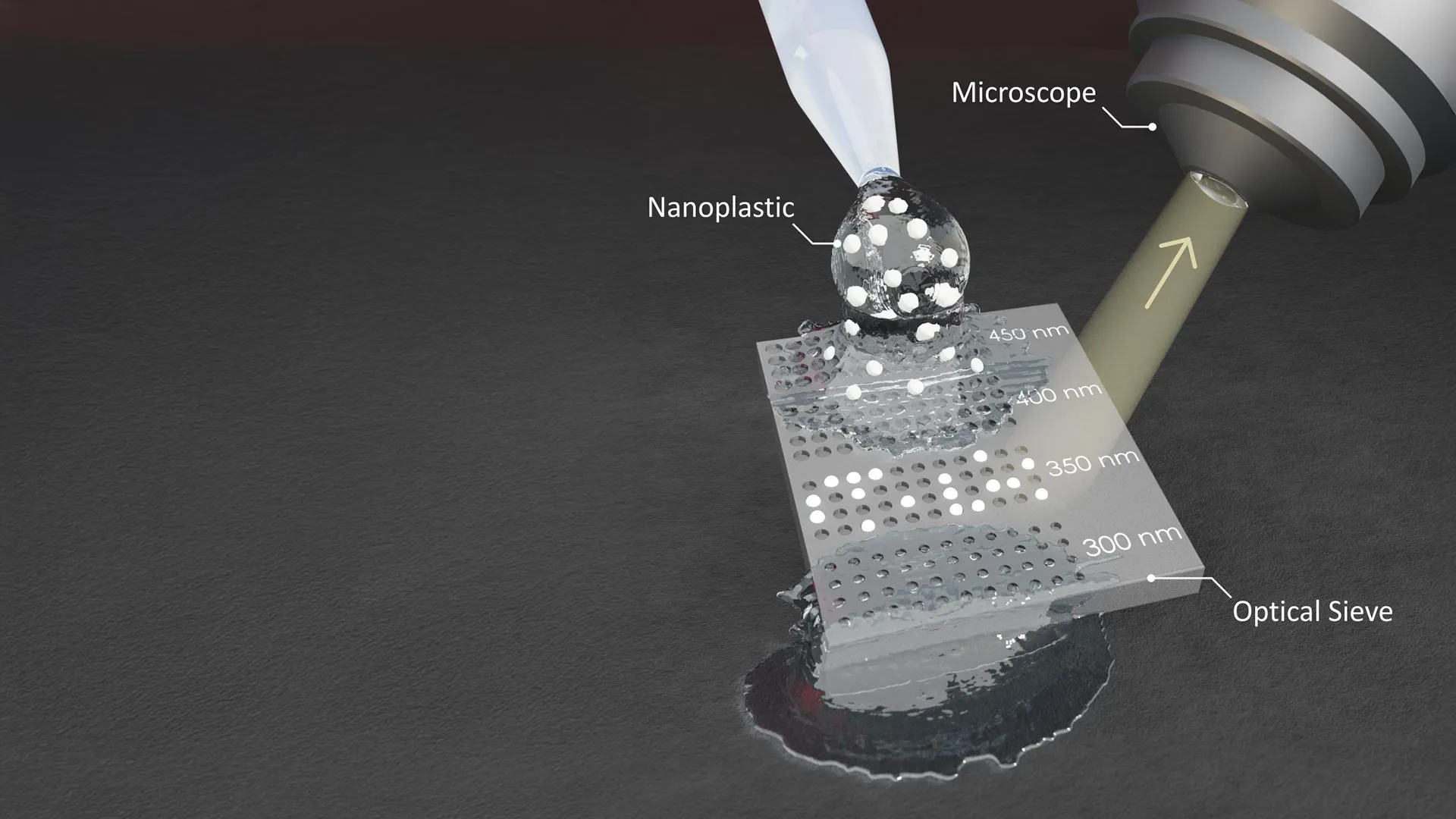
To gain more insight into nanoplastics, a research team led by Drs. Wei Min and Beizhan Yan of Columbia University modified a powerful imaging technique that Min co-invented 15 years ago with NIH support. The technique, called stimulated Raman scattering (SRS) microscopy, is now widely used to visualize small molecules in living cells. The method works by focusing two laser beams on samples to stimulate certain molecules to emit unique detectable light signals. Unlike many other methods, SRS microscopy does not depend on labeling specific molecules to find them.

For the new study, which was supported by NIH, the researchers developed a new SRS approach to detect micro- and nanoplastics at the single-particle level. After confirming that the technique could rapidly spot plastic particles smaller than 1 μm, they developed an algorithm based on machine learning to detect seven common types of plastic.

To test their new high-throughput imaging platform, the team analyzed the micro- and nanoplastics in three popular brands of bottled water. Results were reported on January 8, 2024, in the Proceedings of the National Academy of Sciences.

The researchers found that, on average, a liter of bottled water included about 240,000 tiny pieces of plastic. About 90% of these plastic fragments were nanoplastics. This total was 10 to 100 times more plastic particles than seen in earlier studies, which mostly focused on larger microplastics.

The water contained particles of all seven types of plastic. The most common was polyamide, a type of nylon that’s often used to help filter and purify water. An abundance of polyethylene terephthalate (PET) was also detected. This might be expected, since PET is used to make bottles for water, soda, and many other drinks and foods. Other identified plastics included polyvinyl chloride, polymethyl methacrylate, and polystyrene, which is also used in water purification. The method identified millions of additional particles that did not match the seven categories of plastic. It’s not yet clear if these tiny particles are nanoplastics or other substances.

The researchers say that this new technique will help to advance our understanding of human exposure to nanoplastics. “This opens a window where we can look into a plastic world that was not exposed to us before,” Yan says.

In the future, the researchers will apply this approach to analyze more environmental samples, such as tap water, indoor and outdoor air samples, and biological tissues. They are also developing filters that can reduce plastic pollution from laundry wastewater, since many fabrics include nylon, PET, and other plastics.

—by Vicki Contie

Related Links

References: Rapid single-particle chemical imaging of nanoplastics by SRS microscopy. Qian N, Gao X, Lang X, Deng H, Bratu TM, Chen Q, Stapleton P, Yan B, Min W. Proc Natl Acad Sci U S A. 2024 Jan 16;121(3):e2300582121. doi: 10.1073/pnas.2300582121. Epub 2024 Jan 8. PMID: 38190543.

Funding: NIH’s National Institute of Environmental Health Sciences (NIEHS); Research Initiatives in Science and Engineering of Columbia University; Hudson River Foundation.

CLICK HERE FOR MORE INFORMATION https://www.nih.gov/news-events/nih-research-matters/plastic-particles-bottled-water?

Think Before You Drink: Water Quality Awareness of Common Contaminants

If you think the water you are drinking is just H2O, think again! According to studies, an astonishing 75,000 chemical compounds have been found in our water, yet the EPA has established enforceable safety standards for only 87. Many of these common water contaminants and chemicals are potentially harmful and can spawn health problems. According to the Centers for Disease Control and Prevention, nearly one million people get sick from drinking contaminated water each year, with about 1,000 cases on average ending in death.

Using outdated technology, many municipalities simply weren’t built to handle the influx of common modern-day water contaminants. Various pollutants such as pesticides, herbicides, toxic waste from landfills, chemical and oil spills, acid rain, and more find their way into our water supplies. Most often this water is treated with chlorine or chloramines to control bacterial growth which, according to some health experts, may also contribute to illness.

Even if the water that leaves the treatment plants meets EPA minimum safety standards, health threats don’t stop there. The water may pass through unsafe water lines that recontaminate it on the way to your home. Examine your pipes and those of water distribution systems and you’ll find the insides of some of these pipes caked with mineral, biological and chemical deposits. In some cases, the pipes themselves may leach copper and lead! Another threat lurking inside older water pipes is bio-film, composed of layers of bacteria that can harbor pathogens like E. coli. And don’t think well water is any safer because groundwater pollutants may also seep into that source. Add to that the chlorine and other chemicals used to treat well water, and you have water that is chemically altered.

The sad truth is that our water supply is compromised by harmful chemicals. EPA standards require water treatment plants to reduce certain common water contaminants. Annual reports issued by the EPA for 2002 indicated that there were 80,635 documented violations nationwide. When violations occur, “boil water” alerts are issued but, by then, you may have already consumed dangerously contaminated water.

You have to ask yourself the question, “Over the course of my life, how will these chemicals and trace pollutants affect my health and that of my family?” Consider what this means if, over the course of your life, you drink approximately 13,000 gallons of water. There could be undetected contaminants in each glass you drink having a cumulative effect on your health for the worse. That’s why it’s so important you make doubly sure the water you drink is 100% steam distilled. And with Waterwise’s distilled water-making machines, you can take control of your water quality today and enjoy peace of mind.

CLICK HERE FOR MORE INFORMATION https://www.waterwise.com/think-before-you-drink/?utm_source

Clean water and sanitation: Five facts to becoming informed and engaged global citizens

Toilets are probably not one of the first things most people think about when they are considering ways they can help make the world a better place, but lack of access to clean water and sanitation is a major global issue affecting billions of people around the world every year. Leaders from 193 countries have agreed to ensure access to water and sanitation for all people by the year 2030, which is Goal 6 of the United Nations (UN) Sustainable Development Goals. The Sustainable Development Goals are 17 interconnected goals that seek to transform our world by ending all forms of poverty, eliminating inequalities and improving the state of the world’s natural and human-made environments through sustained multinational cooperation and efforts in the next 15 years.

By learning about, teaching about and taking action on the state of clean water and sanitation around the world, young people can play a valuable leadership role in helping to accomplish the Sustainable Development Goals. Here are five important facts and some educational resources related to Goal 6 of the Sustainable Development Goals that can help youth learn and engage as global citizens, according to the UN.

  • Globally, 2.4 billion people do not have access to toilets or latrines. Earlier this year, the UN declared that access to clean sanitation is a basic human right. Without access to clean sanitation, people are not able to pursue and enjoy their other human rights, such as their right to health, life and education. The UN has found that “more than 443 million school days are lost every year due to sanitation and water related issues. Inadequate sanitation facilities are a common barrier for school attendance, particularly for girls.”
  • Approximately 1.8 billion people use a source of drinking water that is fecally contaminated. That means one in four people around the world have to use water that has been contaminated by human waste, which is a potential source of deadly pathogens and diseases.
  • One thousand children die every day due to preventable water and sanitation-related diarrheal diseases, which continue to be a major source of death in children under 5. “Worldwide, more than two million people die every year from diarrheal diseases. Poor hygiene and unsafe water are responsible for nearly 90 percent of these deaths and mostly affect children,” according to the UN.
  • Approximately 663 million people live without access to improved drinking water sources. “An improved drinking-water source is defined as one that, by nature of its construction or through active intervention, is protected from outside contamination, in particular from contamination with fecal matter, according to the WHO/UNICEF Joint Monitoring Programme for Water Supply and Sanitation.
  • Water scarcity affects more than 40 percent of the global population and is projected to rise.

Goal 6 of the Sustainable Development Goals seeks to improve the global populations access to clean water and sanitation by the year 2030 by ending open defection, reducing water pollution, increasing water-use efficiency, implementing “integrated water resources management,” protecting and restoring water-related ecosystems and expanding water harvesting, desalination, wastewater treatment and water recycling and reuse in developing countries.

Researchers at Michigan State University are engaged in efforts that will help reach the targets set out in Goal 6 of the Sustainable Development Goals. MSU professor Joan Rose, the 2016 Stockholm Water Prize Laureate, along with other university researchers, are studying innovative new materials for use in water filters as a way to make it easier and less costly for people to access clean and safe drinking water.

Adult and youth leaders can help other youth and children learn about global water quality, clean water access and sanitation issues in order to be informed and active global citizens. Here are some activities and lesson plans that can be used to help teach others about these issues:

  • There’s No New Water! A National 4-H curriculum designed for high school aged youth, There’s No New Water is a high quality set of resources and activities to help young people learn “that water is a finite natural resource whose quantity and quality must be responsibly preserved, protected, used and reused.” In addition to learning about the natural water cycle and the impact of human activity on water quality and quantity, the curriculum helps youth plan and conduct a service learning project as the local level.
  • Water Conservation with the Water Lion. For younger learners, Pennsylvania State Extension provides a set of resources on youth water conservation to help elementary, middle and high school-aged youth develop knowledge about the water cycle, water quality and ways to use water responsibly in their home.
  • Clean Water For All. Available as a free download from World’s Largest Lesson website, Clean Water for All is a lesson plan and set of resources for helping youth ages 8-14 learn about the topics of global water pollution and clean water access. The set of activities can be led by older youth leaders or adults, and is designed as a 60-minute learning session with opportunities to extend the learning beyond the activity.
  • Plan for Change: Water Toolkit. This resource and set of activities is available as a free download from Plan Canada’s website. The toolkit includes information and activities to help youth and children learn about access to safe water and clean toilets in other parts of the world.
  • Get Involved and Take Action! Ready to help make a difference in the world around the issue of clean water and sanitation? Get a group of youth together to start planning a service activity for World Toilet Day (Nov. 19) or World Water Day (March 22).

MSU Extension and the Michigan 4-H Youth Development program helps to prepare youth as positive and engaged leaders and global citizens by providing educational experiences and resources for youth interested in developing knowledge and skills in these areas. To learn about the positive impact of Michigan 4-H youth leadership, civic engagement, citizenship and global/cultural programs, read our 2015 Impact Report: “Developing Civically Engaged Leaders.”

Other articles in series

This article was published by Michigan State University Extension. For more information, visit https://extension.msu.edu. To have a digest of information delivered straight to your email inbox, visit https://extension.msu.edu/newsletters. To contact an expert in your area, visit https://extension.msu.edu/experts, or call 888-MSUE4MI (888-678-3464).

CLICK HERE FOR MORE INFORMATION https://www.canr.msu.edu/news/clean_water_and_sanitation_five_facts_to_becoming_informed_and_engaged