More than 19 million Americans may be exposed to unsafe drinking water, researchers warn.
Millions of Americans may be exposed to contaminated drinking water systems that are dangerous for their health, an updated interactive map shows.
The map, a collaborative effort by Environmental Working Group, a nonprofit, nonpartisan organization, and Northeastern University‘s Social Science Environmental Health Research Institute, documents toxic fluorinated compounds known as PFAS at publicly known pollution sites across the U.S., including public water systems, military bases, military and civilian airports, industrial plants, dumps and firefighter training sites.
The researchers found at least 610 drinking water sources in 43 states contain potentially unsafe PFAS levels, and estimate that more than 19 million people are exposed to these man-made chemicals that have been linked to birth defects, increased risk of thyroid disease, infertility and reduced immune responses in children.
“The Environmental Protection Agency has utterly failed to address PFAS with the seriousness this crisis demands, leaving local communities and states to grapple with a complex problem rooted in the failure of the federal chemical regulatory system,” said Ken Cook, president of Environmental Working Group, in a press release. “EPA must move swiftly to set a truly health-protective legal limit for all PFAS chemicals, requiring utilities to clean up contaminated water supplies.”
Any detection of these chemicals were included in the interactive map, despite some of the levels being well below the Environmental Protection Agency’s “non-binding health advisory” standard of 70 parts per trillion, said Bill Walker, editor-in-chief of the Environmental Working Group, via email.
“We, along with many states and academic scientists, regard that number as far too high,” said Walker, who wrote the map’s accompanying reportlet. “EWG endorses studies by Dr. Phillipe Grandjean of Harvard that say levels as low as 1 (part per trillion) could have adverse health effects such as repressed immune function in children. Therefore, we believe a map showing only detections above the EPA advisory would be misleading as to the true extent of the contamination crisis.”
However, a spokesperson for the Environmental Protection Agency cautions the map “seems to show any samples for PFAS chemicals that have been collected, which may or may not be detections.”
“EPA has not fully reviewed the quality of the underlying data, and based on the agency’s commitment to good risk communication with the public, EPA cannot recommend the map be used to determine where public health risks associated with PFAS chemicals may or may not exist,” John Konkus, the EPA’s deputy associate administrator for public affairs, wrote in an email. “The agency’s efforts continue to be focused on taking the actions committed to in the PFAS Action Plan.”
Michigan has 192 sites on the map, reflecting the most comprehensive testing program in the U.S., according to the press release, followed by California, at 47, and New Jersey, at 43. The map also documents 117 military sites.
“Leaders in many communities and states are doing great work to raise awareness about PFAS and push for cleanup, but this is a national crisis demanding national action,” Phil Brown, director of the Social Science Environmental Health Research Institute, said in a press release. “The EPA should act more quickly to evaluate all PFAS chemicals and restrict their use, and polluting industries should be held responsible.”
In March, a bipartisan pair of PFAS-monitoring bills were introduced in U.S. Congress to “inform and enhance assessments of exposure, likely health and environmental impacts, and remediation priorities,” according to the House version of the bill. Meanwhile, the Centers for Disease Control and Prevention and Agency for Toxic Substances and Disease Registry are calling for researchers to apply for a multi-site project on the human health effects of PFAS exposure.
River dwellers carry water gallons, on the sandbanks of the Madeira river, to bring to the isolated region of Paraizinho community, during the worst drought of the river in history, Humaita, Amazonas state, Brazil September 8, 2024. REUTERS/Bruno Kelly
By Bruno Kelly
HUMAITA, Brazil (Reuters) – Water levels in the rivers that run through the vast Amazon rainforest have been falling, after a record drought followed by less rain, presenting unprecedented challenges for the Ribeirinhos people living there.
Generative AI Too Disruptive for Its Own Good: DeepAI FounderPlay Video
With rivers becoming more difficult to navigate and water too dirty to consume, many of the traditional rural population who live on river banks have been relying on outside supplies of drinking water.
Francisca das Chagas da Silva, a resident, said older people in particular have struggled because they needed to walk much further to get water. “We have to carry it from the riverbanks to our homes,” she said.
The Ribeirinhos usually get water directly from rivers or have connected systems – but these means of supply fail when water levels drop so dramatically.
Now, many residents rely on non-governmental organizations or the state government for drinking water.
Joao Ferreira Mendonca, a community leader, said the river bank was about 800 meters (0.5 miles) away from some homes, a long distance for an older person or one with health problems.
“Now imagine a person in the hot sun, people with high blood pressure, doing this journey,” he said.
The Brazilian Geological Service, SGB, has warned in recent days that all rivers in the Amazon basin were expected to drop below their historical levels.
Ribeirinhos usually live on river banks in pile dwellings – from where they move with motor boats.
Rosicleia Gomes Vieira, another resident, said life in general was becoming much more isolated because the low water levels make navigation more difficult and impossible to carry produce to the city.
Other than the rivers, which have long been the main way of transport for residents, there is only a long dirt road that cuts through the dense rainforest.
In Brazil, where wildfires have also occurred, the low water levels are also hitting soy and corn shipments in center-west states such as Mato Grosso, Brazil’s number one grains growing area.
(Reporting by Bruno Kelly in Humaita and Lisandra Paraguassu in Brasilia; Writing by Stefanie Eschenbacher; editing by Diane Craft)
A study of chemicals in U.S. drinking water found that arsenic, even in small concentrations, is responsible for disproportionate numbers of cancer cases.
Chemicals present within legal limits in tap water are projected to be responsible for more than 100,000 cancer cases in the U.S., according to estimates from a new study.
The study, published Thursday in the journal Heliyon, looked at nearly 50,000 water systems across the country. It analyzed the presence of 22 cancer-causing chemicals that are regulated by states and the Environmental Protection Agency but still found in varying degrees in drinking water.
Researchers with the Environmental Working Group, a nonprofit advocacy organization, said the study is the first to project on a national level the cancer risk the combination of chemicals pose over a person’s statistical lifetime – about 70 years.
They found that the majority of cancer cases came from water systems that were fully complying with drinking water standards set either by states or the EPA.
“Water that meets legal standards still poses health risks,” says Sydney Evans, the lead author of the study and a science analyst at Environmental Working Group.
Of the nearly two dozen chemicals examined, the biggest problem is arsenic, which even in small concentrations is responsible for disproportionate numbers of cancer cases, according to the study. But Evans says that this study is an attempt to start looking at the chemicals present in water as a mixture instead of assessing them one by one.
The analysis is conservative, according to Evans, because it only looked at chemicals with national monitoring data or health benchmark levels. Many more chemicals exist in drinking water that haven’t been studied enough to include in the assessment, Evans says.
The study does not include measurements from private wells, which roughly 13.5 million Americans rely on for drinking water. Private wells don’t have to follow federal drinking water standards.
A water filter is a good “first course of action for an individual who is concerned,” Evans says. Residents should check their local water reports to know what kind of filter would be best for the types of chemicals present where they live.
The study shows that tougher standards for drinking water are needed, according to Evans.
“Filters aren’t a solution,” Evans says. “They’re a measure people can take right now until their water quality is improved.”
Satellite imagery of Chennai that circulated across the internet in June starkly demonstrates how drought is affecting the Indian city. The pictures show how the reserves that provide the city with most of its water are nearly dry, contributing to a water scarcity crisis that has hit the 7 million residents hard.
The images from Chennai highlight how water scarcity is reaching into a growing number of countries. An estimated 600 million people across India face high to extreme water stress, according to a 2018 report by NITI Aayog, a think tank affiliated with the government. More than 2 billion people in 53 countries are experiencing high water stress, according to a report from the United Nations released earlier this year.
To combat these crises, many countries are taking measures to conserve water and find solutions to ongoing droughts. And while many of the measures are conventional strategies, from restricting public consumption of water to fixing faulty pipe systems, some of the solutions that have been proposed or implemented have been more creative. Here are five unusual solutions to global water shortages.
Next: Towing Icebergs
2/9
Towing Icebergs
The 2017-18 water shortage in Cape Town, South Africa was one of the worst in recent memory, attracting international attention as people tried to find solutions to the crisis before the city would be forced to shut down its water taps. One idea that was considered by experts was the unusual plan to tow an iceberg from Antarctica across 2,500 miles as a new freshwater source for the struggling region, according to Bloomberg.
Nick Sloane, an expert in marine salvage, came up with the idea, and although the crisis was ultimately averted, concerns about South Africa’s water supply remain and he is still planning to carry out the idea. The project, which is estimated to cost more than $200 million, would use two tugboats to encircle an iceberg in a net fashioned with the supermaterial dyneema. The iceberg would then be towed by tankers to South Africa’s western coast, where it would be harvested for fresh drinking water. Sloane is currently working on developing a deal with South Africa to sell the water to them.
Satellite imagery of Chennai that circulated across the internet in June starkly demonstrates how drought is affecting the Indian city. The pictures show how the reserves that provide the city with most of its water are nearly dry, contributing to a water scarcity crisis that has hit the 7 million residents hard.
The images from Chennai highlight how water scarcity is reaching into a growing number of countries. An estimated 600 million people across India face high to extreme water stress, according to a 2018 report by NITI Aayog, a think tank affiliated with the government. More than 2 billion people in 53 countries are experiencing high water stress, according to a report from the United Nations released earlier this year.
To combat these crises, many countries are taking measures to conserve water and find solutions to ongoing droughts. And while many of the measures are conventional strategies, from restricting public consumption of water to fixing faulty pipe systems, some of the solutions that have been proposed or implemented have been more creative. Here are five unusual solutions to global water shortages.
Next:Towing Icebergs
2/9
Towing Icebergs
The 2017-18 water shortage in Cape Town, South Africa was one of the worst in recent memory, attracting international attention as people tried to find solutions to the crisis before the city would be forced to shut down its water taps. One idea that was considered by experts was the unusual plan to tow an iceberg from Antarctica across 2,500 miles as a new freshwater source for the struggling region, according to Bloomberg.
Nick Sloane, an expert in marine salvage, came up with the idea, and although the crisis was ultimately averted, concerns about South Africa’s water supply remain and he is still planning to carry out the idea. The project, which is estimated to cost more than $200 million, would use two tugboats to encircle an iceberg in a net fashioned with the supermaterial dyneema. The iceberg would then be towed by tankers to South Africa’s western coast, where it would be harvested for fresh drinking water. Sloane is currently working on developing a deal with South Africa to sell the water to them.
Next: Moroccan Fog Catchers
3/9
Moroccan Fog Catchers
Since 2013, Morocco has been utilizing a system of nets that catches fog and converts it to water, in response to climate change and a lack of rainfall in the Southern Moroccan region. According to New York Magazine, the fog nets, which were developed by the sustainability non-profit Dar Si Hmad, are installed in the Mount Boutmezguida region, where fog is periodic.
Condensation builds up in the mesh netting and collects in troughs directly under the nets, which is then transported via a piping system. The nets have been greatly beneficial for Morocco; 800 people in 15 nearby villages receive water pumped from the nets.
Satellite imagery of Chennai that circulated across the internet in June starkly demonstrates how drought is affecting the Indian city. The pictures show how the reserves that provide the city with most of its water are nearly dry, contributing to a water scarcity crisis that has hit the 7 million residents hard.
The images from Chennai highlight how water scarcity is reaching into a growing number of countries. An estimated 600 million people across India face high to extreme water stress, according to a 2018 report by NITI Aayog, a think tank affiliated with the government. More than 2 billion people in 53 countries are experiencing high water stress, according to a report from the United Nations released earlier this year.
To combat these crises, many countries are taking measures to conserve water and find solutions to ongoing droughts. And while many of the measures are conventional strategies, from restricting public consumption of water to fixing faulty pipe systems, some of the solutions that have been proposed or implemented have been more creative. Here are five unusual solutions to global water shortages.
Next:Towing Icebergs
2/9
Credit
Towing Icebergs
The 2017-18 water shortage in Cape Town, South Africa was one of the worst in recent memory, attracting international attention as people tried to find solutions to the crisis before the city would be forced to shut down its water taps. One idea that was considered by experts was the unusual plan to tow an iceberg from Antarctica across 2,500 miles as a new freshwater source for the struggling region, according to Bloomberg.
Nick Sloane, an expert in marine salvage, came up with the idea, and although the crisis was ultimately averted, concerns about South Africa’s water supply remain and he is still planning to carry out the idea. The project, which is estimated to cost more than $200 million, would use two tugboats to encircle an iceberg in a net fashioned with the supermaterial dyneema. The iceberg would then be towed by tankers to South Africa’s western coast, where it would be harvested for fresh drinking water. Sloane is currently working on developing a deal with South Africa to sell the water to them.
Next:Moroccan Fog Catchers
3/9
Credit
Moroccan Fog Catchers
Since 2013, Morocco has been utilizing a system of nets that catches fog and converts it to water, in response to climate change and a lack of rainfall in the Southern Moroccan region. According to New York Magazine, the fog nets, which were developed by the sustainability non-profit Dar Si Hmad, are installed in the Mount Boutmezguida region, where fog is periodic.
Condensation builds up in the mesh netting and collects in troughs directly under the nets, which is then transported via a piping system. The nets have been greatly beneficial for Morocco; 800 people in 15 nearby villages receive water pumped from the nets.
Next: Solar-Powered Irrigation
4/9
Solar-Powered Irrigation
One group hit hard by the recent Indian droughts are farmers, who frequently struggle to find water for their crops. A company called Khethworks, which started as a project at the Massachusetts Institute of Technology and is located in the city of Pune, aims to help farmers through their solar-powered irrigation system. According to the company, switching from diesel irrigation methods to the solar-powered irrigation system will increase a farmer’s annual profits by 170 percent.
Satellite imagery of Chennai that circulated across the internet in June starkly demonstrates how drought is affecting the Indian city. The pictures show how the reserves that provide the city with most of its water are nearly dry, contributing to a water scarcity crisis that has hit the 7 million residents hard.
The images from Chennai highlight how water scarcity is reaching into a growing number of countries. An estimated 600 million people across India face high to extreme water stress, according to a 2018 report by NITI Aayog, a think tank affiliated with the government. More than 2 billion people in 53 countries are experiencing high water stress, according to a report from the United Nations released earlier this year.
To combat these crises, many countries are taking measures to conserve water and find solutions to ongoing droughts. And while many of the measures are conventional strategies, from restricting public consumption of water to fixing faulty pipe systems, some of the solutions that have been proposed or implemented have been more creative. Here are five unusual solutions to global water shortages.
Next:Towing Icebergs
2/9
Credit
Towing Icebergs
The 2017-18 water shortage in Cape Town, South Africa was one of the worst in recent memory, attracting international attention as people tried to find solutions to the crisis before the city would be forced to shut down its water taps. One idea that was considered by experts was the unusual plan to tow an iceberg from Antarctica across 2,500 miles as a new freshwater source for the struggling region, according to Bloomberg.
Nick Sloane, an expert in marine salvage, came up with the idea, and although the crisis was ultimately averted, concerns about South Africa’s water supply remain and he is still planning to carry out the idea. The project, which is estimated to cost more than $200 million, would use two tugboats to encircle an iceberg in a net fashioned with the supermaterial dyneema. The iceberg would then be towed by tankers to South Africa’s western coast, where it would be harvested for fresh drinking water. Sloane is currently working on developing a deal with South Africa to sell the water to them.
Next:Moroccan Fog Catchers
3/9
Credit
Moroccan Fog Catchers
Since 2013, Morocco has been utilizing a system of nets that catches fog and converts it to water, in response to climate change and a lack of rainfall in the Southern Moroccan region. According to New York Magazine, the fog nets, which were developed by the sustainability non-profit Dar Si Hmad, are installed in the Mount Boutmezguida region, where fog is periodic.
Condensation builds up in the mesh netting and collects in troughs directly under the nets, which is then transported via a piping system. The nets have been greatly beneficial for Morocco; 800 people in 15 nearby villages receive water pumped from the nets.
Next: Solar-Powered Irrigation
4/9
Credit
Solar-Powered Irrigation
One group hit hard by the recent Indian droughts are farmers, who frequently struggle to find water for their crops. A company called Khethworks, which started as a project at the Massachusetts Institute of Technology and is located in the city of Pune, aims to help farmers through their solar-powered irrigation system. According to the company, switching from diesel irrigation methods to the solar-powered irrigation system will increase a farmer’s annual profits by 170 percent.
Next: Filtering Salt Out of Seawater
5/9
Filtering Salt Out of Seawater
In 2018, scientists at Australia’s Commonwealth Scientific and Industrial Research Organization in Sydney developed a filter that will help desalinate water. The filtration system is made out of graphene, a material that researchers describe as being more effective at separating multiple contaminants from water. The researchers are hoping to find partners to help scale the technology so it can be used for household and urban water filtration.
Satellite imagery of Chennai that circulated across the internet in June starkly demonstrates how drought is affecting the Indian city. The pictures show how the reserves that provide the city with most of its water are nearly dry, contributing to a water scarcity crisis that has hit the 7 million residents hard.
The images from Chennai highlight how water scarcity is reaching into a growing number of countries. An estimated 600 million people across India face high to extreme water stress, according to a 2018 report by NITI Aayog, a think tank affiliated with the government. More than 2 billion people in 53 countries are experiencing high water stress, according to a report from the United Nations released earlier this year.
To combat these crises, many countries are taking measures to conserve water and find solutions to ongoing droughts. And while many of the measures are conventional strategies, from restricting public consumption of water to fixing faulty pipe systems, some of the solutions that have been proposed or implemented have been more creative. Here are five unusual solutions to global water shortages.
Next:Towing Icebergs
2/9
Credit
Towing Icebergs
The 2017-18 water shortage in Cape Town, South Africa was one of the worst in recent memory, attracting international attention as people tried to find solutions to the crisis before the city would be forced to shut down its water taps. One idea that was considered by experts was the unusual plan to tow an iceberg from Antarctica across 2,500 miles as a new freshwater source for the struggling region, according to Bloomberg.
Nick Sloane, an expert in marine salvage, came up with the idea, and although the crisis was ultimately averted, concerns about South Africa’s water supply remain and he is still planning to carry out the idea. The project, which is estimated to cost more than $200 million, would use two tugboats to encircle an iceberg in a net fashioned with the supermaterial dyneema. The iceberg would then be towed by tankers to South Africa’s western coast, where it would be harvested for fresh drinking water. Sloane is currently working on developing a deal with South Africa to sell the water to them.
Next:Moroccan Fog Catchers
3/9
Credit
Moroccan Fog Catchers
Since 2013, Morocco has been utilizing a system of nets that catches fog and converts it to water, in response to climate change and a lack of rainfall in the Southern Moroccan region. According to New York Magazine, the fog nets, which were developed by the sustainability non-profit Dar Si Hmad, are installed in the Mount Boutmezguida region, where fog is periodic.
Condensation builds up in the mesh netting and collects in troughs directly under the nets, which is then transported via a piping system. The nets have been greatly beneficial for Morocco; 800 people in 15 nearby villages receive water pumped from the nets.
Next:Solar-Powered Irrigation
4/9
Credit
Solar-Powered Irrigation
One group hit hard by the recent Indian droughts are farmers, who frequently struggle to find water for their crops. A company called Khethworks, which started as a project at the Massachusetts Institute of Technology and is located in the city of Pune, aims to help farmers through their solar-powered irrigation system. According to the company, switching from diesel irrigation methods to the solar-powered irrigation system will increase a farmer’s annual profits by 170 percent.
Next:Filtering Salt Out of Seawater
5/9
Credit
Filtering Salt Out of Seawater
In 2018, scientists at Australia’s Commonwealth Scientific and Industrial Research Organization in Sydney developed a filter that will help desalinate water. The filtration system is made out of graphene, a material that researchers describe as being more effective at separating multiple contaminants from water. The researchers are hoping to find partners to help scale the technology so it can be used for household and urban water filtration.
Next: Recovering Water from Power Plants
6/9
Recovering Water from Power Plants
Infinite Cooling is a U.S based company that started at MIT that seeks to recover water from power plants’ cooling tower exhausts. According to the company, power plants use nearly 39% of the country’s total water withdrawals. Their patent-pending technology uses electric fields to capture the water from the plumes leaving the towers. The company says this technology will reduce the water wasted by plants by 20-30%.
Nearly a tenth of the nation’s drinking water service lines contain lead, new data shows.
TNS
A piece of old lead pipe is seen in 2016 in Chicago.
In a first-of-its-kind report, the Environmental Protection Agency has released a comprehensive assessment on lead pipe infrastructure across the United States, revealing that an estimated total of 9.2 million lead pipes serviced American homes in 2021.
According to the report, lead service lines are estimated to make up over 9% of the entire national service line infrastructure, exposing much of America’s drinking water to lead contamination.
The EPA says there are no safe levels of lead in children’s blood, as lead exposure has been tied to an array of adverse health effects in children, including behavioral problems, lower IQ and slowed growth. In adults, lead exposure is linked with decreased cardiovascular health and kidney function, and lead exposure in pregnant women is linked to premature births.
The bulk of the nation’s lead pipe infrastructure is concentrated in a handful of states, including many of the Rust Belt states in the Great Lakes region. Florida has the most lead service lines in the country, with its 1.16 million lines accounting for 12.6% of the country’s total. Over 50% of the national service lines are concentrated in six states: Florida, Illinois (11.4%), Ohio (8.1%), Pennsylvania (7.5%), Texas (7.1%) and New York (5.4%).
Lead service lines are far less common west of the Mississippi River, with Texas as the lone exception. Notably, California’s service line infrastructure, which serves the largest state population over the third-largest area, has less than 13,500 lead service lines, or about 0.15% of the national total.
Federal law prohibits installing new lead plumbing because of its dangers to health. In 2021, the Biden Administration announced an aggressive plan to replace all lead service lines in the next decade as part of the Bipartisan Infrastructure Law, and earlier this year the EPA announced that $1.2 billion had already been distributed to 23 states to address that goal. But the costs associated with such an effort are significant. Over the next two decades, the EPA report estimates that $625 billion is needed to address the challenges with drinking water infrastructure.
Lead exposure does not impact all American demographics evenly. The Centers for Disease Control and Prevention published a study in 2021 indicating that non-Hispanic Black or African American children were at particular risk, as well as children living in areas with higher poverty rates.
Although the Safe Drinking Water Act, which was enacted 1974 and amended most recently in 1996, aims to ensure the public’s access to contaminant-free water, large-scale issues with drinking water distribution systems are still prevalent. Spikes in the rates of lead in children’s blood in 2015 sparked the start of a years-long water crisis in Flint, Michigan. The city of Jackson, Mississippi, which endured days with a full water outage last August and September, has ongoing projects to reduce elevated levels of lead in its water supply, and lead contamination has led to crises in Newark, New Jersey, Chicago and Washington, D.C., among other communities.
These are the states with the most lead pipes, according to the EPA:
A woman sits outside her home after water was delivered during water shortages, in Havana, Cuba September 11, 2024. REUTERS/Norlys Perez
HAVANA (Reuters) – Water shortages in Cuba are increasingly flaring tempers, including in capital Havana, as problems mount for hundreds of thousands of residents already ragged from shortfalls in food, fuel and electricity.
Upwards of 600,000 people – more than 1 in 20 on the Caribbean island of 10 million citizens – are suffering from water supply issues, officials said earlier this month.
Havana is the worst affected by water shortages, though most of the country’s largest cities report over 30,000 customers without water, the government has said.
Officials blame the growing problems on crumbling infrastructure and a persistent lack of fuel, symptoms of a festering economic crisis that has blighted growth and left the Communist-run country nearly bankrupt.
Rachel Trimiño, 32, said the root causes are no mystery, even in her Havana neighborhood of Vedado, a comparatively upscale district of the capital.
“All of the streets are full of leaking pipes, clean running water … but nothing in our homes,” she said.
The problem defies quick fixes.
Spare parts for outdated water infrastructure, like pipes and pumps, are in short supply, officials said. And without fuel and adequate transportation, even emergency water supply by cistern truck has been limited, according to residents.
Frequent blackouts only make matters worse.
“When they cut off power, we can’t give water,” said San Miguel de Padron resident Pedro Martino, who works with a church group that offers residents small quantities to stem the shortfall. “One thing depends on the other, and that’s the game we play.”
Isolated protests have erupted in some areas, as residents overwhelmed by the growing list of problems and shortages lose patience in the still blistering heat of the tropical summer.
Cuba’s economy has been decimated by a combination of factors, including the COVID-19 pandemic, stiffened U.S. sanctions and a state-dominated business model plagued by bureaucracy, mismanagement and corruption.
The social and economic crisis is widely seen as among the worst since Fidel Castro’s 1959 revolution, leading to a record-breaking exodus of Cuban migrants in the past two years.
(Reporting by Carlos Carrillo and Alien Fernandez, writing by Dave Sherwood, editing by Sandra Maler)
California’s water supply for this year looks promising, with the statewide Sierra Nevada snowpack standing at its tallest in four years for early January, according to the state’s Department of Water Resources latest measurement on Thursday.
The Sierra Nevada mountain range supplies nearly a third of California’s water supply as it melts and sends billions of gallons of water into the state’s rivers, according to The Mercury News. On Thursday, state officials conducted their first snowpack measurement of the season at Phillips Station near Lake Tahoe and determined that the snow was 33.5 inches deep and its water content was 97% of the historical average for this time of year.
“It’s a good start,” Chris Orrock, a spokesman for the state Department of Water Resources, told The Mercury News. “It’s better than it was last year. But it’s still early. We’re cautiously optimistic.”
Now, the state must wait to see if January and February, which account for a large portion of California’s precipitation, will be as fruitful as was December.
In early December, rains reduced the portion of the state considered to be abnormally dry from 85.3% to 3.6% in just a week.
“It’s still too early to predict what the remainder of the year will bring in terms of snowpack,” Sean de Guzman, chief of the agency’s snow surveys and water supply forecasting area, told the Los Angeles Times.
After California’s historic drought of 2012 to 2016, the state also has some policies in place to help preserve the water supply. Due to legislation signed by then-Gov. Jerry Brown, officials in areas with some of the most over-pumped groundwater basins must tell the state this month how they will replenish their supplies. There are also a number of dam projects in the works, including one to raise the height of the Los Vaqueros Reservoir.
What’s the difference between Alkaline Water and Ionized Alkaline Water?
Water that has a pH higher than 7.0 is considered Alkaline Water. Minerals, such as baking soda, or other chemicals can be added to water to alter the water’s pH. This process is often confused as meaning Ionized Alkaline Water; however, they are entirely different.
Alkaline Water Ionizers are what create the Ionized Alkaline Water that we’ve come to enjoy. Ionized Alkaline Water is created during the electrolysis process, which gets rid of the low-quality water rather than altering it.
Quick Answer: Water that has a pH higher than 7.0 is Alkaline Water. Generally, this is created with chemicals, minerals and buffers, which lack the antioxidants needed to truly heal.
“Antioxidants are substances that slow down and prevent cellular damage caused by…”Learn More
Here’s why Ionized Alkaline water is better than Bottled Alkaline Water
Alkaline Ionized Water (from a water ionizer machine) and Bottled Water are different because:
Additives, Chemicals, and pH buffers are often used to create a positive ORP Value. By creating Alkaline drinking water with our Water Ionizers, you’ll be drinking chemical free, natural water
With ZERO antioxidant value and a positive ORP value, Bottled Water lacks any molecular hydrogen.
Ranging from $2 to $5 per liter, bottled water is vastly more expensive compared to less than a penny per liter with our Water Ionizer, which will also generate nearly limitless amounts of Alkaline Ionized Water.
Alkaline Water Ionizers, such as our Aqua Ionizer Deluxe 9.5, also provide the benefit of less waste materials, effectively creating a smaller carbon footprint. Bottled water is expensive due to transportation costs, and materials. They also create more waste since they’re only used once then thrown away, making it a very short life-cycled product and wasteful.
What is Positive ORP and Negative ORP?
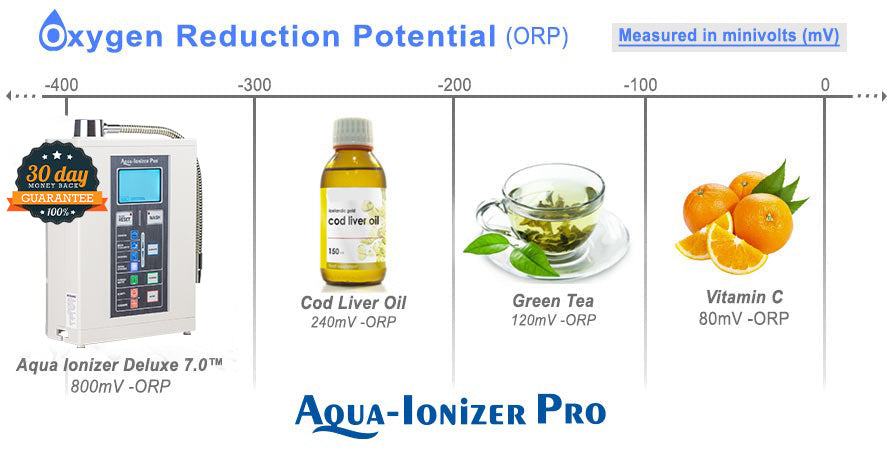
Liquids, such as Soda, Water, Green Tea, and Coffee, all have an ORP, which is the measure of oxidation reduction point.
Antioxidants have a Negative (-) ORP measurement, thus helping eliminate free radicals and help repair the body.
Quick Answer: ORP is the measure of Oxidation Reduction Potential of a substance.
ORP Measures Antioxidants, and Antioxidants HELP YOU HEAL!
Green Tea has a -ORP of 120mV, meaning it is high in antioxidants.
Opposite of the -ORP is the positive ORP. This positive ORP creates excessive oxidation, and free radicals in your body. Most carbonated beverages, such as soda (acidic) have a positive ORP.
Interestingly, most bottled water will contribute to oxidation since it has a positive ORP.
Ionized water is recommended to be consumed immediately after it’s been produced, due to Negative ORP being highly reactive and dynamic. It will also return to it’s neutral or positive state over the course of a few days- demonstrated by it “going flat.”
When ionized water is sitting around for a few days, you’ll begin to see the “off gassing” effect on the water container, where bubbles start to collect on the container. Negative ORP will drop with the increase of apparent bubbles being “off gassed.”
Our Aqua Ionizer Deluxe 7.0™ creates a -ORP of up to 800, a high antioxidant rich solution, depending on the water source. Consuming this water immediately after it’s produced by the water ionizer machine, will ensure that you’re receiving a substantially high oxidation reduction potential (ORP) water.
Our Aqua Ionizer Deluxe 9.0™ creates a -ORP of 860, which is approaching the high end of the spectrum. This unit features the “Daily Drinking” setting, which will allow you to enjoy a -ORP of 300. Comparing that to a cup a green tea, water created from our Water Ionizer machine will ensure you’re receiving more than 3 times the antioxidants!
Alkaline Water Benefits
Health Benefits of Alkaline Water
Toxic substances find their way into our bodies, and Alkaline Water can help combat and counteract that by helping neutralize the acid in our bodies. In an Alkaline environment, your body can focus on healing and fighting back against those toxic substances.
Acidic water can help rehydrate skin and can act as an astringent to help prevent skin problems such as acne, wrinkles, and other skin problems. Acidic water is also great for cleaning glass, and other surfaces in your kitchen. Most plants and flowers also thrive with a lower pH water and actually prefer this environment over a higher pH water.
Antioxidants are created simultaneously while both high and low pH waters are being produced. Molecular hydrogen, antioxidants, and oxygen allow the body to recover and heal effectively and efficiently. Molecular hydrogen helps combat free radicals in the body and helps boost your immune system by working deep within the cell walls.
Reduce or Eliminate GERD (Acid Reflux Indigestion)
Improve sleep quality and sleeping patterns
Stay young and youthful with Antioxidants
Reduce Inflammation in the body, joints, and muscles
Remove free radicals from your body
Stimulate and Promote Weight Loss
Daily Detoxification of your body
Natural astringent so it can reduce wrinkles, acne, fine lines, eczema, rosacea, and help tighten skin
Improve reaction time and memory
Creates more flavorful food when cooking pasta, rice, and when brewing coffee and tea
Promotes hair growth and scalp rebuilding
Micro-clustering and antioxidants increase hydration levels in the body
Reduced soreness and cramping
Reduce body acidity overall
Donates electrons that allow your body to rebuild and recover
Decrease recovery times and increase athletic performance
Boost energy and metabolism levels
Eliminates that “full” water feeling
Helps with dry skin and irritation due to allergies
And so much more!
Uses
Alkaline
pH 13 or higher – Helps remove oil stains, grease, and blood. Use when cooking or heating water for a long time
pH 12 – Best for cooking or heating water for a long time. Lessen pesticide residue on food, as well as reducing bacteria.
pH 11 – HOT brewing tea and coffee, or making stews and soups as well as tenderizing meats, carpet cleaning and washing fruits and veggies.
pH 10 – Ice cubes, working out, hangover, and COLD brewing coffee and tea.
pH 9 – Everyday drinking water for those who have acclimated to alkaline water
pH 8 – When just starting out, you’ll need to get acclimated to the water for about 1-2 weeks. Pets love this water.
Neutral
pH 7 – Use when making baby formula or taking any time-released medication
Acidic
pH 6 – Perfect for Plants!
pH 5 – Great for washing your hair scalp and soaking your feet/hands. Also great for bug bites and sunburns.
pH 4 – Use as an astringent or toner for your body and face.
pH 3 – Excellent at cleaning glass surfaces, stainless steel, counter tops, and for mixing cleaning supplies with
In 1860, when Colorado was still a territory and the gold rush was on, farmers who settled on the eastern plains were looking for another source of wealth—water.
The state’s prairie is mostly without rivers, but many creeks flow out of the Rocky Mountains. So, to irrigate their crops, one group of farmers set their sights on a creek known as the Left Hand—a name given to the stream that was also the English name of Chief Niwot of the Arapaho tribe that lived in the area not far from present-day Boulder, Colorado. The farmers formed the Left Hand Ditch Company and began using the water.
When drought struck the region, the farmers had to look for alternative sources to irrigate their crops. The legend is that a Native American called “Indian Jack” showed them that they could get more water high up in the Rockies from a different creek now called the South St. Vrain and divert it over a ridge. The Left Hand Ditch group built a small dam and dug a half-mile-long ditch that took all of the water, drying up the stream, and eventually dumping it into the Left Hand Creek, and so, their problem was solved—or so they thought.
Unbeknownst to them, their diversion would send a ripple through the expectations of some who thought they could use water simply because it crossed their property, a system called riparian law that’s used in eastern states. Also, they were moving water from one watershed to a completely different one, even though it was close by.
A 12-foot dam on the St. Vrain Creek diverts water to the Left Hand ditch. When water is not needed by the ditch company, a gate closes to allow the creek to flow in its natural channel. Starting this year, the gate can be operated remotely by cellphone. | Credit: Jamie Sudler, H2O Media, Ltd.
Sean Cronin, the executive director of the St. Vrain and Left Hand Water Conservancy District (SVLHWCD), said, “Moving water around in ways that weren’t quite what people had been accustomed to on the East Coast with riparian law was something that was very new, different, and radical at that time.” SVLHWCD is a government entity that works to conserve and protect water in a 500-square-mile area from high in the Rocky Mountains down to the plains with many farms. As its name shows, the district includes both the St. Vrain and Left Hand Creek watersheds as well as the city of Longmont.
Today, Cronin and other officials are at the location of the dam, not far from Ward, Colorado, which, when it was first built, was just trees, logs, and dirt but is now a 12-foot-long steel structure mounted in concrete. Back in the 1800s, it did the job—so well that farmers down on the plains who depended on the St. Vrain for water began to notice.
Water War Leads to Colorado Doctrine of Prior Appropriation
Cronin tells the story of Rueben Coffin, who in the 1860s homesteaded at what is now called the Standstone Ranch in Longmont. One day, Coffin saw that the St. Vrain Creek running through his property had dried up. He and some of his fellow farmers ventured into the mountains—about a day’s trip on horseback—and found the South St. Vrain, a tributary of the St. Vrain Creek, was dammed and realized the water was no longer going down the creek but rather into a ditch. So, Coffin and his colleagues tore up the dam—some say they blew it up with dynamite—igniting a water war.
Learning what happened, the Left Hand Ditch group rebuilt their structure and stationed armed guards to defend it. Cronin says that legend has it weapons were involved, but that can’t be verified.
Terry Plummer, the superintendent of the Left Hand Ditch Company today says he has the original minutes from the company describing the earthen dam structure and that armed guards were stationed to defend it from being destroyed at night. He says the records don’t indicate that gunshots were fired.
Fortunately, bloodshed was avoided, and ultimately the controversy ended up in court when the Left Hand Ditch Company sued the Coffin-led farmers for destroying their dam.
The case (Coffin v. Left Hand Ditch Co.) went to the Colorado Supreme Court, which in 1882 upheld the right of the Left Hand farmers to build their dam and take water—even though they didn’t own the adjacent property. The ruling completely rejected the riparian law of water that existed in the East. The court said that, while the prior appropriation doctrine was recognized in the Colorado Constitution in 1876, it had existed from the date of the earliest appropriations of water within Colorado, which by European settlers was likely in about 1859. The decision gave birth to the Colorado Doctrine of Prior Appropriation, sometimes called “first in time, first in right,” which has been the basis for water allocation in nine states in the West ever since.
140 Years Later Collaboration Leads to Modernization
In 2024, more than 140 years later, the Left Hand Ditch Company still maintains the dam, which sends water from the South St. Vrain down to about 460 farmers. The diversion off the creek and into the ditch has a gate that can be lowered when not all the water is needed by the ditch company shareholders. The creek is then rewetted as water flows over the dam and down the South St. Vrain.
Up until spring of this year, the ditch owners had to travel up the mountain—a three-hour round trip by car—and manually lower or raise the gate, cranking it with a hand winch. Now, Plummer opens and closes the large metal plate using electricity from solar power—and a cellphone. He can operate the gate on a real-time basis from anywhere instead of having to drive up to the diversion. If there’s a storm dumping water and he doesn’t need it, he will lower the gate.
A collaboration between Plummer’s ditch company, the SVLHWCD, and the Left Hand Water District paid for this year’s modernization. The use of smartphone technology in this area was the challenge. Bruce Bacon of the firm Hydrologik installed the equipment and said that the location is about as remote as you can get using cell technology, and they had to spend time tweaking the antennas on the device trying to figure out if they could get a signal.
Plummer says the threat of violence is not a thing of the past, especially when you’re traveling on someone else’s land to protect your water right. He said he’d had a .38 caliber pistol pulled on him on the road to the diversion. He talked the person down, and then attorneys worked it out. Plummer said it’s not uncommon for guns to be pulled, although it’s rare. Another person had a shotgun pulled on him down in the valley. “The old adage, that ‘whiskey’s for drinking, but water’s for fighting’ is really true in the water industry,” Plummer added.
The new technology also makes accounting for every drop of water accurate, something Plummer is focused on for good reason. He said that he has been in meetings with the assistant district attorney, who pointed her finger at him and said they would come after him if he takes one drop of water that is not in priority, meaning his ditch company is not entitled to it.
Now, technology may save both time—and conflict. 💧
Children with higher concentrations of a certain chemical in their blood are more likely to get cavities, according to a new study by West Virginia University School of Dentistry researchers.
Manufactured chemical groups called perfluoroalkyl and polyfluoroalkyl substances are universal as a result of extensive manufacturing and use. Although manufacturers no longer use PFAS to make nonstick cookware, carpet, cardboard and other products, they persist in the environment. Scientists have linked them to a range of health problems — from heart disease to high cholesterol — but now R. Constance Wiener and Christopher Waters are exploring how they affect dental health.
They investigated whether higher concentrations of PFAS were associated with greater tooth decay in children. One of them — perfluorodecanoic acid — was linked to dental cavities. Their findings appear in the Journal of Public Health Dentistry.
“Due to the strong chemical bonds of PFAS, it is difficult for them to breakdown, which makes them more likely to be persistent within the environment, especially in drinking water systems,” said Waters, who directs the School of Dentistry’s research labs. “A majority of people may not be aware that they are using water and other products that contain PFAS.”
The 629 children who participated in the study were 3 to 11 years old and were part of the National Health and Nutrition Examination Survey. Samples of the children’s blood were analyzed for PFAS in 2013 and 2014. Their tooth decay and other factors — such as their race, their BMI and how often they brushed their teeth — were assessed.
Of the seven PFAS that Wiener and Waters analyzed, perfluorodecanoic acid was the one that correlated with higher levels of tooth decay.
“Perfluorodecanoic acid, in particular, has a long molecular structure and strong chemical bonds; therefore, it remains in the environment longer. As a result, it is more likely to have negative health consequences such as dental caries,” said Dr. Wiener, an associate professor in the Department of Dental Practice and Rural Health.
But how does that influence happen? Wiener and Waters have a hypothesis. According to other research, perfluorodecanoic acid may disrupt the healthy development of enamel, which is what makes teeth hard. That disruption can leave teeth susceptible to decay.
However, when it comes to cavities, scientists haven’t parsed perfluorodecanoic acid’s mechanism of action yet. The topic warrants further investigation.
“While the findings of this study are important, there are some study limitations, and more work is needed to fully understand how this molecule impacts normal tooth formation,” said Fotinos Panagakos, the School of Dentistry’s vice dean for administration and research.
“The good news is that, in our study, about half of the children did not have any measurable amount of PFAS. Perhaps this is due to certain PFAS no longer being made in the US,” Wiener said.
Another piece of good news is that the study reaffirmed the importance of dental hygiene and checkups. Children who brushed once a day or less frequently had significantly higher tooth decay than those who brushed at least twice daily.
Likewise, children who had not been to the dentist within the previous year were twice as likely to have higher rates of tooth decay than kids who hadn’t.
So, even though parents cannot control what is in their children’s drinking water, they can still protect their children’s teeth by fostering thorough, regular brushing and scheduling dental exams.
The School of Dentistry will hold Give Kids a Smile Day on Friday, Feb. 7, at the Pediatric Dentistry Clinic. Dental students will treat more than 100 children for free that day. Each visit includes an exam, a cleaning, a fluoride treatment and — if appropriate — X-rays.