SINGAPORE (Reuters) – Governments have no time to lose when it comes to implementing a new global ocean treaty to protect the high seas as threats from human activities intensify, a report by environmental group Greenpeace said on Thursday.
In March, more than 100 countries completed a groundbreaking treaty to protect the high seas after years of negotiations. It was adopted at the United Nations in June and states can signal their intent to ratify it at the U.N. General Assembly on Sept. 20.
The treaty will create ocean sanctuaries that are off-limits to fishing and other human activities. Environmental groups said the agreement was a crucial part of efforts to meet a goal enshrined in last year’s global biodiversity accord to protect at least 30% of the world’s land and seas by 2030 – a target known as “30 by 30”.
The high seas, or international waters, constitute more than 60% of the world’s oceans but have not been under any protection. While the treaty addresses a major regulatory gap, it still needs to be ratified at a national level before it goes into effect.
Greenpeace said fishing hours on the high seas increased by 8.5% from 2018 to 2022, and were up 22.5% in areas that need special protection.
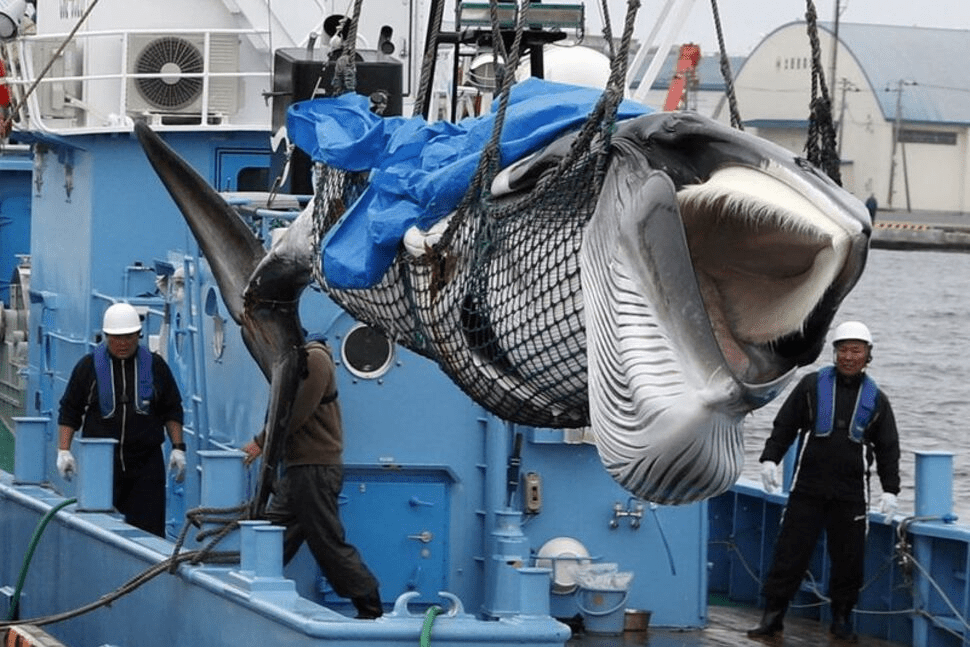
Unsustainable practices have also risen, including longlines that ensnare marine mammals or seabirds. Species like Pacific Bluefin tuna have lost more than 90% of their population in 30 years, the report said.
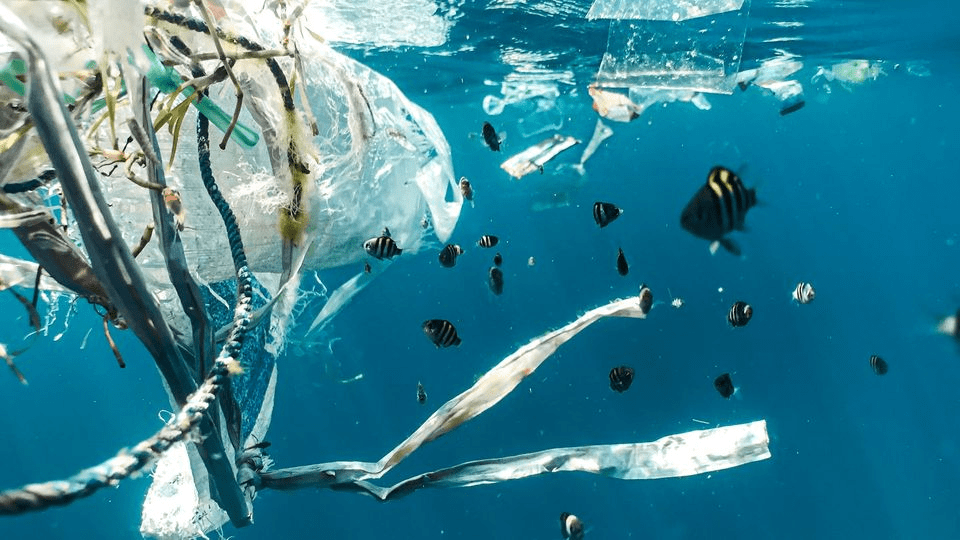
Sea temperatures hit a record 21.1 degrees Celsius (70 degrees Fahrenheit) in April and are driving ocean acidification and deoxygenation. The problems of plastic, oil and noise pollution have still not been brought under control, according to the environmental group.
Greenpeace warned that “new industries wait in the wings”, including the mining of minerals in the seabed as well as ocean carbon removal technology, which are not yet properly regulated.
The U.N. treaty will only go into effect when it has been ratified by 60 countries. Greenpeace said that needs to happen before 2025 if there is any hope of achieving the “30 by 30” target. Funding the treaty could be the next challenge.
“We believe over 60 countries intend to sign the Treaty (at the U.N. General Assembly) on Sept. 20, which would send a very strong signal of continued global unity and momentum towards ratification,” said Chris Thorne of Greenpeace’s Protect the Oceans campaign.
“Reaching 30 by 30 means protecting more than 11 million square kilometres (4.3 million square miles) every year from now to 2030, so there is hardly any time to waste.”
Rivers are warming and losing oxygen faster than oceans, according to a Penn State-led study published today (Sept. 14) in the journal Nature Climate Change. The study shows that of nearly 800 rivers, warming occurred in 87% and oxygen loss occurred in 70%.
The study also projects that within the next 70 years, river systems, especially in the American South, are likely to experience periods with such low levels of oxygen that the rivers could “induce acute death” for certain species of fish and threaten aquatic diversity at large.
“This is a wake-up call,” said Li Li, Penn State’s Isett Professor of Civil and Environmental Engineering and corresponding author on the paper. “We know that a warming climate has led to warming and oxygen loss in oceans, but did not expect this to happen in flowing, shallow rivers. This is the first study to take a comprehensive look at temperature change and deoxygenation rates in rivers — and what we found has significant implications for water quality and the health of aquatic ecosystems worldwide.”
The international research team used artificial intelligence and deep learning approaches to reconstruct historically sparce water quality data from nearly 800 rivers across the U.S. and central Europe. They found that rivers are warming up and deoxygenating faster than oceans, which could have serious implications for aquatic life — and the lives of humans. The National Oceanic and Atmospheric Administration estimates that most Americans reside within a mile of a river or stream.
“Riverine water temperature and dissolved oxygen levels are essential measures of water quality and ecosystem health,” said Wei Zhi, an assistant research professor in the Department of Civil and Environmental Engineering at Penn State and lead author of the study. “Yet they are poorly understood because they are hard to quantify due to the lack of consistent data across different rivers and the myriad of variables involved that can change oxygen levels in each watershed.”
The research team developed novel deep learning approaches to reconstruct consistent data to enable systematic comparison across different rivers, he explained.
“If you think about it, life in water relies on temperature and dissolved oxygen, the lifeline for all aquatic organisms,” said Li, who is also affiliated with Penn State’s Institute of Energy and the Environment. “We know that coastal areas, like the Gulf of Mexico, often have dead zones in the summer. What this study shows us is this could happen in rivers as well, because some rivers will no longer sustain life like before.”
She added that declining oxygen in rivers, or deoxygenation, also drives the emission of greenhouse gases and leads to the release of toxic metals.
To conduct their analysis, the researchers trained a computer model on a vast range of data — from annual precipitation rates to soil type to sunlight — for 580 rivers in the United States and 216 rivers in Central Europe. The model found that 87% of the rivers have been getting warmer in the past four decades and 70% have been losing oxygen.
The study revealed that urban rivers demonstrated the most rapid warming, whereas agricultural rivers experienced the slowest warming but fastest deoxygenation. They also used the model to forecast future rates and found that across all the rivers they studied, future deoxygenation rates were between 1.6 and 2.5 times higher than historical rates.
“The loss of oxygen in rivers is unexpected because we usually assume rivers do not lose oxygen as much as in big water bodies like lakes and oceans, but we found that rivers are rapidly losing oxygen,” Li said. “That was really alarming, because if the oxygen levels get low enough, it becomes dangerous for aquatic life.”
The model predicted that, within the next 70 years, certain species of fish could die out completely due to longer periods of low oxygen levels, which Li said would threaten aquatic diversity broadly.
“Rivers are essential for the survival of many species, including our own, but they have historically been overlooked as a mechanism for understanding our changing climate,” said Li. “This is our first real look at how rivers throughout the world are faring — and it’s disturbing.”
Researchers have genetically engineered a marine microorganism to break down plastic in salt water. Specifically, the modified organism can break down polyethylene terephthalate (PET), a plastic used in everything from water bottles to clothing that is a significant contributor to microplastic pollution in oceans.
“This is exciting because we need to address plastic pollution in marine environments,” says Nathan Crook, corresponding author of a paper on the work and an assistant professor of chemical and biomolecular engineering at North Carolina State University.
“One option is to pull the plastic out of the water and put it in a landfill, but that poses challenges of its own. It would be better if we could break these plastics down into products that can be re-used. For that to work, you need an inexpensive way to break the plastic down. Our work here is a big step in that direction.”
To address this challenge, the researchers worked with two species of bacteria. The first bacterium, Vibrio natriegens, thrives in saltwater and is remarkable — in part — because it reproduces very quickly. The second bacterium, Ideonella sakaiensis, is remarkable because it produces enzymes that allow it to break down PET and eat it.
The researchers took the DNA from I. sakaiensis that is responsible for producing the enzymes that break down plastic, and incorporated that genetic sequence into a plasmid. Plasmids are genetic sequences that can replicate in a cell, independent of the cell’s own chromosome. In other words, you can sneak a plasmid into a foreign cell, and that cell will carry out the instructions in the plasmid’s DNA. And that’s exactly what the researchers did here.
By introducing the plasmid containing the I. sakaiensis genes into V. natriegens bacteria, the researchers were able to get V. natriegens to produce the desired enzymes on the surface of their cells. The researchers then demonstrated that V. natriegens was able to break down PET in a saltwater environment at room temperature.
“This is scientifically exciting because this is the first time anyone has reported successfully getting V. natriegens to express foreign enzymes on the surface of its cells,” Crook says.
“From a practical standpoint, this is also the first genetically engineered organism that we know of that is capable of breaking down PET microplastics in saltwater,” says Tianyu Li, first author of the paper and a Ph.D. student at NC State. “That’s important, because it is not economically feasible to remove plastics from the ocean and rinse high concentration salts off before beginning any processes related to breaking the plastic down.”
“However, while this is an important first step, there are still three significant hurdles,” Crook says. “First, we’d like to incorporate the DNA from I. sakaiensis directly into the genome of V. natriegens, which would make the production of plastic-degrading enzymes a more stable feature of the modified organisms. Second, we need to further modify V. natriegens so that it is capable of feeding on the byproducts it produces when it breaks down the PET. Lastly, we need to modify the V. natriegens to produce a desirable end product from the PET — such as a molecule that is a useful feedstock for the chemical industry.
“Honestly, that third challenge is the easiest of the three,” says Crook. “Breaking down the PET in saltwater was the most challenging part.
“We are also open to talking with industry groups to learn more about which molecules would be most desirable for us to engineer the V. natriegens into producing,” Crook says. “Given the range of molecules we can induce the bacteria to produce, and the potentially vast scale of production, which molecules could industry provide a market for?”
The paper, “Breakdown of PET microplastics under saltwater conditions using engineered Vibrio natriegens,” is published open access in the AIChE Journal. The paper was co-authored by Stefano Menegatti, an associate professor of chemical and biomolecular engineering at NC State.
In the frigid waters surrounding Antarctica, an unusual seasonal cycle occurs. During winter, from March to October, the sun barely rises. As seawater freezes it rejects salts, creating pockets of extra-salty brine where microbes live in winter. In summer, the sea ice melts under constant daylight, producing warmer, fresher water at the surface.
This remote ecosystem is home to much of the Southern Ocean’s photosynthetic life. A new University of Washington study provides the first measurements of how sea-ice algae and other single-celled life adjust to these seasonal rhythms, offering clues to what might happen as this environment shifts under climate change.
The study, published Sept. 15 in the International Society for Microbial Ecology’s ISME Journal, contains some of the first measurements of how sea-ice microbes respond to changing conditions.
“We know very little about how sea-ice microbes respond to changes in salinity and temperature,” said lead author Hannah Dawson, a UW postdoctoral researcher who did the work while pursuing her doctorate in oceanography at the UW. “And until now we knew almost nothing about the molecules they produce and use in chemical reactions to stay alive, which are important for supporting higher organisms in the ecosystem as well as for climate impacts, like carbon storage and cloud formation.”
The polar oceans play an important role in global ocean currents and in supporting marine ecosystems. Microbes form the base of the food web, supporting larger life forms.
“Polar oceans make up a significant portion of the world’s oceans, and these are very productive waters,” said senior author Jodi Young, a UW assistant professor of oceanography. “These waters support big swarms of krill, the whales that come to feed on those krill, and either polar bears or penguins. And the start of that whole ecosystem are these single-celled microscopic algae. We just know so little about them.”
The tiny organisms are also important for the climate, since they quietly perform photosynthesis and soak up carbon from the atmosphere. Polar algae are especially good at producing sulfur-containing molecules that give beaches their distinctive smell and, when lofted into the air in sea spray, promote formation of clouds that can reduce penetration of solar rays.
Antarctic sea ice, though long stable, is at an all-time record low this year.
In other oceans, satellite instruments can capture dramatic seasonal phytoplankton blooms from space — but that isn’t possible for microbes hidden under sea ice. And Antarctic waters are particularly challenging to visit, leaving researchers with almost no measurements in winter.
In late 2018, Dawson and co-author Susan Rundell traveled to Palmer Station, a U.S. research station on the West Antarctic Peninsula. They used a small boat to sample seawater and sea ice at the same nearby sites every three days.
Back on shore, the two graduate students performed 10-day experiments in tanks to see which microbes grew as temperature and salinity were adjusted to mimic sea-ice formation and melt. They also shipped samples back to Seattle for more complex measurements of the samples’ genetics and metabolites, the small organic molecules produced by the cell.
Results revealed how single-celled algae deal with their fluctuating environments. As temperatures drop, the cells produce cryoprotectants, similar to antifreeze, to prevent their cellular fluid from crystallizing. Many of the most common cryoprotectant molecules were the same across different microbial lifeforms.
As salinity changes, to avoid either bursting in freshening waters or becoming desiccated like raisins in salty conditions, the cells change the concentration of salt-like organic molecules. Many such molecules serve a dual role as cryoprotectants, to balance conditions inside and outside the cell to maintain water balance.
The results show that under short-term temperature and salinity changes, community structure in each sample remained stable while adjusting the production of protective molecules. Different microbe species showed consistent responses to changing conditions. This should simplify modeling future responses to climate change, Young said.
Results also hint that the production of omega-3 fatty acids may decline in lower-salinity environments. This would be bad news for consumers of krill oil supplements, and for the marine ecosystem that relies on those algae-derived nutrients. Future research now underway by the UW group aims to confirm that result — especially with the prospect of increasing freshwater input from melting sea ice and glaciers.
“We’re interested in how these sea-ice algae contend with changes in temperature, salinity and light under normal conditions,” Dawson said. “But then we also have climate change, which is completely remodeling the landscape in terms of when sea ice is forming, how much sea ice forms, how long it stays before it melts, as well as the quantity of freshwater input from glaciers. So we’re both trying to capture what’s happening now, and also asking how that can inform what might happen in the future.”
The study was funded by the National Science Foundation, the Simons Foundation, and the Alfred P. Sloan Foundation. Other co-authors are Anitra Ingalls, Jody Deming, Joshua Sacks and Laura Carlson at the UW; Natalia Erazo, Elizabeth Connors and Jeff Bowman at Scripps Institution of Oceanography; and Veronica Mierzejewski at Arizona State University.
OAKLAND, Calif. (AP) — An unprecedented red tide in the San Francisco Bay Area is killing thousands of fish and other marine life whose carcasses are washing ashore, creating a foul odor that experts say could get worse during this weekend’s expected heat wave.
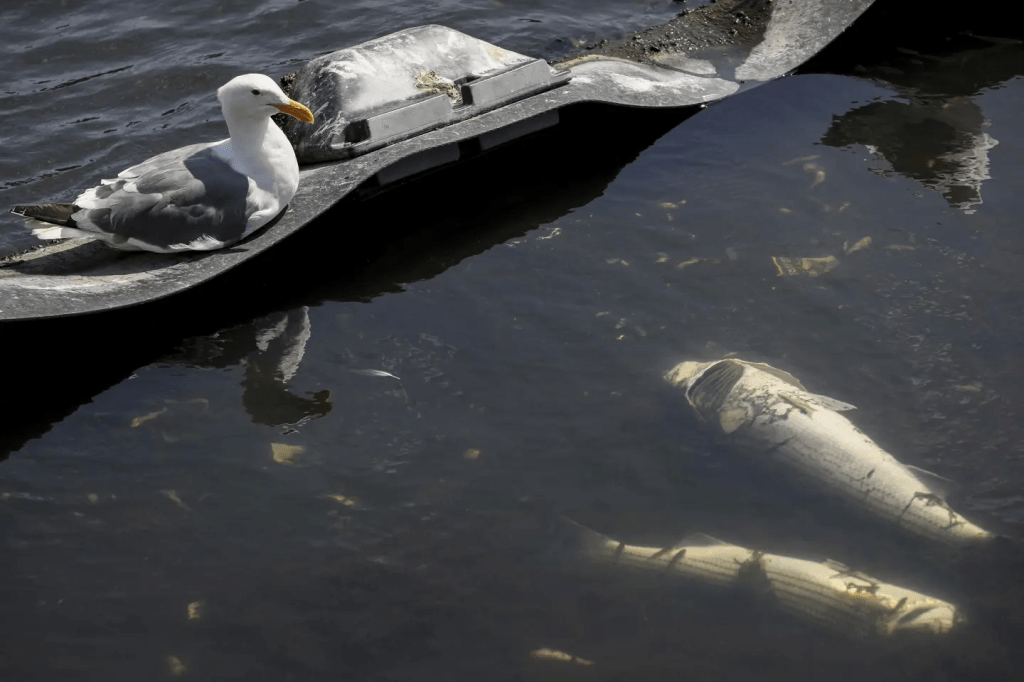
At Oakland’s Lake Merritt, a popular spot for joggers, walkers and those looking to be in nature, crews on Wednesday began removing dead crabs, bat rays, striped bass and other fish that began piling up on its rocky shores over the weekend.
The fish die-off at Lake Merritt and throughout the Bay Area may be due to a harmful algae bloom that has been spreading in the region since late July, said Eileen White, executive officer of San Francisco Bay Regional Water Quality Control Board.
“We normally have algae blooms during the summertime. But what’s unusual about this one is how large it is and the fact that there are fish kills,” White said.
Most algae blooms end after a week or so. But a triple-digit heat wave forecast for the holiday weekend may help the Bay Area’s grow even more, White said. She said that reports of dead fish started coming in last week.
“This was a natural occurrence of Mother Nature and so, we don’t know when it’s going to end,” she said
A microorganism called Heterosigma akashiwo formed a bloom first spotted in the Alameda Estuary, White said. It is present in the bay all the time, but scientists are trying to determine what caused it to spread so far and wide and for so many weeks.
They say a years-long drought has prevented stagnant water from flowing into the ocean and unseasonably warm and sunny weather may be helping the algae spread.
Jon Rosenfield, a scientist with the San Francisco Baykeeper conservation group, said high levels of nutrients like phosphorus and nitrogen in wastewater also drive the growth of algae blooms.
“The only lever that we have to control the problem is to reduce nutrients put into the bay from the 40 wastewater treatment plants that operate around the bay,” he said.
Rosenfield said sewage treatment plants are cleaning the water of solid material and bacteria, but they’re not designed to pull out nitrogen and phosphorus.
Treating the water for nutrients would cost billions of dollars, and those costs would be passed on to residents, White said. She said water districts are funding studies to understand the effects of nutrients that have been present in the water since people settled in the area.
“The goal is to make the appropriate regulations based on sound science,” White said.
Experts are also trying to determine what exactly is killing the fish.
Algae blooms produce a toxin that is lethal to fish and other marine life, and as they spread, bacteria in the water start to consume the algae. As it decays, it depletes the water of oxygen, leading the fish to suffocate, Rosenfield said.
“Which of those mechanisms is operating here, the toxin or the low dissolved oxygen? We just don’t know yet,” he said.
Algae bloom has been reported in Contra Costa and Marin counties to the north and San Mateo County to the west. In the South Bay, concentrations of chlorophyll — an indicator of algae density —measured on Aug. 10 were the highest observed in more than 40 years, White said.
In Oakland, people turned to social media to post photos of some of the thousands of dead fish at Lake Merritt, where visitors have started complaining about the stench.
“It doesn’t smell very good right now, so it’s a bit of a nuisance,” said Graham Webster, who jogs around the lake once or twice a week.
“But the bigger question is what’s happening to the lake and the bay? And what’s causing it? Is it our fault? Can it be fixed?” he asked.
White said the algae aren’t known to be toxic to people, but they can cause skin and eye irritation. Her office is recommending people and pets stay out of any water that looks reddish-brown.
Cely Aquino said she visits Lake Merritt regularly and seeing all the dead fish was sad.
“I saw a lot of the dead fish, and I saw a couple of stingrays that were dead also. It’s pretty sad,” she said. “But I figure nature it’s going to take care of it all.”
Health risks due to high lead levels in drinking water in a majority Black and impoverished Michigan city were not taken quickly to U.S. Environmental Protection Agency leadership, according to a report released Thursday.
The EPA Office of Inspector General said staff monitoring the state’s response to lead levels and compliance in Benton Harbor failed to “elevate” the issue of health risks to the city’s residents, per an EPA policy that encourages staff to do so. The issues met several EPA elevation policy criteria, including the appearance of a substantial threat to public health and that normal enforcement and compliance tools seemed unlikely to succeed in the short term, the report said.
In October 2018, the state notified the Benton Harbor water system it had exceeded 15 parts per billion in water samples — the federal threshold for taking action.
Those levels stayed high. In 2021, activists ramped up pressure for more action, and state leaders responded as the lead issue attracted national attention. State officials promised to rapidly remove the city’s lead pipes and instructed residents to switch to bottled water for basic needs like cooking and drinking.
Lead, which can leach from aging pipes into residential drinking water through taps, is a potent toxin that can damage the cardiovascular and reproductive systems. It is particularly harmful to children, causing lower IQ and behavioral problems.
The EPA’s 2016 Policy on Elevation of Critical Public Health Issues followed the lead-contaminated water crisis in Flint, Michigan. Flint, which was under state-appointed managers, used the Flint River for water in 2014 and 2015, but the water wasn’t treated the same as water previously supplied by a Detroit-area provider. As a result, lead leached throughout the pipe system.
Benton Harbor is about 100 miles northeast of Chicago. Federal auditors announced an investigation in February 2022 into how the government dealt with lead contamination of Benton Harbor drinking water. The probe followed a petition for federal help from groups that accused local and state governments of dragging their feet.
“Because the elevation policy was not used, the Office of the Administrator’s senior-level team did not have an opportunity to assess and recommend steps for resolving elevated lead levels in the Benton Harbor water system,” the report stated.
The EPA has disagreed with a recommendation that it determine how the policy can be more effective but did agree to develop and implement a strategy to help staff understand when and how to use the policy.
Cyndi Roper, senior policy advocate with the Natural Resources Defense Council, called the response in Benton Harbor “another abject failure of the EPA to protect an environmental justice community.”
“The EPA must do better to end the public health disaster linked to lead-contaminated drinking water, starting with issuing and enforcing a new federal lead and copper rule that will finally tackle the lead crisis, so no other community is poisoned by leaded tap water,” Roper said Thursday in a release.
About 87% of Benton Harbor’s roughly 9,100 residents are Black. The city’s median household income was about $24,000 in 2021, according to the U.S. Census.
Much of the city’s water distribution network is around 100 years old. The city’s water system has added corrosion control chemicals to prevent lead from leaching into the drinking water.Lead levels finally dropped below the 15 parts per billion action level in December 2021. Millions of dollars in state and federal funds have been used to replace thousands of lead service lines. After about a year — an incredibly fast timeline to replace lead pipes in any city — officials announced nearly all of Benton Harbor’s lead pipes had been replaced.
Japan has told the World Trade Organization (WTO) that China’s ban on Japanese seafood after the release of treated water from the Fukushima nuclear plant was “totally unacceptable”, the Japanese foreign ministry said late on Monday.
In a counterargument to China’s Aug. 31 notification to WTO on its measures to suspend Japanese aquatic imports, which started last month, Japan said it would explain its positions in relevant WTO committees and urged China to immediately repeal the action.
Some Japanese officials have signaled the country may file a WTO complaint, which the U.S. ambassador to Japan said last week the United States would support.
Japan will explain the safety of the released water at diplomatic forums, including the ASEAN Summit in Indonesia and G20 Summit in India this month, chief cabinet secretary Hirokazu Matsuno told reporters on Tuesday.
“Nothing is decided about a Japan-China leaders’ meeting,” added Matsuno, Tokyo’s top government spokesperson. Japanese Prime Minister Fumio Kishida and China’s Premier Li Qiang will attend the ASEAN and G20 summits, while Chinese President Xi Jinping is skipping both conferences.
In a separate statement on Monday, Tokyo’s foreign ministry said Japan has also asked China to hold discussions over the import ban based on the provisions of the Regional Comprehensive Economic Partnership (RCEP) trade pact.
Although marine products make up less than 1% of Japan’s global trade, which is dominated by cars, Japan exported about $600 million worth of aquatic products to China in 2022, making it the biggest market for Japanese exports, followed by Hong Kong.
Data on Tuesday showed China-bound exports of aquatic products fell for the first time in 2 1/2 years in July, dropping 23% year-on-year to 7.7 billion yen ($52.44 million).
Goods bound for China have faced stricter inspections since Japan announced its plan to release the treated Fukushima water, slowing down shipments.
To ease the pain of losing that seafood demand, Japan will spend more than 100 billion yen ($682 million) to support the domestic fisheries industry.
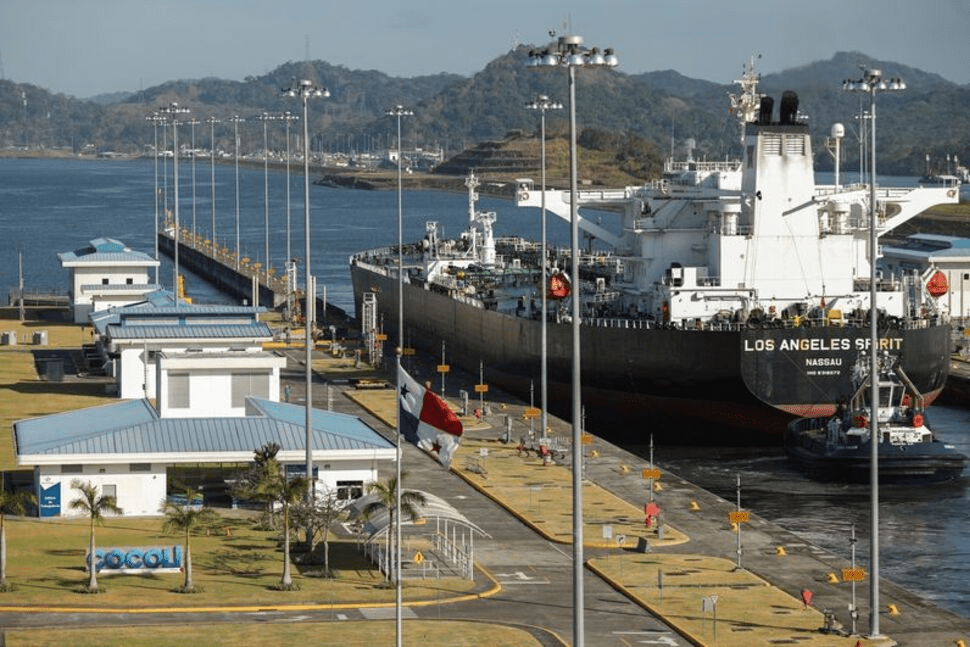
The Panama Canal’s water levels have not recovered enough as the end of the rainy season approaches and limits on daily transit and vessel draft will stay in place for the rest of the year and throughout 2024, the waterway’s authority said on Tuesday.
The restrictions, implemented earlier this year to conserve water amid prolonged drought, triggered a backlog of ships waiting to pass the key global waterway, which handles an estimated 5% of world trade, contributing to more expensive freight costs ahead of the approaching Christmas season.
The bottleneck at the canal connecting the Pacific and Atlantic Oceans has eased about 20% since last week, but waiting times to transit the waterway doubled last month from July in some vessel categories, while many ship owners have opted for alternate routes to avoid costly delivery delays.
The authority that manages the canal added in a statement that this week’s ship traffic represents a “normal” level for this season.
It noted that a month before the end of its 2023 fiscal year, the canal’s total vessel crossings already total nearly 800 more that what the canal authority’s budget had forecast.
The additional vessel crossings, which contribute to a total of more than 13,000 transits so far during the fiscal year, show strong demand by vessel owners.
But insufficient rainfall continues to negatively impact the Gatun Lake, which feeds the canal, lowering its water level to 24.2 meters (79.7 feet), versus 26.6 meters (87.41 feet) for the month of September in recent years.
Each vessel passing through the 50-mile (80-km) trans-oceanic waterway uses some 51 million gallons (193 million litres) of water from the lake.
At the end of the rainy season in November, the lake’s water level typically reaches some 27 meters (89 feet) and then drops to slightly below 26 meters (85 feet) after the dry season ends in April, according to the canal authority.
Experts have warned about maritime trade disruptions ahead of what is shaping up to be an even drier period next year. They argue that a potential early start to Panama’s dry season and hotter-than-average temperatures could increase evaporation and result in near-record low water levels by April.
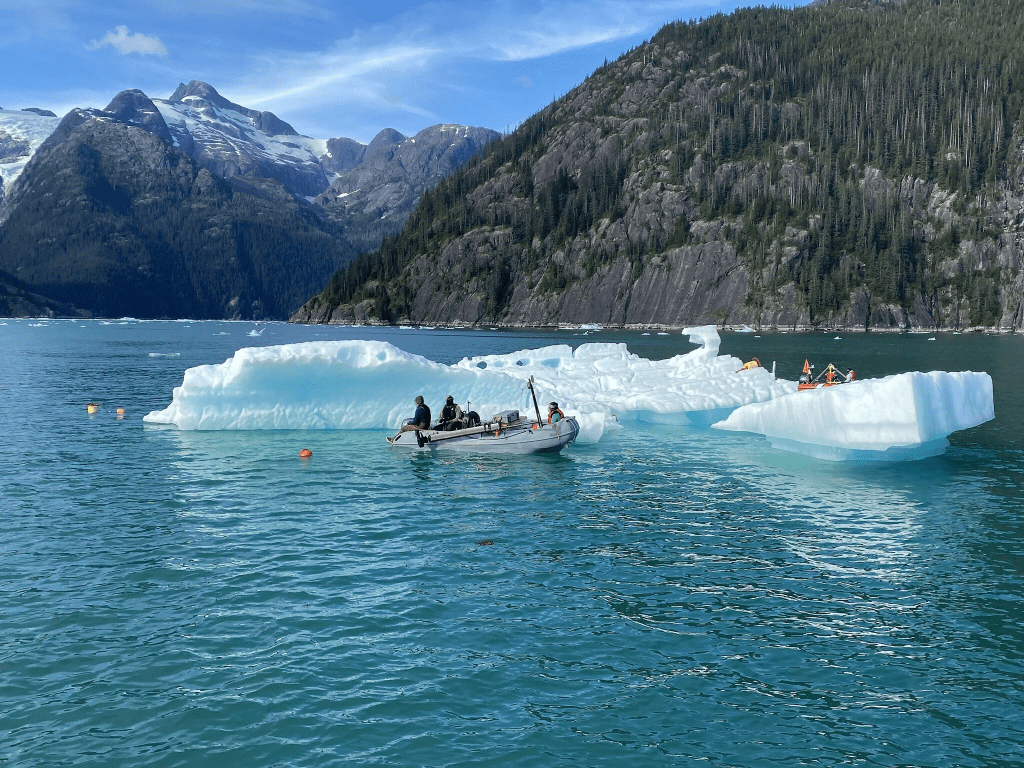
Published today in Nature Geoscience, the study shows that glacier ice, characterized by pockets of pressurized air, melts much more quickly than the bubble-free sea ice or manufactured ice typically used to research melt rates at the ocean-ice interface of tidewater glaciers.
Tidewater glaciers are rapidly retreating, the authors say, resulting in ice mass loss in Greenland, the Antarctic Peninsula and other glacierized regions around the globe.
“We have known for a while that glacier ice is full of bubbles,” said Meagan Wengrove, assistant professor of coastal engineering in the OSU College of Engineering and the leader of the study. “It was only when we started talking about the physics of the process that we realized those bubbles may be doing a lot more than just making noise underwater as the ice melts.”
Glacier ice results from the compaction of snow. Air pockets between snowflakes are trapped in pores between ice crystals as the ice makes its way from the upper layer of a glacier to deep inside it. There are about 200 bubbles per cubic centimeter, meaning glacier ice is about 10% air.
“These are the same bubbles that preserve ancient air studied in ice cores,” said co-author Erin Pettit, glaciologist and professor in the OSU College of Earth, Ocean, and Atmospheric Sciences. “The tiny bubbles can have very high pressures — sometimes up to 20 atmospheres, or 20 times normal atmospheric pressure at sea level.”
When the bubbly ice reaches the interface with the ocean, the bubbles burst and create audible pops, she added.
“The existence of pressurized bubbles in glacier ice has been known for a long time but no studies had looked at their effect on melting where a glacier meets the ocean, even though bubbles are known to affect fluid mixing in multiple processes ranging from industrial to medical,” Wengrove said.
Lab-scale experiments performed in this study suggest bubbles may explain part of the difference between observed and predicted melt rates of tidewater glaciers, she said.
“The explosive bursts of those bubbles, and their buoyancy, energize the ocean boundary layer during melting,” Wengrove said.
That carries huge implications for the way ice melt is folded into climate models, especially those that deal with the upper 40 to 60 meters of the ocean — the researchers learned glacier ice melts more than twice as fast as ice with no bubbles.
“While we can measure the amount of overall ice loss from Greenland over the last decade and we can see the retreat of each glacier in satellite images, we rely on models to predict ice melt rates,” Pettit said. “The models currently used to predict ice melt at the ice-ocean interface of tidewater glaciers do not account for bubbles in glacier ice.”
Right now, data from NASA attributes about 60% of sea level rise to meltwater from glaciers and ice sheets, the authors note. More accurate characterization of how ice melts will lead to better predictions of how quickly glaciers retreat, which is important because “it’s a lot more difficult for a community to plan for a 10-foot increase in water level than it is for a 1-foot increase,” Wengrove said.
“Those little bubbles may play an outsized role in understanding critical future climate scenarios,” she added.
The Keck Foundation, the National Science Foundation and the National Geographic Society funded the research, which also included Jonathan Nash and Eric Skyllingstad of the OSU College of Earth, Ocean, and Atmospheric Sciences and Rebecca Jackson of Rutgers University.
Gudrun Schmidt, an associate professor of practice in Purdue’s Department of Chemistry, and a team of researchers developed the formulations from zein, a protein found in corn, and tannic acid. A paper about the team’s research was published in the peer-reviewed journal ACS Applied Materials & Interfaces.
The adhesive formulations could be further developed and used in the restoration of coral reefs and have applications in the construction, manufacturing, biomedical, dental, food and cosmetic industries.
Stronger in water
Schmidt and her colleagues conducted underwater adhesive experiments on their formulations, using different surfaces and different waters, including seawater, saline solution, tap water and deionized water.
“Interestingly, the water type does not influence performance a great deal, but the substrate type does,” Schmidt said. “An additional unexpected result was bond strengths increasing over time when exposed to water, contradicting general experiments of working with traditional, petroleum-based glues. Initial adhesion underwater was stronger compared to benchtop adhesion, suggesting that water helps to make the glue stick underwater.”
Protective skin formed on the surface of the adhesives when placed underwater, which kept water from entering the rest of the material immediately.
“But once the skin was in place, it could be broken to induce faster bond formation,” Schmidt said.
The experiments also indicated maximum bonding at about 30 degrees Celsius, then another increase at higher temperatures.
Schmidt said the process to make the adhesive formulations is a short one.
“We can use inexpensive, sustainably sourced, plant-based materials to make gallons of glue within hours,” Schmidt said. “The adhesives are very simple to make in the lab or outdoors, everywhere on the planet.”
The demand for nontoxic formulations
Schmidt said other researchers are formulating adhesives that mimic the glues used by mussels, barnacles, oysters and sandcastle worms to adhere to the seafloor and other wet surfaces. Those best-performing formulations, however, are fully synthetic.
“Lengthy syntheses with the use of harsh chemicals may hold back their future development,” Schmidt said. “Nontoxicity, sustainably sourced materials and minimal environmental impact are increasingly in demand. Consequently, several groups have turned to developing new and remaking old adhesive systems using bioinspired or bio-based chemistry.”
The increased demand of nontoxic materials has led to creating adhesives for biomedical applications. The resulting glues have properties similar to soft tissue. Schmidt said that bio-based adhesives have further applications.
“Once the in vivo and biomedical realm is left behind, there is an entire world of other applications requiring metals, plastics, wood and inorganic substrates that need adhesives to work in the presence of water,” Schmidt said. “Food, oral and cosmetic applications are less restrictive when it comes to purity of starting materials. Food-grade polymers can often be used for making wet adhesives. We also are working on dental applications, trying to make bonds in this wet and challenging environment.”
Coral reef restoration
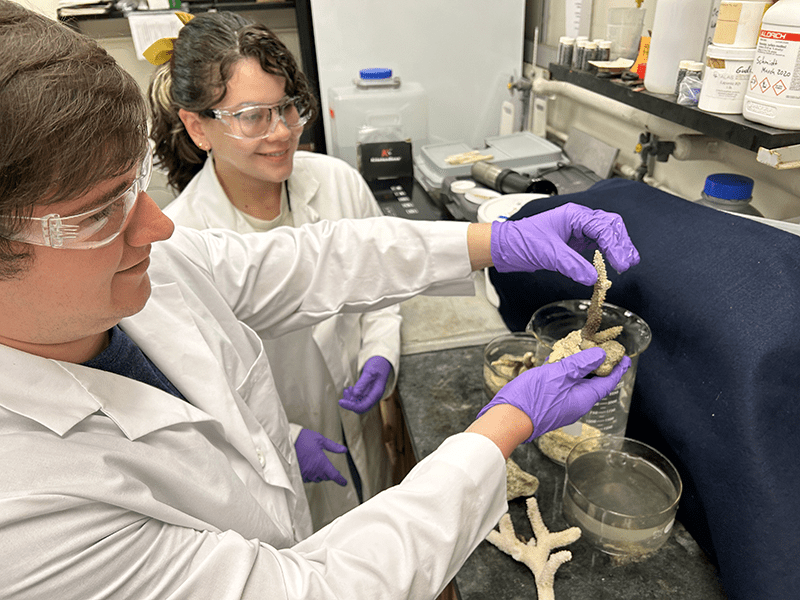
Schmidt said another particularly intriguing application for the patent-pending Purdue-developed adhesive formulations is the restoration of coral reefs.
“There are several major efforts, worldwide, planting young corals to replace those structures that are already dead,” Schmidt said. “A major hindrance to these efforts is lack of suitable underwater adhesives that work well for this application.”
Schmidt and her research team are working with the Coral Restoration Foundation, sending various formulations to be tested.
“We recently visited the Florida Keys to test a few formulations in bucketsful of ocean water,” Schmidt said. “It is great to see our work outside of the research lab and in the real, wet world.”
The Coral Restoration Foundation constantly searches for the most efficient and effective method of outplanting coral onto reef sites, said Phanor H. Montoya-Maya, coral restoration program manager at CRF.
“Having different alternatives means different species and habitats can be outplanted with positive results,” Montoya-Maya said. “Science collaborations like this allow us to test and fine-tune methods before mainstream restoration. Field preliminary results are very encouraging, and we’ll continue to provide feedback to Purdue researchers to ensure the final product is consistently successful across multiple restoration goals.”
Schmidt disclosed the adhesive formulations to the Purdue Innovates Office of Technology Commercialization, which has applied for a patent to protect the intellectual property.