In 1997 Union County in southern Arkansas faced a serious crisis: its key water source, the Sparta Aquifer, was declining by as much as two meters per year. This underground reservoir of water trapped within pores and fractures in rock was the county’s only supply, and it was disappearing.
“If we didn’t do something in five years or less, we were going to lose our water source,” says Sherrel Johnson, projects manager for the Union County Water Conservation Board, which formed in response to the crisis.
Just two years later the county’s water board instituted a new groundwater pumping fee, and citizens voted for a temporary tax to pay for $65 million worth of new infrastructure—to draw and treat water from the nearby Ouachita River instead. Today the part of the aquifer that once showed steep declines is now 36 meters higher than it was in 2004.
A study published on Wednesday in Nature suggests other places may need to look to Union County’s example. The new research shows that crucial aquifers around the world are drying up. And in 30 percent of such cases, the current drop-offs are happening faster than ever before. “Groundwater is declining rapidly, especially in dry places where cultivation is widespread,” says study leader Scott Jasechko, an assistant professor of water resources at the University of California, Santa Barbara.
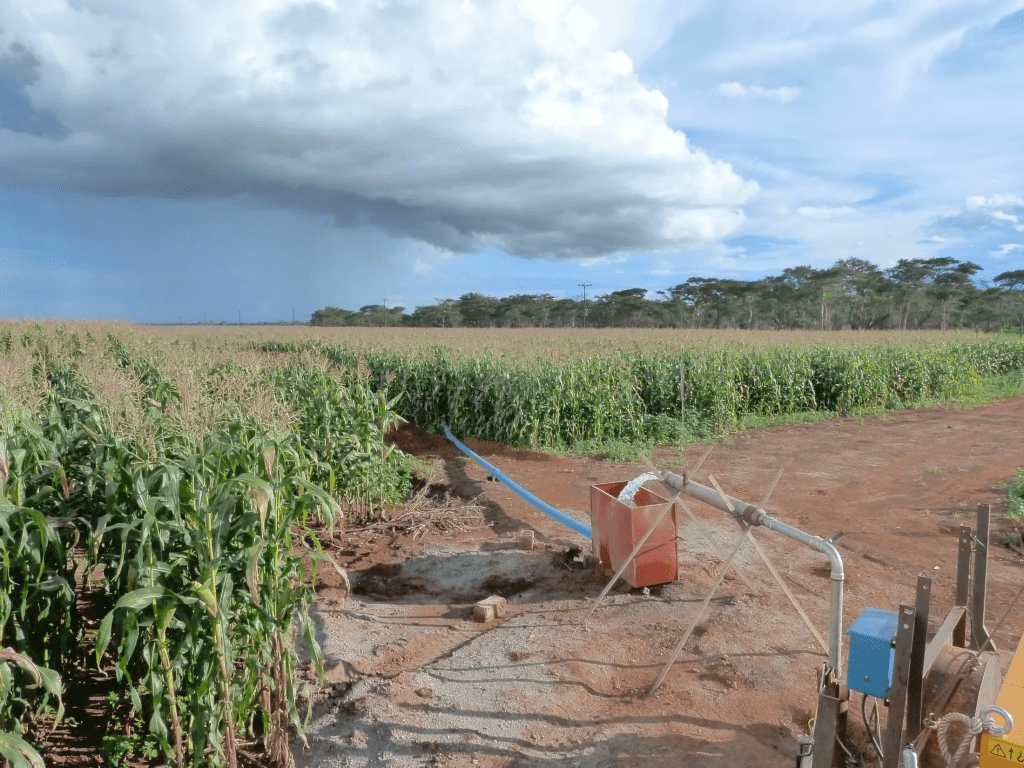
In the Great Plains, the Ogallala Aquifer (a massive underground reservoir stretching from Texas to South Dakota) is becoming depleted in many places as farmers draw on the region’s groundwater to irrigate their crops, especially in times of drought. In 2022 alone, for example, average groundwater levels across western and south-central Kansas dropped by 0.6 meter, according to the Kansas Geological Survey.
Many aquifers are monitored at wellheads, but scientists have long supplemented these data with more approximate satellite measurements to get a rough global picture of depletion. Until now, no one had combined detailed, on-the-ground monitoring with a worldwide scope, the authors say. Jasechko and his collaborators did just that by gathering wellhead monitoring data from 170,000 wells in 1,693 aquifer systems in more than 40 countries.
These data show that 36 percent of aquifers are losing water at more than 0.1 meter per year and that 12 percent are declining at more than 0.5 meter per year. Among aquifers for which there were enough data to compare current trends with the years 1980 to 2000, 30 percent show accelerating losses. The aquifers that are losing water tend to be in regions that are also experiencing declining precipitation over time. “During droughts, in drylands, humans tend to rely on groundwater more,” Jasechko says.
The news from the new study wasn’t all bad, however. In 20 percent of the aquifers that had been monitored long-term, declines are slowing rather than accelerating. In 16 percent, a declining trend has reversed. And in 13 percent, the aquifer has actually grown over time. “We are seeing a very complex picture,” says study co-author Mohammad Shamsudduha, a risk and disaster reduction researcher at University College London.
The findings show that groundwater depletion isn’t inevitable, Jasechko says. In the places where groundwater loss is slowing or where aquifers are refilling, these trends are usually caused by human decisions. In Bangkok, for example, new fees on private well pumping were instituted in the early 2000s; this reversed groundwater losses and slowed the massive city’s land subsidence problems. Outside of Tucson, Ariz., a project that began in 2008 now uses water from the Colorado River to refill the once struggling Avra Valley Aquifer.
Such changes can be controversial, says Johnson, who spearheaded the effort in Union County. “Paying for water was the toughest challenge,” she says, referring to the fact that industries that originally pumped water from the aquifer for free had to start paying a fee. But the infrastructure, built largely with county tax dollars and the water-pumping fee, now supplies the county’s main industries with river water, Johnson says, and that infrastructure has proven a boon for luring new development.
“You have to have trusted leadership,” she says, “and good science and tenacity.”
Israel’s military has begun injecting “high-flow” seawater into Hamas-built tunnels beneath the Gaza Strip as part of its attempt to “neutralize terrorist infrastructures.”
On 30 January, the Israel Defense Forces (IDF) confirmed that the plan to flood tunnels under the Gaza Strip, a strategy that has been the subject of rumours since December, is being implemented at a number of undisclosed locations. The IDF’s statement added that the move was a “significant engineering and technological breakthrough” and that locations were chosen so that “groundwater in the area would not be compromised.”
However, some water researchers are warning that flooding tunnels with seawater could have a devastating effect on Gaza’s already scarce freshwater supplies and might destabilize buildings. There are also concerns that flooding the tunnels could endanger many of the approximately 130 remaining Israeli hostages who were abducted by Hamas in its attacks of 7 October 2023. The hostages’ locations remain unknown. But one researcher& Nature spoke to says he suspects the impact of the flooding will be limited, because Gaza’s aquifer is already contaminated by seawater.
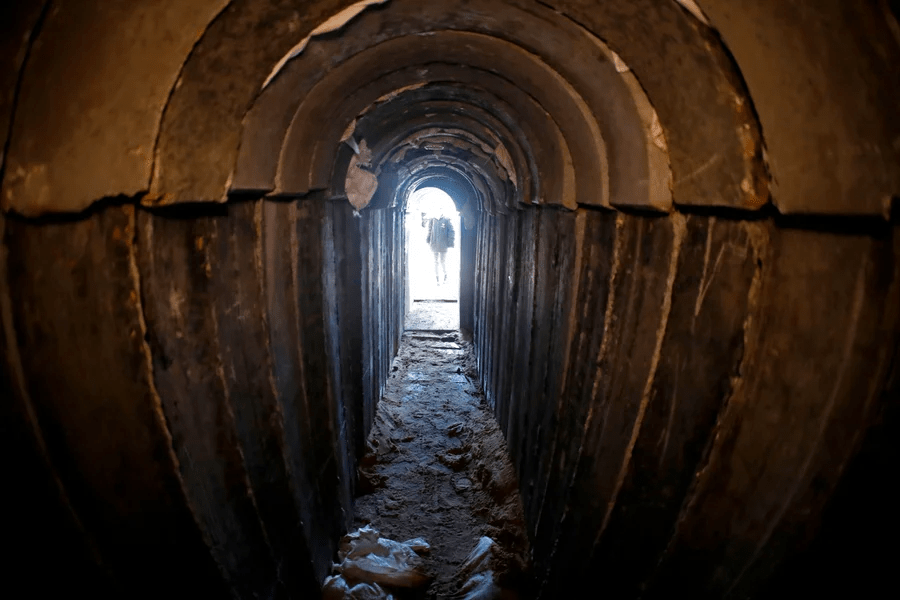
The tunnels are a “spider web” of damp passageways dug in sandy soil, former hostage Yocheved Lifshitz told the media after she was released last October. One tunnel is 50 metres deep, according to Israel’s Ministry of Foreign Affairs, and some have several entrance shafts and are reinforced with concrete and equipped with power cables and piping. The tunnels are probably used to store weapons, as well as for holding hostages captive. They extend to almost every corner of the crowded and devastated 363-square-kilometre Gaza Strip.
BIGGEST CONCERN
One of the biggest concerns is that seawater used to flood the tunnels will contaminate an important coastal aquifer, which lies between Gaza, Egypt and Israel and supplies nearly 80% of Gaza’s water.
Mark Zeitoun, a water engineer and director-general of the Geneva Water Hub in Switzerland, says that Gaza’s main source of drinking water is being contaminated. “If you put salty water into a freshwater source, it’s polluting, it’s contaminating, it’s poisoning,” he says.
There’s a possibility that the seawater, once pumped into the tunnels, will simply leak out, Zeitoun adds. “If you just try filling the tunnels with water, I assume that they’re not sealed well enough to hold any water. The water would drain out and into the aquifer,” he says.
Geographer Ahmed Ra’fat Ghodieh, based at An-Najah National University in Nablus in the West Bank, agrees that the aquifer is likely to become irreparably contaminated with salt water.
“If they flood these tunnels, then the seawater will penetrate the geological strata, towards the aquifer,” says Ghodieh. “Such action will have severe consequences on all aspects of life in Gaza — on agriculture, on soil, on infrastructure.” Ghodieh adds that the seawater could create sinkholes that destabilize the foundations of buildings.
But hydrologist Noam Weisbrod, who is dean of the Jacob Blaustein Institutes for Desert Research at Israel’s Ben-Gurion University of the Negev, says that those concerned that the entire coastal aquifer will be irreparably contaminated are probably overestimating the flooding’s effects. “I’m not sure that the environmental risk is as extreme as people want to believe,” he says. The impact of flooding would differ depending on where the affected tunnels are located, he adds.
The water level of Gaza’s coastal aquifer ranges from about 60 metres below the surface in the east to just a few metres deep near the coastline, according to a 2020 study published in the journal Water. More water is being drawn out of the aquifer than can be replaced naturally by fresh water, and as a result the aquifer is already being infiltrated by seawater.
Weisbrod’s reasoning takes into account the fact that, in areas close to the coast, the water in the aquifer is already saline. Moreover, he says, “large sections of the aquifer water are already contaminated from unregulated sewage systems, fertilizers and more”.
Weisbrod also says that Israel’s plan could have limited impact. The tunnel network “is not one big metro plan like in New York or in London,” he explains. “It’s not one big thing that is all connected. So, you’ll use a lot of effort and you’ll flood something quite limited, eventually. So maybe it’s not worth it.”
GAZA’S WATER CRISIS
The debate over the tunnels highlights a problem that existed before the flooding started: clean water is scarce in Gaza, irrespective of the extent to which the aquifer is contaminated by seawater pumping. In 2020, United Nations agencies estimated that 10% of the population had access to safe drinking water.
Some water is piped in by Israel and Egypt. A €10-million (US$10.9-million) seawater desalination plant funded by the European Union opened in Gaza in 2017, but it presumably cannot function without an electricity supply. Before the war, around half of Gaza’s electricity came from Israel, but, in October, the Israeli government cut off supplies.
Almost 1.9 million people have been displaced by the war, with many living in tents or on the streets in the southern Gazan city of Rafah. Following torrential rains in January, many are collecting drinking water in dishes and buckets, Ghodieh says. Others buy water from tanker trucks — low-quality water from the aquifer that has been desalinated by private companies — says David Lehrer, director of the Center for Applied Environmental Diplomacy at the Arava Institute for Environmental Studies in the Arava Valley, Israel.
When the war ends, Israel and Gaza need to start planning for a better water future, Lehrer says. In 2023, through a partnership with the Israeli company Watergen, the Palestinian non-governmental organization Damur for Community Development, and the Israeli Civil Administration, the Arava Institute installed five solar-powered atmospheric water generators at municipal health-care centres in Gaza. According to the Arava Institute, these can generate around 900 litres of clean drinking water per day by capturing humidity, condensing and filtering it.
This initiative, and other interim measures such as off-grid wastewater treatment, Lehrer says, will “provide a glimmer of hope that the situation will eventually improve.”
And yet, until the late 19th century, the San Joaquin Valley held a lake more than 100 miles long and over 30 miles wide.
Tulare Lake “was the largest body of fresh water west of the Mississippi River. It’s really difficult to imagine that now,” says Vivian Underhill, formerly a postdoctoral research fellow at Northeastern University with the Social Science and Environmental Health Research Institute.
Once, Underhill says, there was so much water that a steamship could carry “agricultural supplies from the Bakersfield area up to Fresno and then up to San Francisco”—a distance of nearly 300 miles.
The “ancestral lakes” and connecting waterways that made such a route possible have all but disappeared thanks to manmade irrigation, Underhill says.
Called “Pa’ashi” by the indigenous Tachi Yokut tribe, Tulare Lake was fed primarily by snowmelt out of the Sierra Nevada mountains, Underhill says, as opposed to rainfall. And because “there’s no natural outlet within the valley,” the water collects to form a lake.
To many traveling through the San Joaquin Valley today, it’s hard to imagine such a large body of water co-existing alongside such an arid landscape, Underhill says. But in the 1800s, “Fresno was a lakeside town.”
One unnamed prospector, she continues, reported that “there was driftwood piled in the trees of downtown Fresno” because of recent flooding.
Where did the water go?
The lake first began disappearing in the late 1850s and early 1860s, Underhill says, propelled by “the state of California’s desire to take public land and put it into private ownership.”
However, Underhill continues, “when we say ‘public land,’ that is historically indigenous land that the state of California blanket-proclaimed as ‘public.'”
“They really wanted to get [land] into private hands so that indigenous land claims—that were ongoing at that time—would be rendered moot by the time they went through the courts.”
This process was called “reclamation” and often entailed “either draining inundated land or irrigating desert land to create arable farmland. Reclamation really was a process across the entire U.S. west,” Underhill says.
If “people could drain that land,” she says, they would “be granted ownership of parts of that land. So there was a big incentive for white settlers to start doing that work.”
“It was a deeply settler colonial project” that “proceeded in fits and starts.”
The first time the lake fully disappeared was around 1890, when its “water essentially was [used to] irrigate all of the arid lands around that area.”
“Now the valley is crisscrossed by hundreds of irrigation canals, all of which were originally built to take that lake water and put it onto irrigated fields,” she says.
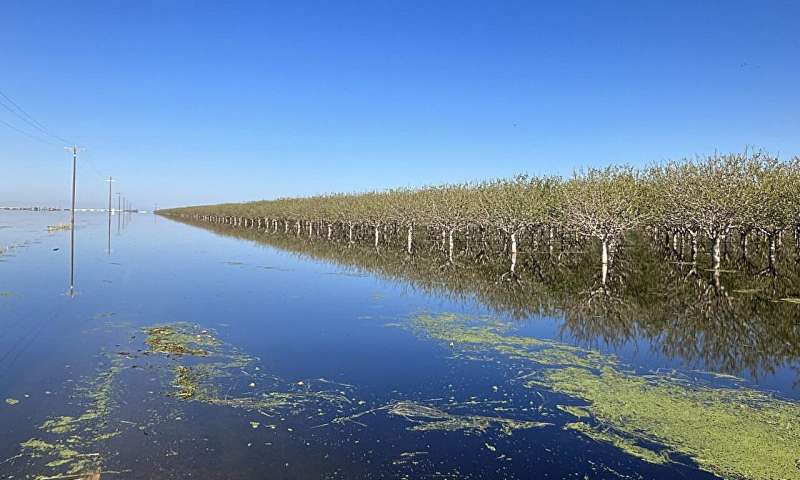
But in 2023, Tulare Lake—Pa’ashi—came back. “California just got inundated with snow in the winter and then rain in the spring,” Underhill says. “If you have a rain and snow event, the snow melts really fast.”
And all that snow and rain in the Sierra still runs into the depression where Tulare Lake once sat.
A complicated homecoming
Underhill’s quick to note that this isn’t the lake’s only return since the 1800s, however. “It happened in the ’80s, it happened once in the ’60s, a couple of times in the ’30s.”
The repercussions for the lake’s return are complex and layered, Underhill says, with sometimes oppositional effects between wildlife and the humans who live in the valley.
Before the lake’s disappearance into irrigation canals and watering spigots, “People talk about there being so many wetland birds,” Underhill says, “that if you startled them, when they lifted off it was like a giant clap that resounded across the landscape.”
Now, after less than a year back, “birds of all kinds—pelicans, hawks, waterbirds” are returning. And Underhill notes that “the Tachi also say that they’ve seen burrowing owls nesting around the shore,” a species described as “vulnerable or imperiled” by the U.S. Fish and Wildlife Service.
Tulare Lake was once part of the Pacific Flyway, Underhill says—it was an important stopover area for migratory birds. “The loss of that habitat has been a major issue in bird conservation and bird diversity.”
“Something that continues to amaze me is—[the birds] know how to find the lake again. It’s like they’re always looking for it.”
In addition to species returning—including fish and amphibians likely brought down from the Sierras by rainfall and flooding—winds off the lake can cool temperatures by as much as 10 or 20 degrees, Underhill says. A real benefit when San Joaquin Valley summers often spike well above 100°F.
Differential effects
When it comes to human occupancy in the Central Valley, Underhill says that there are three distinct groups that have been affected by the lake’s return.
The first is the Tachi Yokuts, for whom “the return of the lake has been just an incredibly powerful and spiritual experience. They’ve been holding ceremonies on the side of the lake,” Underhill says. “They’ve been able to practice their traditional hunting and fishing practices again.”
The other two groups that Underhill says have been most affected are those involved in agricultural production: the farmworkers on the one hand and the growers on the other—those who own the land and employ the workers.
The growers, “over the last five decades or so, have built a complicated system of flood prevention,” Underhill says. In the latest flooding, these measures “protected some of their farmland, which was essentially the lowest elevation part of the historic lake.”
But by cordoning off this low-lying farmland with canals and weirs, it was the surrounding communities of workers that have now been flooded by Tulare Lake.
Many of these farmworkers “don’t speak English or are procedurally very distant from the state,” Underhill says. Unfortunately, they are also the ones who “experience the most personal, place-based impact in terms of having their housing flooded [or] losing their homes entirely.”
Looking out for the lake
“Most of the news coverage about this time talked about it as catastrophic flooding,” Underhill says. “And I don’t want to disregard the personal and property losses that people experienced, but what was not talked about so much is that it wasn’t only an experience of loss, it was also an experience of resurgence.”
She points to the return of native wildlife as one example, and to the Tachi’s ability to practice their traditions on the water.
Efforts are already underway to drain the lake once more, and Underhill expects it to remain in some form for about two more years—although new atmospheric river events over California this year could complicate that prediction.
“Under climate change,” Underhill says, “floods of this magnitude or higher will happen with increasing frequency.”
“At a certain point, I think it would behoove the state of California to realize that Tulare Lake wants to remain. And in fact, there’s a lot of economic benefit that could be gained from letting it remain.”
Of what happens next, Underhill says that “this landscape has always been one of lakes and wetlands, and our current irrigated agriculture is just a century-long blip in this larger geologic history.”
“This was not actually a flood. This is a lake returning.”
A recent study found bottled water contains far more pieces of plastic — tiny bits known as microplastics and even more minuscule nanoplastics — than previously estimated. The findings raise questions about potential health concerns, but experts say there some ways to reduce your exposure.
Just how much plastic are we talking about? The average liter of bottled water contains around 240,000 detectable plastic fragments, researchers found in the study, published Monday in the journal Proceedings of the National Academy of Sciences.
What are nanoplastics and microplastics?
Micro- and nanoplastics are both tiny fragments of plastic which just differ in size. Microplastics are small plastic pieces less than 5 millimeters long. These have been measured in large quantities in previous studies.
In the latest study, researchers also examined nanoplastics, which are particles less than 1 micrometer — a size “previously invisible under conventional imaging,” they wrote. For reference, the diameter of a human hair is about 70 micrometers.
They were able to find nanoplastics by probing water samples with lasers that were tuned to make specific molecules resonate.
They found that nanoplastics made up 90% of the plastic particles detected in the water samples, while microplastics accounted for the other 10%.
In response to the study, the International Bottled Water Association noted that there “currently is both a lack of standardized (measuring) methods and no scientific consensus on the potential health impacts of nano- and microplastic particles. Therefore, media reports about these particles in drinking water do nothing more than unnecessarily scare consumers.”
Can you avoid plastics in water?
It’s very hard to avoid this kind of nanoplastic exposure, says Dr. Céline Gounder, a CBS News medical contributor and editor-at-large for public health at KFF Health News. This is because plastic can be found in any beverages we consume from plastic bottles, and it’s in our food supply and in the environment as well.
One basic step you can take? Avoid plastic packaging when possible. “That will help reduce some of the risks,” Gounder said on “CBS Mornings.”
“Don’t microwave your food in plastics,” she advised. For food storage, “Try to use containers like glass or stainless steel. At least that’ll help reduce your exposure a little bit.”
Since some water filters can actually introduce other plastics, Gounder says, she suggests most people go straight to their tap for drinking water.
“Tap is generally going to be safe unless you have an area where there’s lead pipes or something like that,” she said.
Previous research has also found microplastics present in tap water, though far less than in bottled water.
Are plastic water bottles bad for you?
Researchers are unsure just how risky microscopic pieces of plastics are for people — it is a subject of ongoing research.
The International Bottled Water Association notes that there is “no scientific consensus on potential health impacts.”
The World Health Organization said in 2019 that potential hazards associated with microplastics come in three forms: from the particles themselves, the chemicals that make them up, and “microorganisms that may attach and colonize on microplastics, known as biofilms.”
“We don’t know if the plastic itself can cause health effects, but they are bonded to, or combined with, other chemicals like phthalates, for example, which are what make plastic more flexible,” Gounder explains. “So when you get these tiny pieces of plastic, you’re also getting exposed to these other chemicals.”
These chemicals, known as “endocrine disruptors,” can mimic things like estrogen and have hormonal effects.
“Those hormones or higher exposures to those kinds of hormones can be associated with anything from diabetes, to neurocognitive effects in little kids to cancer. So that is why we have some real concerns about these exposures,” Gounder said.
The study’s researchers also note that “nanoplastics are believed to be more toxic since their smaller size renders them much more amenable, compared to microplastics, to enter the human body.”
Beizhan Yan, an environmental chemist at Columbia University, also believes there is cause for concern.
“When they are getting into the nano size, they can potentially get into the blood and then they can be transported to the vital organs,” he told CBS News.
MEXICO CITY (Reuters) -Frustrated Mexico City residents have been protesting weeks of water shortages, with officials warning of “unprecedented” low levels in a main system that supplies millions of people.
The bustling metro area of 21 million people – one of Latin America’s largest cities – is struggling after years of low rainfall blamed on climate change, as well as chaotic urban growth and outdated infrastructure.
In the community of Acambay, about 80 miles (130 km) outside the Mexican capital, protesters forced open the gates of an office of Mexico’s National Water Commission (Conagua), breaking windows and ripping shingles off the roof, local media reported.
In the Azcapotzalco neighborhood of Mexico City, residents lined up to fill buckets and trashcans with water piped from a truck.
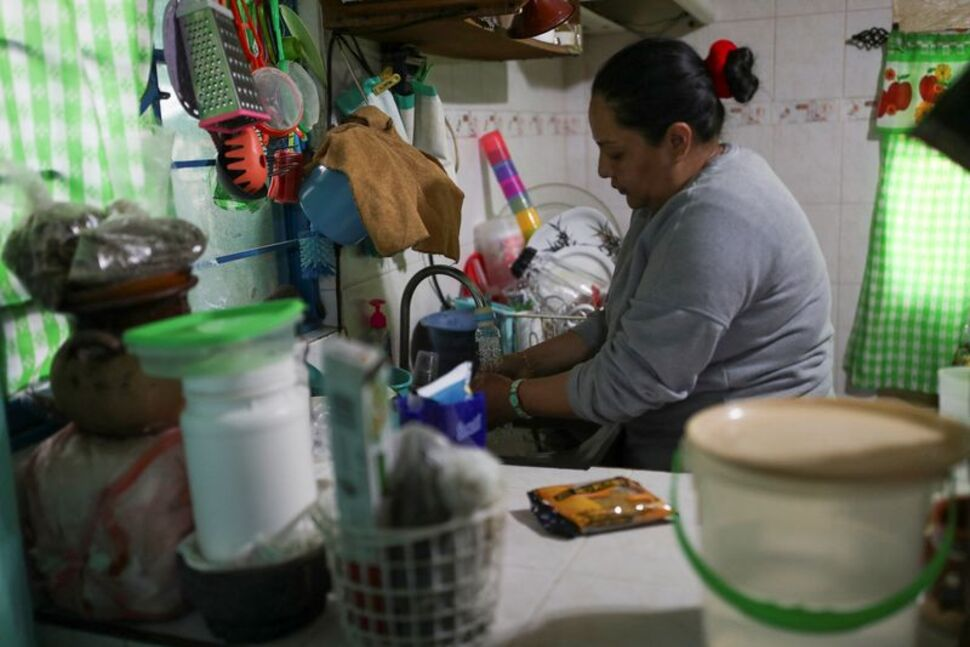
Azcapotzalco resident Maribel Gutierrez said she had been without water at her home for more than a month. Neighbors have started fighting over the limited supplies, residents said.
“I think they should be empathetic,” Gutierrez said of government officials. “We understand there was a serious water problem, but they must understand that water is vital for everyone.”
The Mexican capital, situated in a high-altitude valley and built on a former lake-bed, has struggled to supply its residents for years. It relies mostly on water pumped from its underground aquifer and reservoirs outside the city to meet demand.
Officials from Mexico City’s water utility SACMEX have said the Cutzamala System, a network of pumping plants, dams and other infrastructure that is the source of water for about 6 million people, is the most stressed it has ever been. They have asked residents to change habits in order to conserve as much water as possible.
“Due to … the number of residents, plus the population that comes to work in our city, it is in an unprecedented condition. It is something that we had not experienced during this administration, nor in previous administrations,” said Rafael Carmona, director of SACMEX.
The Cutzamala System was at 39.7% capacity on Jan. 29, down from about 41% in December and 54% this time last year, government data show.
Mexico City gets at least half its annual rainfall from the North American Monsoon between May and August. With recent seasons drier than usual, the city’s reservoirs are now depleted with no chance at rebounding until the summer months, said Andreas Prein, an atmospheric scientist for the NSF National Center for Atmospheric Research in Boulder, Colorado.
“In Mexico, you have to wait until May or June until you can really get a significant boost of precipitation to have a chance to recover water in the reservoirs,” Prein said.
The situation puts Mexico City and other major world capitals at risk for the so-called “whiplash effect,” Prein said – when a city experiences a rapid swing to wet conditions that can spark flooding.
“The swings are getting more extreme due to climate change,” Prein said. “This is what we see on a global scale.”
Seventeen landfills across England are known to be producing a highly toxic liquid substance containing some banned and potentially carcinogenic “forever chemicals”, in some cases at levels 260 times higher than that deemed safe for drinking water, it can be revealed.
However the government says it does not know where these landfills are.
Over a 10-month period from 2021 to 2022, consultants working for the Department for Environment, Food and Rural Affairs (Defra) and the Environment Agency were asked to take samples from a “number of different operational and closed landfills” developed between the 1960s and the present day in order to provide an “overall picture” of the chemical substances found in the landfills’ leachate.
The results of the sampling, published in an Ends Report investigation and shared with the Guardian, reveal that in one landfill, the total sum of per- and polyfluoroalkyl substances (PFAS) in the raw leachate sample was 105,910 nanograms a litre (ng/l).
PFAS are a group of about 10,000 human-made chemicals used in industrial processes, firefighting foams and consumer products. They are known as “forever chemicals” owing to their persistence in the environment.
In England there are no restrictions on the total sum of PFAS allowed in drinking water, but the Drinking Water Inspectorate’s guidelines allow levels of PFOS and PFOA – two of the most widely used and studied types of PFAS – in drinking water at up to 100 ng/l. In the US, the legal limit is 0.004ng/l for PFOA and 0.02 ng/l for PFOS.
In one sample PFOA was recorded at 26,900 ng/l – 260 times higher than the current guidance for safe levels in drinking water in England.
PFOA is considered to be toxic above certain levels and has been linked to a range of diseases in humans including kidney cancer, testicular cancer, hypertension, thyroid disease, ulcerative colitis, high cholesterol and reduced response to vaccines.
According to the Environment Agency’s own definition, landfill leachate is a “potentially polluting liquid” which “unless managed and eventually returned to the environment in a carefully and controlled manner, may cause harmful effects on the groundwater and surface water that surround a landfill site”.
Although the quantities of PFAS found in each sample varied – with the lowest total recorded being 79 ng/l – the average across all the samples was 19,497 ng/l.
The data provided to Ends revealing the high levels of PFAS in the landfill leachate did not include location information, meaning it is not possible to assess their potential to contaminate drinking water sources.
When queried, the Environment Agency and Defra said they did not know the locations of these landfills because the contractors provided the government with an anonymised dataset.
This, they said, was because the purpose of the study was to “build an initial nationwide (England) picture of substances in landfill leachate that are known to be or suspected to be harmful to the environment”. They said the “study was not intended to carry out monitoring for the purpose of compliance regulations”.
An Environment Agency spokesperson said none of the landfills assessed “found this leachate being discharged directly into the environment”. They added that the agency was “working closely with the landfill industry to deepen our understanding of chemicals and any challenges they pose”.
“This is a hugely important study that is now informing our longer-term approach to managing risks to the environment. Defra will be publishing a report in due course.
“The Environment Agency wants to provide government with really compelling advice, fully evidenced, on the scale of the PFAS challenge and how it may be dealt with. This study is a very useful first step but more work is essential.
“The research is not intended as regulatory monitoring – as such the names and site locations were not required for this particular work, which was carried out by a contractor on our behalf.”
However, the admission that the locations of the landfills are not known to Defra and the Environment Agency has shocked experts. Dr Shubhi Sharma, scientific research assistant at campaign group Chem Trust, said it was “extremely worrying” that the Environment Agency “claims not to know the locations of landfills where high levels of PFAS have been found in leachate”.
“How can action be taken by the Environment Agency and others to deal with the contamination of local groundwater and soil if they don’t know the source of it? Workers, local residents and businesses have a right to know if their workplace or local area is polluted with toxic chemicals,” she added.
Penelope Gane, the head of practice at campaign group Fish Legal, said: “You would have thought that someone in the Environment Agency would be sitting up and taking notice with PFAS readings coming back hundreds of times higher than safe limits for drinking. What exactly is stopping the agency going back to its contractors and asking for the location of these sites?”
While it is impossible to say where the 17 problem landfills are located, there are multiple pollution pathways associated with landfill leachate which are well known to environmental experts.
The Environment Agency has said that most of the sites targeted by the survey were operational landfills, receiving household and commercial waste which have containment systems to prevent leachate escaping into the ground or groundwater.
However, the Environment Agency says in its guidance that “even the best-engineered landfill sites will leak to some extent” and states that “while it is possible that the best of engineered landfill sites will contain and control leachate with minimal leakage, there is always a probability that some failure in engineering will occur”.
Landfills that are no longer operational have long been a concern owing to their potential for contamination. These landfills typically have no leachate or gas containment and limited or no records of the source, type, or volume of waste stored.
According to Kate Spencer, professor of environmental geochemistry at Queen Mary University and expert in historic coastal landfills, “if the landfills aren’t lined then they are almost certainly leaching those chemicals directly into the environment”.
Spencer said that when assessing the risk posed by these landfills it was important to think about the likelihood of people coming into contact with these concentrations. But to do that, you would need to know what the pathways are.
“If you were to tell me that one of these sites was a historic unlined site, and it was in close proximity to groundwater or to a river, and if you were to tell me that that groundwater or that river was also a drinking water source, then that’s concerning,” she said.
From solar panels that produce water to ‘self-filling’ coffee machines and water coolers, technology companies are putting a new spin on a centuries-old technique.
In the dry, desert air of Las Vegas, it seems strange to be talking about a plentiful source of water all around us.
Southern Nevada is in the grip of one of the worst droughts it has experienced in recorded history, leading to water shortages and restrictions on use. So, in water-stressed areas such as this, the prospect of wringing water from thin air is an appealing prospect. And it is exactly what Cody Friesen is trying to do.
Friesen, an associate professor of materials science at Arizona State University, has developed a solar-powered hydropanel that can absorb water vapour at high volumes when exposed to sunlight.
It is a modern-day twist on an approach been used for centuries to pull water from the atmosphere, such as using trees or nets to “catch” fog in Peru, a practice that dates back to the 1500s and is still being used today.
Amid the flashy transparent televisions and electric vehicles at the Consumer Electronics Show (CES) in Las Vegas in January, there were a few start-ups claiming to have new ways of exploiting this ancient, and often overlooked source of clean drinking water. And with the help of artificial intelligence, they’re finding ways of pulling even more water out of the air.
Friesen founded his own company Zero Mass Water in 2014 following his research on solar-powered hydropanels. Today the company is called Source Global, operates in more than 50 countries and has a private valuation of more than $1bn (£800m).
The panels work by using sunlight to power fans that pull air into the device, which contains a desiccant material which absorbs and traps moisture. The water molecules accumulate and are emitted as water vapour as the solar energy raises the temperature of the panel to create a high-humidity gas. This then condenses into a liquid before minerals are added to make it drinkable.
“That’s how we’re able to create water in most places in the world, even when it’s very dry,” says Friesen. “We’re headquartered in Scottsdale, Arizona, which is sub-5% relative humidity in the summer and we’re still making water. It’s a uniquely efficient and low-cost approach that enables us to go places where nobody else can go.”
Friesen’s goal is to democratise access to water for people with few options, such as rural and tribal communities that don’t have electricity, and regions devastated by natural disasters. Among Source’s customers is a sub-Saharan school in Africa where girls once had to trek for hours a day to find fresh water, and now can spend their time learning instead.
A panel costs about $2,000 (£1,500) and lasts at least 15 years, according to Friesen. But advancements in artificial intelligence have taken yields to the next level with constant monitoring of data in terms of changing conditions, humidity, temperatures, sunlight and usage to extract the maximum amount of water, says Adam Sharkawry of Material Impact, a venture capital company that has invested in Source Global.
“These panels are constructed to create four to five litres of drink per panel per day,” he says. “But with AI and machine learning algorithms, these numbers can go much higher, maybe aspiring towards seven, eight, nine. That makes it even more effective and more cost efficient.” Yield however is highly-dependent on weather patterns and sun exposure, caveated Source.
Friesen believes his hydropanels could even make drinking water one day available on Mars where the atmosphere averages 1% water vapour. “You’d have to engineer it differently, but there is no reason why you couldn’t take that water vapor, absorb it into a material that would be appropriate for that atmosphere, and then use the power of the Sun to respire that water vapour and produce liquid water,” he says.
Coffee wizardry
There are some who are looking to use similar techniques to appeal to a very different market. Water dispenser company Kara Water made a splash at CES winning an innovation award last year with a $4,899 (£3,800) designer water cooler they say produces up to 10 litres of water a day by using desiccants to pull moisture from the air.
In 2024, the start-up introduced the Kara Pod, a coffee machine they claim can brew a bottomless cup by continuously refilling itself with water extracted from the air.
Source Global and Kara Water are not alone in their pursuit of air-to-water solutions. In other parts of the world, considerable competition is brewing. Canadian company Rainmaker is marketing products that can harvest up to 20,000 litres per unit per day. Austria’s Phantor–Imhotep Industries says it can get 10,000 litres a day. Atmospheric Water Solutions has an air-to-water dispenser that is also an air purifier and dehumidifier. Atmospark is even marketing a mobile device for water-on-the-go, while rivals Watergen have their own device coming soon.
It’s too early to say whether these devices will live up to their promise, but the prospect of a truly bottomless cup is hard not to find appealing.
In winter 2021, more than 150,000 people living in Jackson, Miss., were left without running water.
Faucets were dry or dribbling a muddy brown. For weeks, people across the city lost the water they normally relied on to drink, cook and bathe. With no way to flush their toilets, some parents sent their children into the woods to relieve themselves. Businesses closed. Mississippi’s capital effectively shut down.
The following year, at the height of Mississippi’s sweltering summer in August 2022, it would all happen again.
Each time Jackson faced a water crisis, local and state leaders cast blame in familiar directions. Lawmakers criticized city officials for ignoring leaky pipes and failing to collect payments from customers. City officials pointed to Jackson’s shrinking population and decades of economic decline. And they said state officials, mostly white and Republican, had starved the mostly Black, Democratic city of resources.
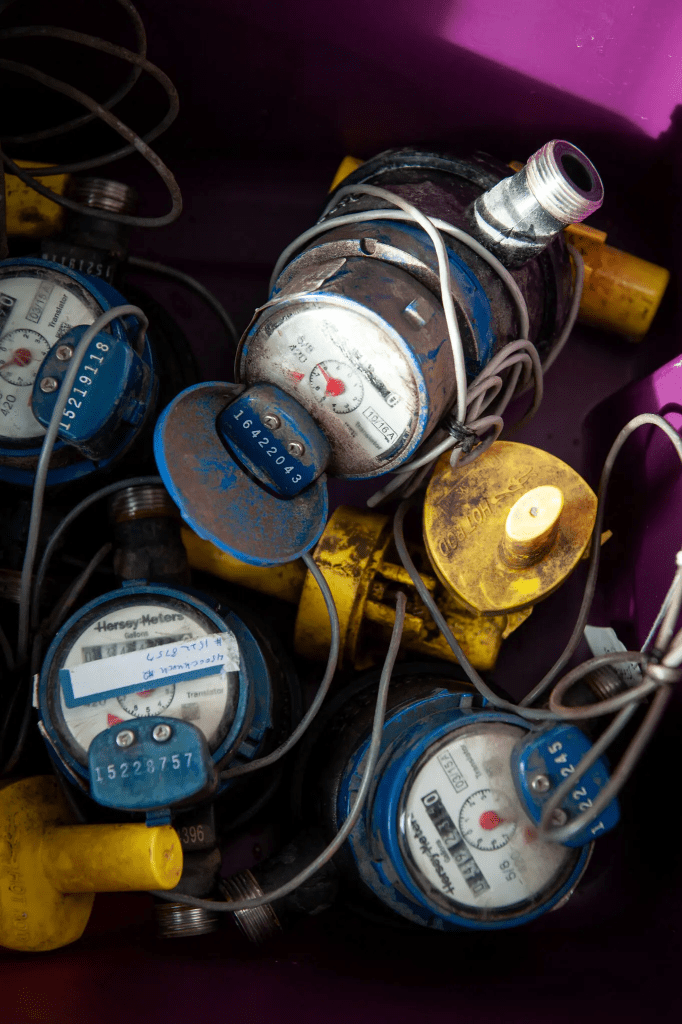
But the final blow was delivered by Siemens, a giant German corporation that had swept into town in 2010, boldly promising to install modern water meters that would boost revenues and return Jackson’s water system to a moneymaking enterprise that could afford to fix its crumbling infrastructure.
Siemens, better known for building power plants and high-speed trains, failed to deliver on its promises. Jackson found itself with many meters that didn’t work and wildly inaccurate water bills it couldn’t collect.
Siemens returned the $90 million it had been paid for the project. But the damage was done. Jackson was out more than $450 million in fees and lost revenue. It had no way to repair failing equipment and aging pipes that left city water unsafe to drink and ultimately led to a federal takeover of the water system in December 2022.
The outlines of Siemens’s role in Jackson’s water issues were laid out publicly in 2019, when the city sued the company. But Jackson was not the only Mississippi city that fell victim to the promise of easy money.
A yearlong New York Times investigation, drawing on thousands of pages of government records and interviews with city officials across the state, reveals how Siemens and other corporations went from one small, cash-strapped town to the next making grand promises to modernize water systems and boost revenues. It also sheds new light on the involvement of a state agency that was supposed to vet the deals.
In town after town, salesmen lured city officials who had little expertise in water meters with gee-whiz technology and complicated cost-saving algorithms. They said the meters could be installed at no cost to taxpayers and offered cash-back guarantees.
Even when meters started failing in large numbers and cities complained they were on the verge of financial disaster, the companies kept selling their services.
For nearly a decade, three companies — Siemens; the Mississippi-based McNeil Rhoads, started by a former Siemens salesman, Chris McNeil; and the North Carolina water meter manufacturer Mueller — crisscrossed the state signing multimillion-dollar deals in cities desperate for money.
Mr. McNeil pitched most of the deals, first for Siemens, then for his own company. He claimed that Mueller’s “smart” meters would be so accurate and efficient they would more than pay for themselves. In accordance with state policy at the time, every project was reviewed by the Mississippi Development Authority, an agency run by executives appointed by the governor.
From 2009 to 2017, at least 10 Mississippi cities signed contracts with the companies to install smart meters or other new technology. All but one have reported problems, and at least four have sued to recoup money they paid to Siemens, McNeil Rhoads or Mueller. Three of those suits are still pending.
Siemens and McNeil Rhoads, competitors that pitched the projects and acted as project managers, hired contractors who installed many meters improperly, according to officials in Jackson, McComb and Moss Point. In some cities, the two companies also struggled to link meters to the home office or to merge a new billing system with an old one.
Officials in at least eight Mississippi cities said they had problems with Mueller’s smart meters, which sometimes didn’t measure accurately because of faulty parts or batteries that died sooner than promised. Water departments in other states, including California and Missouri, have reported similar problems with Mueller meters over the past decade.
McComb, a city of 12,000 people south of Jackson, signed the first Siemens water meter contract in Mississippi. Mayor Quordiniah N. Lockley, city manager at the time, said McComb agreed to pay the company $10 million to install 6,000 smart Master Meters.
But contract workers hired by Siemensput them in backward and missed deadlines to install the antennas that the meters needed to communicate with a central office, Mr. Lockley said. Then some customers saw their water bills hit as much as $1,000 per month, with no obvious explanation.
Mr. Lockley said he called a friend, whom he declined to name, on the Jackson City Council and warned him not to go forward with the developing Siemens deal there.
He said he had one message: “Run.”
“Just because they come in a suit and tie doesn’t mean they’re not selling snake oil,” Mr. Lockley said in an interview.
Even as lawsuits and complaints from customers mounted, the companies continued making the same promises, and state and city officials continued approving contracts.
Jackson ultimately signed a deal with Siemens to install Mueller meters, the largest contract in the city’s history. Officials in Cleveland, a small city in the Mississippi Delta, inked a deal with Siemens for Mueller meters as well. Columbus, Meridian and Moss Point — all largely Black cities of fewer than 35,000 people — hired McNeil Rhoads to install Mueller meters.
Officials in some of the cities say they have been financially crippled.
In a letter to the development authority and the state attorney general, Jamie Lee, the city attorney for Cleveland, wrote that hundreds of meters were malfunctioning and the issue “could lead Cleveland into a major financial deficit if not addressed immediately.” She asked for “the assistance of your two offices in achieving a resolution with Siemens.”
Ms. Lee said she never received a response.
n a statement that did not address complaints by other Mississippi cities, a Siemens spokeswoman, Annie Satow, said the company had invested significant work in Jackson to “help navigate persistent challenges outside the company’s control,” including “substantial assistance beyond contractual requirements” with the billing system.
“Siemens acted in good faith, worked cooperatively with city personnel and was transparent and responsive to oversight by the city’s administration and Department of Public Works,” she wrote.
Mayor Chokwe Antar Lumumba of Jackson said that while he couldn’t discuss the specifics of the deal, Siemens was not entirely to blame. Jackson, he said, willingly entered into a bad agreement. He declined to elaborate, and his office did not respond to repeated requests for an interview. Since the federal takeover, which came with an infusion of $600 million and a third-party manager to run the water system, leaks are being repaired and citywide boil-water notices have drastically diminished.
Mr. McNeil did not return numerous calls seeking comment. A Mueller spokesman and other executives did not respond to repeated calls and emails.
Records show that Siemens and Mueller made attempts to replace or repair some meters in the cities where problems arose, but the cities still lost money and some, including Jackson, McComb and Moss Point, had to pay to replace meters or other technology on their own.
Reached by phone, Glenn McCullough, executive director of the Mississippi Development Authority from 2015 to 2020, said he had not been aware of widespread problems with Siemens, McNeil Rhoads or Mueller. He referred questions to the agency’s spokeswoman, Tammy Craft, who declined to comment.
“We can’t speak on this any further, since no one involved in reviewing these contracts back-when is at M.D.A. anymore,” Ms. Craft wrote.
But she noted that in 2017, state lawmakers passed a bill ending M.D.A.’s oversight of such contracts.
A promising solution for an ailing system
At the time Jackson was considering a deal with Siemens, the water industry was in the midst of a major transition. New technologies had made it possible for sensors to more accurately measure water use. Smart meters could eliminate the need for meter readers to visit homes to calculate people’s water bills, a huge potential savings for utility departments.
Manufacturers, including Mueller, saw the technology as a critical part of their future. But only if they could convince municipal water departments it was worth spending millions of dollars to replace old equipment. In financial statements filed with the Securities and Exchange Commission in 2015, Mueller described water utilities as slow adopters of the technology because of installation costs.
The water industry found a solution in the growing effort to make public agencies and schools more energy-efficient.
As far back as the 1980s, the federal government had been supporting partnerships with private companies to retrofit buildings with more efficient equipment.
Under energy performance contracts, municipalities could borrow money and use it to hire private contractors to replace old light fixtures, air-conditioning units and other appliances. Savings from lower electric bills would then be used to pay off the debt, allowing cities to invest in improvements at no real cost to taxpayers.
The contracts had made Siemens tens of millions of dollars in Mississippi alone and allowed a financially struggling state to afford equipment upgrades that otherwise might have been out of reach.
Then, two years before Siemens pitched a plan to help Jackson fix its ailing water system, the Mississippi attorney general’s office issued an opinion that helped pave the way for even more ambitious projects.
In 2008, the office reviewed the state statute governing energy performance contracts and concluded that cities and school districts could use them to finance projects that conserved water, not just energy.
An opportunity ‘too good to pass up’
In 2009, a decade before Jackson officials sued Siemens over failed meters, the company signed its first water contract in the state in tiny McComb.
McComb had boomed as a railroad city in the 1870s, carved out of a dense pine forest about halfway between Jackson and New Orleans.
Today it resembles a lot of small Mississippi towns: Its shrinking population is almost 75 percent Black. One in three people live under the poverty line. A downtown resurgence has begun, but money for civic improvements is in short supply.
So when Siemens offered a way to fill city coffers through the water department, the opportunity seemed too good to pass up.
According to Mr. Lockley, Siemens told city officials they would be able to disconnect someone’s water with the touch of a button while sitting in their office. New smart meters would measure water use remotely and more accurately.
Siemens said the meters would boost revenues by more than $600,000 a year, sales materials show. And city officials believed McComb would be “one of the top water departments in the state,” Mr. Lockley recalled.
McComb paid Siemens to replace 6,000 water meters, but computer software glitches and delays in installing communication antennae left the city unable to monitor water usage remotely, Mr. Lockley said. Residents also began complaining of erroneous water bills.
When McComb tried to cancel the contract, Siemens sued and the case went to mediation. To get out of the contract, McComb agreed to pay for the meters already in the ground at a cost of $2 to $3 million, Mr. Lockley said. Then the city hired another company to install software that allowed the meters to function.
Mr. Lockley said he has never spoken publicly about the settlement before because he signed a nondisclosure agreement.
“They tie your hands, say you can’t talk about the situation, and it just keeps happening,” Mr. Lockley said.
Jackson’s crippling ‘sweetheart deal’
Even as problems arose in McComb, Mr. McNeil used the city as a selling point to win new business for Siemens.
He and a fellow salesman, Dusty Rhoads, the son of the mayor of nearby Flowood, traveled the state, pitching similar contracts to financially strapped towns. They eventually left Siemens and started their own company, McNeil Rhoads, signing smart meter contracts with at least six cities.
When pitching to Cleveland, Mr. McNeil, representing Siemens, noted the McComb contract in a sales presentation, city records show. Savings were “guaranteed,” his slide show said. If they fell short, “we will write you a check for the difference.” The statement was followed by eight exclamation points.
In September 2010, Mr. McNeil sent the first in a series of emails to the Public Works Department in Jackson. He had a plan to replace the city’s water meters and make critical repairs to its infrastructure. The project would create jobs, he promised, and the new meters would cover the cost of installation — or else the company would.
Mr. McNeil pursued Jackson officials for two years and backed up his cost-saving claims with a Siemens-funded study of the meters. All of this, he said, had already been done down the road in McComb.
By the end of 2012, Jackson was on the verge of signing a $90 million deal that the city would later estimate cost it $450 million in expenses and lost revenues.
Based on an email Mr. McNeil sent to Jackson’s public works director then, Dan Gaillet, at least one Jackson official was aware of the project in McComb. But Mr. Lockley said no one called him about it and his warning was ignored.
Problems emerged just weeks into the Jackson project. A politically connected subcontractor, hired by Siemens at the recommendation of city officials, had installed some meters improperly, and later, there were communication errors between the meters and receivers. Some meters showed customers not using any water, while others got huge bills that city officials said were implausible.
Unable to calculate realistic bills, Jackson officials stopped collecting from thousands of customers.
The loss of revenue exacerbated years of neglect and poor decision-making and left the water department in dire financial straits and residents facing a near continuous string of boil-water notices. City officials would later accuse subcontractors involved with the project of contributing to the problems, something they deny.
A former Jackson councilman, Melvin Priester, was elected after the city had signed the deal but before groundbreaking had begun. He voiced his objections but was in the minority.
Siemens got a “sweetheart deal,” Mr. Priester told The Times, but “when you are in bad straits like the City of Jackson is now and was in 2013, all of your options are bad deals.”
Calls for help went unanswered
The Mississippi Development Authority, which greenlit the project, was created in 2000 as an economic engine for the state. It directs tax credits to attract companies and gives out millions of dollars in grants to spur revitalization efforts.
As far back as 2010, it also played a role in reducing local energy and water use.
If a city wanted to borrow against future savings for a retrofit project, it had to submit a request to the development authority. State law required the authority to review and approve each contract to “assure that entities can rely upon projected and guaranteed energy savings,” according to policies that were in effect until 2017.
The reviews, conducted by licensed engineers outside the authority, were seen as a critical backstop by city officials, who often lacked the expertise or resources to verify companies’ promises.
“M.D.A. legitimized it,” said Amy St. Pe’, Moss Point’s city attorney, who is suing McNeil Rhoads and Mueller. “Any doubts that we had, when we saw that M.D.A. was backing the program, we felt that it had to be good for the city.”
During a sales pitch, Mr. McNeil cited the agency’s approval process to dispel naysayers in Harrison County, a Gulf Coast community that was considering a project with his company. At a September 2014 meeting, the board of supervisors worried that the county could be left millions in debt if the savings didn’t pan out, according to an article in The Biloxi Sun Herald. Mr. McNeil responded by saying the project was “100 percent regulated by the Mississippi Development Authority,” and the board voted unanimously in favor.
Records show the agency often engaged in back-and-forth with cities seeking approval of the contracts. No application prompted more scrutiny than Jackson’s.
When the development authority reviewed Siemens’s proposal, it raised more than 200 questions, asking how the work being described could possibly save the city money. Mayor Harvey Johnson Jr. sent a 19-page reply that answered and largely dismissed those concerns. One week later, in March 2013, the agency signed off on the contract.
From 2009 to 2017, at least 12 cities pursued energy performance contracts that the agency reviewed, a number of them involving water projects.
Companies pitching the work came up with predicted cost savings using their own methods, records show. Siemens’s estimate, for example, depended largely on how much more accurate new meters would be than old meters. But nowhere in the state’s analysis did engineers ask Siemens or the other companies to prove their calculations.
In a review of hundreds of pages of correspondence between the agency and local officials, The Times did not find a single instance when state officials passed on information about problems cities were experiencing with Siemens, McNeil Rhoads or Mueller.
In fact, when cities directly reported problems and begged the agency for help, they found themselves on their own.
Ms. Lee, the Cleveland city attorney, said she, the mayor and at least two aldermen sought guidance from the agency to no avail.
Ms. Lee wrote her letter in May 2018. A year later, in August 2019, when the city was already embroiled in a lawsuit with Siemens and Mueller, Alderman Gary Gainspoletti sent another letter, pleading with officials as the city was trying to “stop the bleeding.”
An agency official acknowledged receipt, but help never came.
Mr. McCullough, the agency’s executive director at the time, said, “I don’t recall seeing any document regarding defective water meters coming to my desk.”
Warning signs emerge nationwide
For years as companies installed Mueller meters across Mississippi, the meter manufacturer was aware of problems with its products in other states, including California and Missouri.
In 2012, the same year Cleveland was putting faulty water meters in the ground and Jackson was signing its contract, Mueller alerted a water authority in Missouri that some meters had defective magnets that would break, preventing them from recording water consumption, according to a regulatory report. The water authority returned the meters to Mueller for repair.
Years later, a federal class action lawsuit filed in New York by a Mueller shareholder alleged that executives had “misled the investing public” by not being honest about the failure rate of smart meters. The suit was dismissed in 2020, but sworn statements by three confidential informants suggested that Mueller was struggling with high failure rates as early as 2013.
That is when San Diego officials realized that a connection problem was preventing many of the meters from recording data, according to one of the witnesses, described in the suit as a regional manager for Mueller. Residents complained for years of abnormally high bills. The same issues would arise in Jackson and other Mississippi cities.
The suit also pointed out problems that year in Missouri. Mueller replaced nearly 80 percent of water meters in Chillicothe after moisture was found in parts that were supposed to be dry. By 2019, because of battery issues, the replacement meters had a failure rate of 89 percent.
The largest investigation into Mueller by a public utility would unfold in the state. From 2012 to 2015, Missouri American Water installed thousands of Mueller meters. Regulators reported that the meters had “several different kinds of defects,” leading to inaccurate readings or none at all. In August 2015, the utility began a costly campaign to replace 24,000 of the nearly 100,000 that had been installed.
All the while, Mueller was touting its smart meters as a critical driver of growth and telling investors that municipal governments would increasingly seek out the new technology.
‘They preyed on disadvantaged cities’
Mr. McNeil continued to push Mueller meters. After winning Siemens the Jackson contract, he started his own company and used the meters in energy performance contracts he landed across Mississippi — in Columbus, Gautier, Grenada, Meridian, Moss Point and Tupelo.
Seven years after signing in 2014, Columbus Light and Water Department reported excessive failure rates and began pressing Mueller to make good on an extended warranty it had promised. Early on, the company was responsive, answering emails and sending a batch of parts, according to department records. But when complaints continued, Mueller employees stopped answering the department’s questions, said Mike Bernsen, the utility’s interim general manager in 2021.
“We played it through the channels as far as we could.” Mr. Bernsen said.
Frustrations with getting Mueller officials to respond continued into 2022, emails show. In a series of emails early that year, department officials asked Mueller for a meeting to discuss the increasing number of failing meters, but after weeks without an answer, they concluded the company was avoiding them.
Moss Point, signing with McNeil Rhoads in 2017, discovered problems almost immediately, according to Ms. St. Pe’, the city attorney. Residents’ bills were improbably high, and Mueller initially offered batches of replacement devices.
But then, once the city filed suit, the company claimed it was under no obligation to replace the meters because the city had bought them from McNeil Rhoads, not directly from Mueller. Mueller stopped responding and McNeil Rhoads went out of business, leaving Moss Point with little financial recourse, Ms. St. Pe’ said.
“McNeil Rhoades is who convinced us to purchase these water meters,” she said. “I feel like they preyed on disadvantaged cities, predominantly African American cities.”
Out of the six known cities that hired McNeil Rhoads, four are majority Black.
Mueller may have stopped replying to Columbus and Moss Point, but a sales representative, John Flynn, was still pushing updated meters in Tupelo last June.
In an email to Chris Lewis, the local utility’s superintendent, he asked if the city wanted to “try some of our new meters.” Mr. Lewis said he would take five. Mr. Flynn said they come eight to a box.
Water samples collected by Pittsboro officials Friday morning show that a slug of 1,4-dioxane is just beginning to reach the town’s drinking water intake on the Haw River. Officials detected 3.07 parts per billion of the toxic chemical in raw water collected from its intake, Pittsboro spokesman Colby Sawyer wrote in a press release. The chemical was not detected at five other sampling points throughout the town, including in its finished water. “The Town is cautiously optimistic about these results, as they indicate that the Town’s response plan to 1,4 dioxane events successfully maintained our water supply while limiting the uptake of the substance into our water distribution system,” Sawyer wrote.
The City of Burlington, upstream on the Haw from Pittsboro, reported Wednesday afternoon that it had discovered a spike of 1,4-dioxane in a wastewater sample taken early Tuesday. Burlington has since indicated that it believes Apollo Chemical, a local company whose wastewater goes to the South Burlington Wastewater Treatment Plant, could be the source of the chemical. The Environmental Protection Agency has called 1,4-dioxane a probable human carcinogen. The chemical is used as an industrial solvent and stabilizer. North Carolina has set a target level of 0.35 ppb in drinking water sources. The Burlington wastewater sample found 545 ppb. In an effort to avoid drawing 1,4-dioxane into the town’s water system, Pittsboro is urging its residents and water customers to avoid non-essential uses. That means avoid washing cars, watering lawns or running partial loads in dishwashers or washing machines until the chemical has entirely passed by the town. “The Town will not draw additional water until our water supply reaches its minimum limit, and only enough to maintain daily use will be pulled,” Sawyer wrote. Drinking water that has been treated via reverse osmosis and with ultraviolet filtration is available for free at Chatham Marketplace, 480 Hillsboro St., Pittsboro. Those interested are asked to bring their own jugs and bottles from home and can use code 64261 to fill containers for free. Pittsboro expects to receive additional test results Monday afternoon or Tuesday, Sawyer wrote. Those tests will provide information about whether the chemical made its way into Pittsboro’s system and whether concentrations are rising or falling.
Portugal’s caretaker government has ordered cuts to the amount of water used in farmland irrigation and in urban environments including hotels in the tourism-dependent southern region of Algarve, where a severe drought has nearly emptied reservoirs.
Across the Iberian peninsula, Spain’s northeastern region of Catalonia is suffering its worst drought on record and authorities in the greater Barcelona area said on Thursday they would reduce water pressure in some towns’ supply systems.
Portugal’s Environment Minister Duarte Cordeiro said late on Wednesday agricultural irrigation in the region will have to drop by an average of 25% from last year’s levels, but the cuts could reach as much as 50% around certain dam reservoirs with less water.
Urban consumers, including golf courses and hotels, will face cuts of 15%.
“Algarve reservoirs are at their lowest levels ever. If nothing was done in relation to moderation on the consumption side, we would reach the end of 2024 without water for public supply,” he said.
Water reservoirs in mainland Portugal are 73% full on average, with some in the north at capacity as a result of heavy rains, while in the Algarve they are on average only 25% full, with some as low as 8%-15%, compared to 45% a year ago, he said.
A 2022 study showed that climate change had already left the Iberian peninsula at its driest in 1,200 years.
Meanwhile, Catalan authorities this week warned that new emergency restrictions, of up to 80% for agricultural water usage, would be imposed once the region’s overall reservoirs level reaches 16%. Reservoirs are now just 16.2% full.
Filling empty swimming pools will be banned, including for tourism facilities. For outdoor pools, clubs will be obliged to shut all their showers. Beach showers will also be shut.
Those breaching the restrictions will be fined up to 3,000 euros in the Barcelona area.
In the southern region of Andalusia, officials on Thursday said there would be water restrictions in big cities such as Seville, Cordoba or Malaga by the summer in the absence of substantial rain before then. Water pressure has already been reduced at night in some towns.