Nitrogen runoff strategies complicated by climate change

By Carnegie Institution for Science

As climate change progresses, rising temperatures may impact nitrogen runoff from land to lakes and streams more than projected increases in total and extreme precipitation for most of the continental United States, according to new research from a team of Carnegie climate scientists led by Gang Zhao and Anna Michalak published in the Proceedings of the National Academy of Sciences.

The conditions predicted by these findings are opposite to recent decades, in which increasing precipitation has outpaced warming and led to more aquatic nitrogen pollution. Understanding the relative roles of changes in temperature and rainfall is critical for designing water quality management strategies that are robust to climate change while ensuring sustainable food and water supplies.

Human activity has completely altered how nitrogen moves through the planet’s aquatic, terrestrial, and atmospheric systems. Nitrogen from fertilizer washes into waterways, and in excess, can lead to toxin-producing algal blooms or low-oxygen dead zones called hypoxia. Over the past several summers, large algal blooms in lake and coastal regions across the United States have received extensive news coverage.

Carnegie’s Anna Michalak and her team have spent the last decade studying how climate change will affect nitrogen runoff and the subsequent risks posed to water quality. One of the biggest questions for those working to understand and prevent serious water quality impairments is the balance between how changes in temperature and changes in precipitation will affect nitrogen pollution’s ability to get into at-risk waterways.

“The complex soil and aquatic systems through which nitrogen travels, the chemical transformations it undergoes along the way, and the various ways in which changes in temperature and precipitation will affect these processes make nutrient management a big challenge,” Zhao explained.

For example, average and extreme precipitation affects how much nitrogen runs off the land and into waterways, as well as how long it takes for the nitrogen to reach lakes or coastal zones, where it can eventually create dangerous conditions. Temperature also indirectly impacts how much nitrogen ends up in waterways, because warming temperatures increase evaporation, preventing it from going into streams. Additionally, temperature affects how nitrogen interacts with microbial life in the soil and sediment, potentially trapping it there or altering its course.

“Although the impacts of climate change-induced shifts in precipitation patterns have been explored, the effect of temperature increases on the movement of nitrogen into rivers has not been quantified at continental scales until now due to a lack of available data,” Zhao added.

Zhao, Michalak, and their Carnegie colleagues Julian Merder and Tristan Ballard analyzed several decades of data tracking nitrogen’s movement through river systems across the continental United States and used it to project future trajectories for nitrogen movement under climate change scenarios. They determined that rising temperatures will likely offset—or even decrease—the amount of excess nitrogen flushed into rivers for the majority of the U.S., despite a predicted uptick in precipitation.

These findings are counter to recent decades, when precipitation was the dominant factor over temperature in determining the amount of nitrogen that built up in U.S. waterways. Zhao, Michalak, and their colleagues say that this work forms a critical baseline for future research on the interplay between the nitrogen cycle and climate change.

“Our research illustrates the complex and sometimes surprising ways that climate change affects our planet’s dynamic systems,” Michalak concluded. “Untangling the various factors that are altering the climate change impacts on water quality will help farmers, land managers, and policymakers to pursue the best possible strategies for ensuring that we safeguard water quality, while simultaneously ensuring sustainable food production and water supply.”

CLICK HERE TO LEARN MORE: https://phys.org/news/2023-08-nitrogen-runoff-strategies-complicated-climate.html

EPA moves to give states, tribes more power to protect water

By Michael Phillis and Suman Naishadham

WASHINGTON (AP) — The Biden administration on Thursday proposed undoing a Trump-era rule that limited the power of states and Native American tribes to block energy projects like natural gas pipelines based on their potential to pollute rivers and streams.

The Clean Water Act allows states and tribes to review what effect pipelines, dams and some other federally regulated projects might have on water quality within their borders. The Trump administration sought to streamline fossil fuel development and made it harder for local officials to block projects.

The Biden administration’s proposed rule would shift power back to states, tribes and territories.

Environmental Protection Agency Administrator Michael Regan said in a statement that the agency’s draft regulation would empower local entities to protect water bodies “while supporting much-needed infrastructure projects that create jobs.”

Thursday’s action is the latest move by the Biden administration to tighten water regulations loosened under the Trump administration.

The Trump rule required local regulators to focus their reviews on the pollution that projects might discharge into rivers, streams and wetlands. It also rigidly enforced a one-year deadline for regulators to make permitting decisions. Some states lost their authority to block certain projects based on allegations they blew the deadline.

Now, the EPA says states should have the authority to look beyond pollution discharged into waterways and “holistically evaluate” the impact of a project on local water quality. The proposal would also give local regulators more power to ensure they have the information they need before facing deadline pressure to issue or deny a permit.

The public will have an opportunity to weigh in on the EPA proposal before it is finalized. The final rule isn’t expected to go into effect until the spring of 2023.

For now, the Trump-era rule remains in effect.

Robin Rorick, a vice president at the industry group American Petroleum Institute, said the energy industry doesn’t need more “red tape.” The proposal may lead to unnecessary delays.

“We support the Clean Water Act and are concerned these actions would counteract the well-defined timeline and review process enacted by Congress,” Rorick said in a statement.

But environmental groups praised the Biden administration’s action.

“Before the Trump administration got involved, the interpretation had been the more holistic approach,” said Moneen Nasmith, a senior attorney at Earthjustice. The environmental group represented three tribes in a lawsuit that challenged the Trump administration’s rollback.

Former President Donald Trump had argued that states were improperly wielding the Clean Water Act to block needed fossil fuel projects.

New York, for example, has used its review authority to deny certain natural gas pipeline projects. Washington refused to issue a permit for a coal export terminal in 2017.

In 2020, EPA officials said the Clean Water Act shouldn’t be used to hold infrastructure projects hostage and finalized its rule that curtailed state and tribal power.

Washington state’s Attorney General Bob Ferguson applauded EPA’s move, calling it a “major improvement over the Trump administration’s rule.”

The Trump rule was challenged in federal court by a coalition of environmental groups and several states including New York and Washington. Oil and gas industry trade associations and several predominantly Republican-led states defended it.

The rule was tossed by a federal judge, but in April a divided Supreme Court reinstated it. The Supreme Court’s three liberal justices and Chief Justice John Roberts dissented, saying supporters of the rule hadn’t shown that they would be sufficiently harmed by the lower court’s ruling.

Certain energy projects like natural gas pipelines that cross state lines must be reviewed by federal agencies. The Clean Water Act says if a project discharges material into federally regulated waters, states, territories and tribes have the right to review whether those discharges are lawful.

CLICK HERE TO LEARN MORE: https://apnews.com/article/environment-climate-and-water-quality-government-politics-9057b0dbb146b6d45d364720665a67dd

Oil pipeline construction in Minnesota ruptured an aquifer. Officials say it’s the 4th time

By Unknown

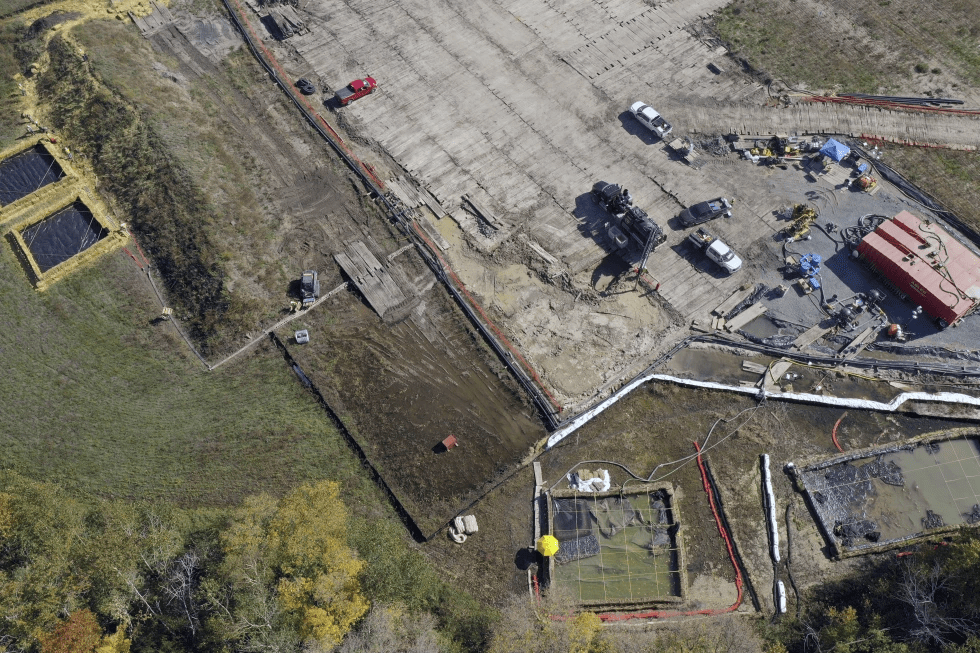
ST. PAUL, Minn. (AP) — A fourth aquifer breach has been confirmed in northern Minnesota stemming from a Canadian oil company’s construction of an oil pipeline replacement in the region, state officials said.

Officials with Enbridge Energy and the Minnesota Department of Natural Resources confirmed to the Minneapolis Star Tribune that the breach occurred near Moose Lake in Aitkin County. Officials said Enbridge is working to fix the rupture, in which the layer of earth above an aquifer is punctured, causing the water to leak to the surface and possibly introducing pollutants.

It’s the fourth confirmed breach along the Line 3 pipeline route, which started operating in the fall of 2021 and generated fierce opposition from environmental activists and Native American tribes. Last October, state regulators announced that Enbridge would pay more than $11 million for water quality violations and the three previous aquifer breaches.

An aquifer is a natural underground reserve of fresh water capable of being tapped by wells. Environmentalists say such groundwater reserves face a multitude of threats from human populations, including depletion from overuse, pollution from agriculture and septic systems and contamination from pipeline construction and spills.

Groundwater at the Moose Lake breach is flowing to the surface at about 10 to 15 gallons per minute, department officials said. That’s “considerably lower” than the rate at which groundwater initially flowed from the other three breaks, the agency said.

Enbridge will submit a plan to correct the Moose Lake area damage and will implement it when it’s approved, company spokeswoman Juli Kellner said in a statement. The aquifer breaches don’t involve the pipe itself, she said. It stems from sheet-metal piling driven into the ground used to reinforce the trenches that crews work in.

CLICK HERE TO LEARN MORE: https://apnews.com/article/enbridge-oil-pipeline-breach-minnesota-3aec2792d9a6cae11be9c7ae8179cad2

Dead fish in San Francisco Bay Area blamed on toxic red tide

By Terry Chea and Olga R. Rodriguez

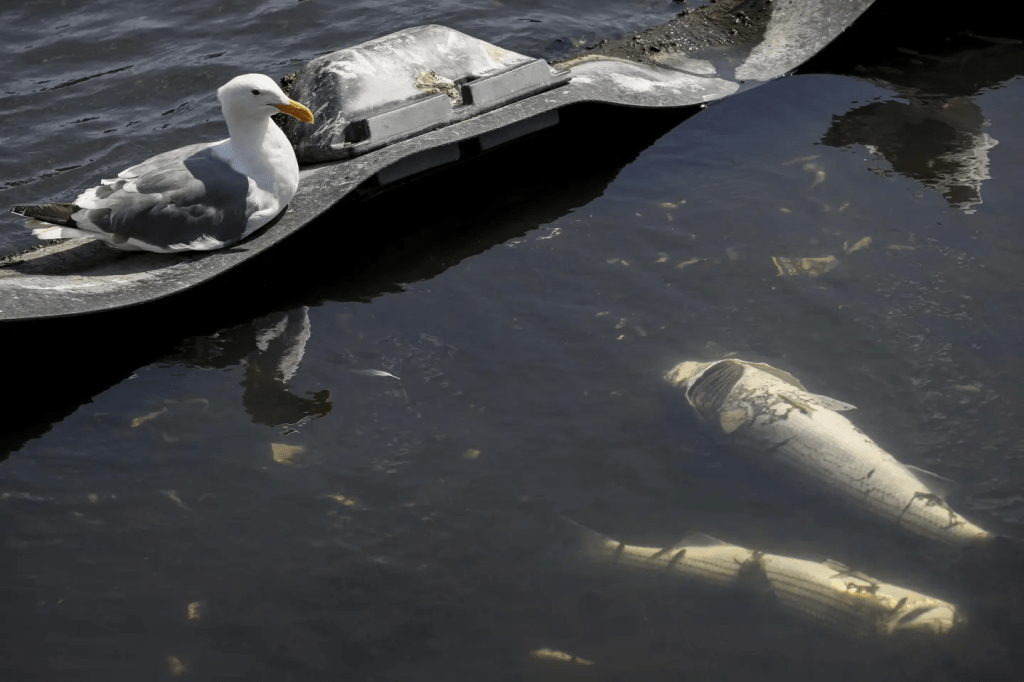
OAKLAND, Calif. (AP) — An unprecedented red tide in the San Francisco Bay Area is killing thousands of fish and other marine life whose carcasses are washing ashore, creating a foul odor that experts say could get worse during this weekend’s expected heat wave.

At Oakland’s Lake Merritt, a popular spot for joggers, walkers and those looking to be in nature, crews on Wednesday began removing dead crabs, bat rays, striped bass and other fish that began piling up on its rocky shores over the weekend.

The fish die-off at Lake Merritt and throughout the Bay Area may be due to a harmful algae bloom that has been spreading in the region since late July, said Eileen White, executive officer of San Francisco Bay Regional Water Quality Control Board.“We normally have algae blooms during the summertime. But what’s unusual about this one is how large it is and the fact that there are fish kills,” White said.

Most algae blooms end after a week or so. But a triple-digit heat wave forecast for the holiday weekend may help the Bay Area’s grow even more, White said. She said that reports of dead fish started coming in last week.

“This was a natural occurrence of Mother Nature and so, we don’t know when it’s going to end,” she said

A microorganism called Heterosigma akashiwo formed a bloom first spotted in the Alameda Estuary, White said. It is present in the bay all the time, but scientists are trying to determine what caused it to spread so far and wide and for so many weeks.

They say a years-long drought has prevented stagnant water from flowing into the ocean and unseasonably warm and sunny weather may be helping the algae spread.

Jon Rosenfield, a scientist with the San Francisco Baykeeper conservation group, said high levels of nutrients like phosphorus and nitrogen in wastewater also drive the growth of algae blooms.

“The only lever that we have to control the problem is to reduce nutrients put into the bay from the 40 wastewater treatment plants that operate around the bay,” he said.

Rosenfield said sewage treatment plants are cleaning the water of solid material and bacteria, but they’re not designed to pull out nitrogen and phosphorus.

Treating the water for nutrients would cost billions of dollars, and those costs would be passed on to residents, White said. She said water districts are funding studies to understand the effects of nutrients that have been present in the water since people settled in the area.

“The goal is to make the appropriate regulations based on sound science,” White said.

Experts are also trying to determine what exactly is killing the fish.

Algae blooms produce a toxin that is lethal to fish and other marine life, and as they spread, bacteria in the water start to consume the algae. As it decays, it depletes the water of oxygen, leading the fish to suffocate, Rosenfield said.

“Which of those mechanisms is operating here, the toxin or the low dissolved oxygen? We just don’t know yet,” he said.

Algae bloom has been reported in Contra Costa and Marin counties to the north and San Mateo County to the west. In the South Bay, concentrations of chlorophyll — an indicator of algae density —measured on Aug. 10 were the highest observed in more than 40 years, White said.

In Oakland, people turned to social media to post photos of some of the thousands of dead fish at Lake Merritt, where visitors have started complaining about the stench.

“It doesn’t smell very good right now, so it’s a bit of a nuisance,” said Graham Webster, who jogs around the lake once or twice a week.

“But the bigger question is what’s happening to the lake and the bay? And what’s causing it? Is it our fault? Can it be fixed?” he asked.

White said the algae aren’t known to be toxic to people, but they can cause skin and eye irritation. Her office is recommending people and pets stay out of any water that looks reddish-brown.

Cely Aquino said she visits Lake Merritt regularly and seeing all the dead fish was sad.

“I saw a lot of the dead fish, and I saw a couple of stingrays that were dead also. It’s pretty sad,” she said. “But I figure nature it’s going to take care of it all.”

CLICK HERE TO LEARN MORE: https://apnews.com/article/lakes-san-francisco-fish-oakland-81f90e972270abcf566549f92dedb5a9

5,350 United States Based Water Systems Are In Direct Violation Of Lead Laws

By US Water News

It is a shocking water and health and safety statistic that will leave more than just a bad metallic after taste in the mouths of most Americans this year. In fact Eighteen million Americans live in communities where the water systems are in violation of the federal laws that dictate just how much lead should sit within our drinking water. A dangerous water quality situation that could accelerate health insurance claims and increase the cost of medical cover for the many affected citizens living in towns and cities across the US.

Moreover, the federal agency in charge of making sure those water systems are safe not only knows the health and safety issues exist with the water supply, but it’s done very little to stop them, according to a new report and information provided by multiple sources and water experts from around the country.

A Farcical Water Health and Safety Situation That Must Be Stopped

Consider this scenario for a moment. “Imagine a cop sitting, watching people run stop signs, and speeding across town at 100 miles per hour in small communities and still doing absolutely nothing about it, knowing the people who are violating the law. And doing nothing. That’s unfortunately what we have now,” said Erik Olson, health program director at Natural Resources Defense Council, which analyzed the EPA’s data for its report.In this case, the “cop” is a combination of the states and the EPA. States are the first line of enforcement, but when they fail — as they did recently in Flint, Michigan — the EPA is supposed to step in. But in many cases, the agency hasn’t.

Clear Excess Lead Violation In US Water Systems

More than 5,300 water systems in America are in violation of the EPA’s lead and copper rule, a federal regulation in place to safeguard America’s drinking water from its ageing infrastructure.
Violations include failure to properly test water for lead, failure to report contamination to residents, and failure to treat water properly to avoid lead contamination.

Yet, states took action in 817 cases; the EPA took action in just 88 cases, according to NRDC’s report.
What’s worse, the report reveals that the EPA is also aware that many utilities “game the system,” using flawed or questionable testing methods in order to avoid detecting high levels of lead.
That means there could be many more communities violating the laws, exposing residents to dangerous levels of lead. And the public has no idea.

Even Flint, a city with the most notorious case of lead in water discovered, is still not listed as having violated the EPA’s lead and copper rule.
In response to the report, the EPA said it works closely with states “who are responsible for and do take the majority of the drinking water enforcement actions and are the first line of oversight of drinking water systems.”
The agency added that, “it’s important to note that many of the drinking water systems that NRDC cites in its analysis are already working to resolve past violations and return to compliance with the Safe Drinking Water Act in consultation with state regulators or EPA.”

The Philadelphia Water Quality Scandal

Experts say Philadelphia is a perfect example of the EPA unwilling to act, and having too cozy a relationship with local regulators.
The city has come under scrutiny recently for only testing less than 40 of an estimated 50,000 homes with lead service lines.

City officials say that’s all they could find after putting out 8,000 requests to residents. Seven homes had high lead levels.
After the Flint water crisis, the EPA in February issued new guidance instructing water authorities to stop pre-flushing taps and other practices that were considered “cheating.”

Our Verdict on Lead in the Water Supply

One thing is crystal clear, if the situation with excess lead in the water supply of so many US homes is going to be curbed, it will take more than just tough talk to see it done as we move into 2018. Clean lead free drinking water is what we all expect and we expect the water companies to robustly monitor the quality of water that is distributed to customers. There are no legitimate excuses for failure or gaming the system.

CLICK HERE TO LEARN MORE: https://www.uswaternews.com/5350-united-states-based-water-systems-are-in-direct-violation-of-lead-laws/

Paris’ test for Olympic swimming in the Seine canceled due to poor water quality

By The Associated Press

PARIS (AP) — Heavy rains in Paris have led to the cancellation on Sunday of a swimming event in the River Seine that was to be a test for next year’s Summer Olympics, but Games organizers say the waterway will be better prepared in 2024.

The Open Water Swimming World Cup event was canceled because “the water quality in the Seine has remained below acceptable standards for safeguarding swimmers’ health,” French Swimming Federation (FFN) said in a statement Sunday.

Water quality falls below acceptable standards when rains cause overflows of untreated waste into the Seine. France’s capital city is spending massively on water-management projects that officials say will make pollution caused by storms less frequent.

Brigitte Legaré, sport manager at the Paris Olympics organization committee, said “unfortunately, this morning when we took the (water quality) reading that came out after 24 hours, we were still slightly above the limits. We’re not very far.”

World Aquatics’ President Husain al-Musallam said the organization is “disappointed… but the health of our athletes must always be our top priority.

“World Aquatics remains excited at the prospect of city-centre Olympic racing for the world’s best open water swimmers next summer. However, this weekend has demonstrated that it is absolutely imperative that robust contingency plans are put in place,” he said in the statement.

The Seine is the venue for marathon swimming at the Games next summer and the swimming leg of the Olympic and Paralympic triathlon.

Paris Olympics organizers and the city’s authorities said in a joint statement Sunday that “in recent weeks, water quality in the Seine has regularly reached the levels required for competitions to be held on the dedicated site, demonstrating the significant progress made.”

They said water quality will be closely monitored in the coming days in the hope that triathletes can race in the Seine during a test event scheduled on August 17-20.

“By 2024, new infrastructure will be delivered to further improve rainwater treatment to improve water quality,” they said.

Those public works include a giant underground reservoir in Paris that will stock excess water during storms, so it doesn’t have to be spilled untreated into the river and can be treated later.

Pierre Rabadan, deputy mayor of Paris in charge of sports, said “we’re in an outdoor sport subject to climatic variations, weather conditions and that brings uncertainties. We’re going to deal with these uncertainties.”

When new water cleanup facilities will be ready, “we’ll be able to regulate even exceptional phenomena like the one we’re facing today,” he said.

Paris Games organizers also say the schedule for Olympic events in the river can be adjusted next year if the water quality doesn’t allow them to take place on their original dates.

Their statement said the recent weather was “exceptional,” with the Paris region seeing its heaviest summer rainfalls since 1965.

CLICK HERE TO LEARN MORE: https://www.msn.com/en-us/sports/other/paris-test-for-olympic-swimming-in-the-seine-canceled-due-to-poor-water-quality/ar-AA1eV8ye

Snowmelt Runoff Sets Streamflow Records in the Southwest

By WaterNews Network

Across the western U.S., many areas received record or near-record amounts of snowpack over the winter. With the spring and summer temperatures melting the abundant snow, a record volume of streamflow has been recorded in several basins in the southwestern U.S., providing more water for the area later into the summer than is typically seen.

Snowmelt runoff in Walker and Carson basins

The Walker and Carson basins near the California-Nevada border, for example, have reported the largest volume of streamflow for April through July that has ever been observed in roughly a century, when the records began. The ample runoff is helping fill reservoirs that have been depleted from years of drought conditions.

Weekly U.S. Drought Monitor: Cooler Northwest, Warmer Southwest

Dry conditions dominated the West and southern Plains, coupled with above-normal temperatures. Precipitation was most widespread throughout much of the upper Midwest and central Plains and into the Northeast. Almost the entire country had near- to above-normal temperatures this last week, with the greatest departures over the Southwest and central Plains where temperatures were at least 4-7 degrees above normal.

Cooler-than-normal temperatures were recorded in the Pacific Northwest with departures of 3-6 degrees below normal. At the end of the current U.S. Drought Monitor period, significant rains developed over portions of the Midwest and central Plains, and they will be accounted for in the next analysis.

U.S. Seasonal Drought Outlook

Central portions of the Intermountain West may be spared degradation, as those areas are still showing residual benefits from above normal winter snowpack leading up to the summer, in addition to periods of above normal rainfall during the last 60 to 90 days. Seasonal temperature and precipitation outlooks, ENSO, and climatology favor widespread drought improvement and removal across the central U.S. However, drought persistence is favored across the Upper Midwest, although there is the potential for localized improvements.” Read full assessment:  cpc.ncep.noaa.gov/products/expert_assessment/sdo_summary.php.

Seasonal Precipitation Outlook: November, December, January 2023-24

Colors show where total precipitation has an increased chance of being higher or lower than usual during the next three months. The darker the shading, the greater the chance for the indicated condition. White areas have equal chances for precipitation totals that are below, near, or above the long-term average (median) for the next three months.

Climate scientists base future climate outlooks on current patterns in the ocean and atmosphere. They examine projections from climate and weather models and consider recent trends. They also check historical records to see how much precipitation fell when patterns were similar in the past.

CLICK HERE TO LEARN MORE: https://www.waternewsnetwork.com/snowmelt-runoff-sets-streamflow-records-in-the-southwest/

Florida Could Soon Become Uninsurable—and Other States Will Likely Follow

By Giulia Carbonardo

Florida is no stranger to extreme weather events, a fact that those living in Sunshine State have always factored in when insuring their homes.

But as climate change exacerbates the frequency and severity of events like droughts, floods, tornadoes, and hurricanes in the U.S., the reality Floridians and insurers in the state are working with is quickly changing.

Florida, according to several experts, is becoming “uninsurable.” And other states, starting from California, might follow suit in the near future.

Florida’s Perfect Insurance Storm

Some 15 major insurers, including Farmers, have announced their intention to abandon Florida over the last year, with many citing the state’s increased vulnerability to extreme weather events.

And the crisis unfolding in Florida has been a long time coming, Charles Nyce, department chair and a Dr. William T. Hold associate professor of risk management and insurance at Florida State University, told Newsweek.”A lot of this started in the 1990s when Hurricane Andrew made landfall in southeast Florida. That was a real wakeup call to the insurance industry about the level of catastrophic exposure they had in the state,” he said.

Hurricane Andrew caused somewhere between $16 and $20 billion in insured losses in 1992. Seven major storms between 2004 and 2005 caused between $35 billion in losses combined, representing another “wakeup call for insurers about how frequent storms can cause a lot of problems,” Nyce said.

But it’s not just climate change that has led to the current crisis in the Sunshine State. “Florida has a fraud problem,” Nyce said. “It represents 7 percent of the U.S. homeowners’ insurance market, yet Florida represents 75 percent of all litigation coming out of homeowners.”

These two problems have existed for years, he added, but since 2016 the number of storms hitting Florida has increased.

“This is when the market started going into the crisis we’re still in,” Nyce said. “In 2022, we had six insurance companies go insolvent. While the state is making legislative efforts to solve Florida’s insurance problem, Florida still has the hurricane problem.

“Insurance companies are private enterprises, they’re in business to make money. For them to make decisions, it’s all about risk and reward. And they decided that there was too much risk relative to the reward that they receive in Florida.”

Uninsurable Homes

Insured losses in the U.S. have averaged a 6 percent annual rate of growth above the rate of inflation since 2000, according to data from Gallagher Re, a reinsurance broker.

The country averaged $23 billion in annual insured losses during the 1990s but has skyrocketed to an average of $70 billion per year.

Every major peril has shown consistent loss growth in the last two decades, according to the reinsurer. “The combination of climate change influence and exposure growth are both notable factors in the direct physical damage and broader societal impacts being experienced throughout all 50 states,” a spokesperson for the company told Newsweek.Climate change—which has been identified as a likely cause of the increase in the frequency of storms and hurricanes—means that the risk for homeowners and their insurers, especially those in areas prone to experience extreme weather events, is constantly growing, and it’s difficult to estimate in the long term.

“Damage that’s associated with extreme events is actually the hardest part of the risk to measure for insurers,” Yanjun Liao, an economist and researcher at Resources for the Future, told Newsweek.

“If we continue to have more catastrophic events, what happens for the insurers is that they might not be completely clear about how to measure that risk,” she continued.”There are new modeling techniques and things like that that they can invest in, but then, on the other hand, in a catastrophic event there could be a lot of correlated losses for them, which means that a lot of the properties that they insure can simultaneously generate damage and insurance claims.”

That is easier said than done. “In order to prepare for those events, they need to build up their capital reserves so that they can handle all these claims all at once,” Liao said. “And that is financially very hard to do and it’s very costly for them.”

This is how states like Florida and California become almost uninsurable.

“Wildfires, hurricanes, sea-level rising—those kinds of risks are generally considered less insurable,” Liao said. “In the current market, insurers might still have options and room to operate, but the increasing of catastrophic events is definitely a threat.”

Insurers are already retreating from offering coverage in the areas most at risk of experiencing extreme weather events—with dire consequences for homeowners.

“For the potential homebuyers in those areas, if they want to get a mortgage, they need a homeowner’s insurance. And if they cannot get one, they cannot get a mortgage,” said Liao.

This, in turn, increases the difficulty for people to buy a house in Florida—already one of the most overvalued housing markets in the entire country—or they can get more expensive coverage provided by the state’s FAIR Plan.

“A fraction of the homeowners, it seems like they might be going without any insurance,” Liao added. “And that’s very dangerous, because once the storm or the fire hits, if they don’t have insurance, they’re going to suffer really big losses.”

In California, insurers cannot raise their rates above a certain threshold set by regulators—a move that protects homeowners, but also block insurers from matching premiums with the higher risk of damage. Insurers like State Farm and Allstate have announced earlier this year that they will stop offering new homeowner insurance policies in the state.

A Growing Problem: Who’s Next?

“There’s going to have to be a real fundamental shift in terms of how everybody within the financial markets is thinking, not just in the long term, but in the short term as well,” Bowen said.

“We have to fundamentally change how we reprice, how we look at risk, and how we’re investing from a mitigation and adaptation standpoint,” he continued, saying that this might still not be enough for everyone to be able to afford new insurance premiums.

“It’s a very complex problem and I don’t think there’s any easy solutions, unfortunately,” said Nyce, adding that the issue could expand in time to other U.S. states.

“Arizona is affected by wildfires, but it’s not as heavily populated as California, so that helps a little,” he said. “Colorado and Oregon, they’re also at wildfire risk. If you look at the middle part of the country, we see a lot more tornadoes happening, they don’t touch down but they come with really bad thunderstorms and hail. These are big causes of loss.”

According to Nyce, the insurance crisis could expand to the lower Southeast and the upper Midwest in future, “where insurance companies may decide to start pulling back as well.”

As climate change unfolds, Nyce said, the areas most vulnerable to extreme weather events are likely to change. “Wildfire will spread out of California, storms will spread,” he said. “Areas that were considered safe will no longer be safe, and areas which may have been considered risky before may start to become safer.”

In Louisiana, said Bowen, a series of major storms over the last five years has already driven up the overall cost of insurance on the private side. In Oklahoma, “the cost of insurance has gone up a lot in the last decade because of this, the substantial increase in thunderstorm-related loss,” Bowen said.

“We have already started to see that shift in some of these non-traditional prime-focused states like Florida or California. That shift is already happening,” he added.”It’s truly a 50-state issue,” Bowen concluded. “Obviously, there are going to be some states that are more imminently at risk than others, but the reality is that the influence of climate change is going to be very evident regardless of which state you live in.”

CLICK HERE TO LEARN MORE: https://www.newsweek.com/florida-california-insurance-uninsurable-climate-change-1817260

Monterey City Council welcomes regional collaboration to tackle water crisis

By Tess Kenny

MONTEREY – Affordable housing and water – you can’t have one without the other. It’s a stark reality cities on the Monterey Peninsula know well, with the latter always seeming in short supply. But the city of Monterey seems determined to make sure the tap doesn’t run out, for either resource.

The possible solution? Regional collaboration.

At the Monterey City Council’s regular meeting Tuesday night, the Peninsula’s perennial disjunction – not enough water and not enough housing – was back on the agenda. But it wasn’t all doom and gloom, as is often the case when it comes to hopes of feasible development. Instead, the possibility of finding a path forward was met with optimism, thanks to a handful of alternatives introduced by city staff that, if seen through, could open up opportunities for the city.

All it would take is some extra help from an unlikely source: the Marina Coast Water District, which – though not Monterey’s main purveyor of water – might have the capacity to augment the city’s supply, at least according to early talks between district and city staff.

“We are in a situation where we cannot win … using the existing resources that we have. It’s like the game of tic-tac-toe,” Monterey City Manager Hans Uslar said at Tuesday’s meeting. “Once we know how to play, you always arrive at a situation where you will never have sufficient water for the challenges that are ahead of us in the foreseeable future.”

Historically, the Peninsula has been served by two sources of water: the Carmel River and a local underground aquifer (the Seaside Groundwater Basin). The Monterey Peninsula Water Management District regulates the resources, while California American Water Company distributes water to customers. But sources are limited, not just by availability alone but through regulatory oversight.

For years, the Peninsula’s water supply has been restricted by the State Water Resources Control Board, which – in 2009 – slapped a cease-and-desist order on any additional water hookups because of over-pumping from the Carmel River. Needing additional water to support development, local officials have tried to get the order rescinded, but to no avail. Without revocation, localities are scrambling to find other sources of water outside of what’s historically supported the area.

The urgency of diversifying sources is apparent now more than ever, as Peninsula cities work to meet state-required construction goals.

Through a process called the Regional Housing Needs Assessment (RHNA), cities and counties across the state are given targets every eight years for how much housing – split into different income levels – that they need to satisfy projected lodging needs for their communities. Though the process doesn’t obligate local governments to build out the aspirational housing, it does mandate that they demonstrate appropriate zoning, development regulations and policies to support homebuilding goals.

Monterey has been tasked with planning for 3,654 homes over the next eight years, including nearly 2,000 low income units. Moreover, city officials have stated that they don’t want to just do the bare minimum with planning, but put a concerted effort into building out imagined units. That kind of development needs water, and a lot of it – a lot more than Monterey currently has.

A long anticipated dilemma, some prospects are already out there to help fill the gap. One potential new source is Monterey One Water’s expansion of the Pure Water Monterey (recycled water) project, which, when complete, would provide an extra 2,250-acre feet of water to the Peninsula. There’s also Cal Am’s proposed desalination project, which was conditionally approved by the California Coastal Commission in November but is still years out from coming to fruition.

It’s in this web of needs, options and caveats that city staff started to think outside Monterey’s usual repertoire of water supply, they say. Though alternatives are on the table, whether they will provide enough water – in a timely fashion – for the kind of growth Monterey is not only planning for but wants to support over the next eight years is unclear. Wanting backups they could rely on, city staff asked, what else?

“Our city takes (the Regional Housing Needs Assessment) very seriously,” Uslar said in a call Wednesday. “We could elect to plan (for growth) then point to an insufficient supply of water on the Peninsula and sit on our hands. But that’s not what we’re doing. We’re looking at other options.”

In working with the Marina Coast Water District, staff think there could be a few. Chief among them: funneling water from Marina Coast, which is primarily supplied by the Salinas Valley Groundwater Basin, to Monterey customers.

Uslar said that though they are very early into fleshing the idea out, “it looks absolutely feasible that (the district) has sufficient water that they can provide us here in the Peninsula.”

What needs some figuring out is how Marina Coast-supplied water would actually get to Monterey. According to Uslar, that will take bringing Cal Am into the fold. Because Monterey is mostly a Cal Am customer, Uslar says that to realize hopes of collaborating with Marina Coast, the utility company would need to agree to wheel in water from the district into its pipes that service the city.

“Cal Am is for sure a player here,” Uslar said. “They need to be approached and negotiated with. Are they willing to transport the water, and at what cost?”

Wheeling water aside, other options staff suggested Tuesday night included securing additional water from Marina Coast to support development of Monterey’s former Fort Ord properties. Staff even suggested the city take advantage of burgeoning plans by Marina Coast to revamp its old desalination plant on Reservation Road.

Opportunities abound, the City Council welcomed continued partnership with the district Tuesday night.

“I think we’re in a situation where we have to pursue every possible water source solution and this seems like a very viable one,” Councilman Alan Haffa said.

Receiving general consensus support from the council, staff can start to meet formally with partners – Marina Coast and Cal Am, first and foremost – to see how far aspirations can go, Uslar said.

“There’s a lot of work ahead of us, but we feel that these are all challenges in the general environment of pro-affordable housing and increased supply of housing that will get a lot of political attention and pragmatic solutions,” he said.

In other council news out of Tuesday’s meeting, the body unanimously decided to move forward with a long-awaited fire services agreement between the city and the Monterey Peninsula Airport District. It is now up to the district to OK next steps for the arrangement, which would see the Monterey Fire Department service the airport for the next five years. The Monterey Peninsula Airport District Board of Director’s next meeting is set for Aug. 16.

CLICK HERE TO LEARN MORE: https://www.montereyherald.com/2023/08/02/monterey-city-council-welcomes-regional-collaboration-to-tackle-water-crisis/

Arizona’s groundwater supplies are essentially unregulated. That means rural wells are drying up

By Ron Dungan

While temperatures push well above 100 degrees, it’s easy to forget that Arizona’s deserts lie on top of groundwater basins that formed during the Ice Age.

The state’s rural communities rely on that water, which experts say is a finite resource. But in most cases, it’s not regulated in any meaningful way. That lack of regulation has begun to show, as wells dry up and local residents call for action.

But the same political roadblocks that have long existed at the state Capitol are still in place.

More than four decades ago, Arizona attempted to pass a statewide groundwater law. Resistance from rural stakeholders forced the state to settle for a law that focused only on urban areas. Policymakers assumed that a law for rural communities would come later. It never did.

“Eighty percent of the state’s land area is essentially unprotected, unmanaged when it comes to its groundwater supplies,” said Haley Paul, of Audubon Southwest.

Out-of-state agriculture companies have noticed the lack of regulation, and they’ve come to set up shop in Arizona. Water tables have begun to fall.

“So it really is the deepest well wins,” Paul said.

A Saudi-financed company that grows alfalfa with La Paz County groundwater and ships it overseas has made headlines, but cattle growers from Minnesota and nut farmers from California have also come to drop deep wells in the desert. They’re backed by hedge funds or corporations.

“It’s a shame, because in the meantime people’s wells are going dry and people are feeling like they have no option,” Paul said.

Arizona has a reputation as a business-friendly state, with a Republican Legislature that tries to keep it that way. Some GOP lawmakers have begun to question the lack of action on groundwater, but they haven’t been able to do anything about it.

Kathleen Ferris, of the Kyl Center for Water Policy, helped write the Groundwater Law of 1980. She said that when corporate farmers in other states run out of groundwater, they come to the Arizona desert.

“They come, and they come to these areas to grow crops because they can. Very simply, the law allows them to do it,” Ferris said.

Lawmakers have proposed several bills in recent years, but they die in committee.

“Rarely, rarely do they get a hearing, even get a hearing. So, you can’t move a bill forward in the Legislature, unless the committee that has been assigned the bill holds a hearing and votes the bill out of committee,” she said.

Groundwater bills get assigned to the Natural Resources, Energy and Water Committees, where they die.

“The chairs of these legislative committees have a great deal of power. And they really have the power to decide the ultimate fate of a bill,” Ferris said.

The House committee is chaired by Republican Gail Griffin, a real-estate broker at Sierra Vista Realty. The Senate committee is chaired by Republican Sine Kerr, a dairy farmer from Buckeye. Both declined requests for interviews.

Ferris said that although Republicans in areas hit hard by corporate agriculture want change, groundwater is far from a bipartisan issue. La Paz County Supervisor Holly Irwin said that people in her region are getting frustrated.

“We can’t even get hearings on bills. That’s the problem,” Irwin said.

In some cases, the state can’t even take measurements on groundwater, which means our understanding of the water table is incomplete.

“We need to find out, number one, what’s underneath the ground, and number two, we need to do something to protect what we do have,” she said.

Irwin said she understands why people might resist regulation.

“I totally understand their perspective, but my whole thing is, OK, then let’s all get to the table. What will work to where we can start protecting what we have, before it’s too late,” she said.

She said for La Paz County residents, the biggest frustration is watching water get shipped off to other places – to Saudi Arabia, for example. Or piped to Queen Creek, which happened recently when a corporate farm in the county sold its share of Colorado River water.

“To be honest with you, you can’t keep kicking this can down the road, you know, they’re going to have to do something. La Paz County shouldn’t be the sacrificial lamb for everybody else,” Irwin said.

She’s optimistic that with a new administration, something might get done. Gov. Katie Hobbs has appointed a committee to study the problem, but any meaningful change will likely have to go through the Legislature.

In April, the Legislature appointed its own committee to study Arizona’s water supply. It’s co-chaired by Griffin and Kerr.

CLICK HERE TO LEARN MORE: https://kjzz.org/content/1852694/arizonas-groundwater-supplies-are-essentially-unregulated-means-rural-wells-are