MIT engineers make filters from tree branches to purify drinking water

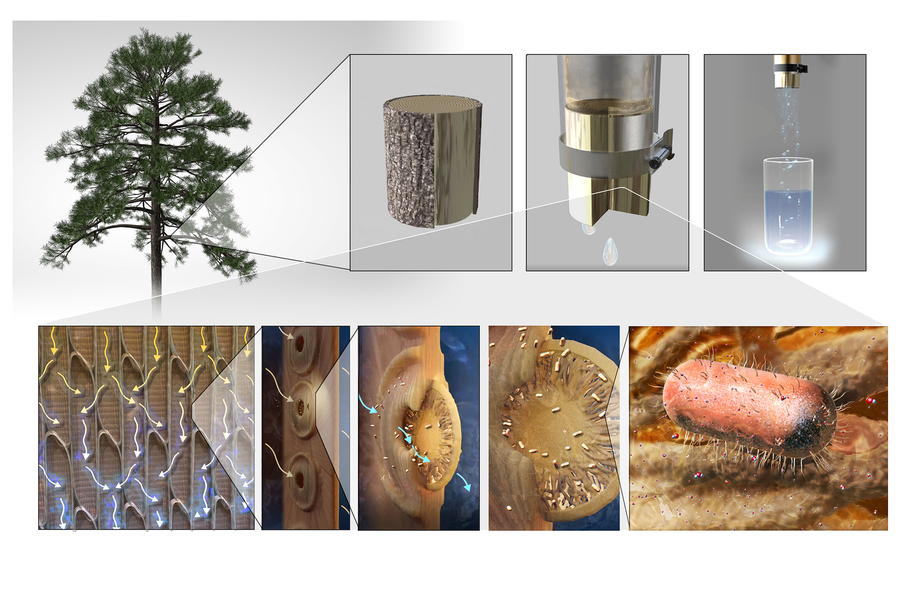
Xylem tissue in gymnosperm sapwood

The interiors of nonflowering trees such as pine and ginkgo contain sapwood lined with straw-like conduits known as xylem, which draw water up through a tree’s trunk and branches. Xylem conduits are interconnected via thin membranes that act as natural sieves, filtering out bubbles from water and sap.

MIT engineers have been investigating sapwood’s natural filtering ability, and have previously fabricated simple filters from peeled cross-sections of sapwood branches, demonstrating that the low-tech design effectively filters bacteria.

Now, the same team has advanced the technology and shown that it works in real-world situations. They have fabricated new xylem filters that can filter out pathogens such as E. coli and rotavirus in lab tests, and have shown that the filter can remove bacteria from contaminated spring, tap, and groundwater. They also developed simple techniques to extend the filters’ shelf-life, enabling the woody disks to purify water after being stored in a dry form for at least two years.

The researchers took their techniques to India, where they made xylem filters from native trees and tested the filters with local users. Based on their feedback, the team developed a prototype of a simple filtration system, fitted with replaceable xylem filters that purified water at a rate of one liter per hour.

Their results, published today in Nature Communications, show that xylem filters have potential for use in community settings to remove bacteria and viruses from contaminated drinking water.

The researchers are exploring options to make xylem filters available at large scale, particularly in areas where contaminated drinking water is a major cause of disease and death. The team has launched an open-source website, with guidelines for designing and fabricating xylem filters from various tree types. The website is intended to support entrepreneurs, organizations, and leaders to introduce the technology to broader communities, and inspire students to perform their own science experiments with xylem filters.

“Because the raw materials are widely available and the fabrication processes are simple, one could imagine involving communities in procuring, fabricating, and distributing xylem filters,” says Rohit Karnik, professor of mechanical engineering and associate department head for education at MIT. “For places where the only option has been to drink unfiltered water, we expect xylem filters would improve health, and make water drinkable.”

Karnik’s study co-authors are lead author Krithika Ramchander and Luda Wang of MIT’s Department of Mechanical Engineering, and Megha Hegde, Anish Antony, Kendra Leith, and Amy Smith of MIT D-Lab.

Clearing the way

In their prior studies of xylem, Karnik and his colleagues found that the woody material’s natural filtering ability also came with some natural limitations. As the wood dried, the branches’ sieve-like membranes began to stick to the walls, reducing the filter’s permeance, or ability to allow water to flow through. The filters also appeared to “self-block” over time, building up woody matter that clogged the conduits.

Surprisingly, two simple treatments overcame both limitations. By soaking small cross-sections of sapwood in hot water for an hour, then dipping them in ethanol and letting them dry, Ramchander found that the material retained its permeance, efficiently filtering water without clogging up. Its filtering could also be improved by tailoring a filter’s thickness according to its tree type.

The researchers sliced and treated small cross-sections of white pine from branches around the MIT campus and showed that the resulting filters maintained a permeance comparable to commercial filters, even after being stored for up to two years, significantly extending the filters’ shelf life.

The researchers also tested the filters’ ability to remove contaminants such as E. coli and rotavirus — the most common cause of diarrheal disease. The treated filters removed more than 99 percent of both contaminants, a water treatment level that meets the “two-star comprehensive protection” category set by the World Health Organization.

“We think these filters can reasonably address bacterial contaminants,” Ramchander says. “But there are chemical contaminants like arsenic and fluoride where we don’t know the effect yet,” she notes.

Groundwork

Encouraged by their results in the lab, the researchers moved to field-test their designs in India, a country that has experienced the highest mortality rate due to water-borne disease in the world, and where safe and reliable drinking water is inaccessible to more than 160 million people.

Over two years, the engineers, including researchers in the MIT D-Lab, worked in mountain and urban regions, facilitated by local NGOs Himmotthan Society, Shramyog, Peoples Science Institute, and Essmart. They fabricated filters from native pine trees and tested them, along with filters made from ginkgo trees in the U.S., with local drinking water sources. These tests confirmed that the filters effectively removed bacteria found in the local water. The researchers also held interviews, focus groups, and design workshops to understand local communities’ current water practices, and challenges and preferences for water treatment solutions. They also gathered feedback on the design.

“One of the things that scored very high with people was the fact that this filter is a natural material that everyone recognizes,” Hegde says. “We also found that people in low-income households prefer to pay a smaller amount on a daily basis, versus a larger amount less frequently. That was a barrier to using existing filters, because replacement costs were too much.”

With information from more than 1,000 potential users across India, they designed a prototype of a simple filtration system, fitted with a receptacle at the top that users can fill with water. The water flows down a 1-meter-long tube, through a xylem filter, and out through a valve-controlled spout. The xylem filter can be swapped out either daily or weekly, depending on a household’s needs.

The team is exploring ways to produce xylem filters at larger scales, with locally available resources and in a way that would encourage people to practice water purification as part of their daily lives — for instance, by providing replacement filters in affordable, pay-as-you-go packets.

“Xylem filters are made from inexpensive and abundantly available materials, which could be made available at local shops, where people can buy what they need, without requiring an upfront investment as is typical for other water filter cartridges,” Karnik says. “For now, we’ve shown that xylem filters provide performance that’s realistic.”

Journal Reference:

  1. Krithika Ramchander, Megha Hegde, Anish Paul Antony, Luda Wang, Kendra Leith, Amy Smith, Rohit Karnik. Engineering and characterization of gymnosperm sapwood toward enabling the design of water filtration devices. Nature Communications, 2021; 12 (1) DOI: 10.1038/s41467-021-22055-w

FOR MORE INFORMATION:  Massachusetts Institute of Technology

‘Climbing droplets’ could lead to more efficient water harvesting

Dr. Xianming Dai, assistant professor of mechanical engineering in the Erik Jonsson School of Engineering and Computer Science, and his research team have been working to develop technology that harvests clean water from the air without using external energy.

University of Texas at Dallas researchers have discovered that a novel surface they developed to harvest water from the air encourages tiny water droplets to move spontaneously into larger droplets.

When researchers placed microdroplets of water on their liquid-lubricant surface, the microdroplets propelled themselves to climb, without external force, into larger droplets along an oily, ramp-shaped meniscus that forms from the lubricant around the larger droplets. The “coarsening droplet phenomenon” formed droplets large enough for harvesting.

“This meniscus-mediated climbing effect enabled rapid coalescence on hydrophilic surfaces and has not been reported before. We have discovered a new physical phenomenon that makes it possible to harvest water more rapidly from air without external force,” said Dr. Xianming Dai, assistant professor of mechanical engineering in the Erik Jonsson School of Engineering and Computer Science, who led the work. “If we don’t have this new phenomenon, the droplets would be too small, and we could hardly collect them.”

Microdroplets of water on a hydrophilic SLIPS surface (left) propel themselves to climb, without external force, into larger droplets along an oily, ramp-shaped meniscus that forms from the lubricant around the larger droplets. On the right, the video clip shows how microdroplets behave on a solid slippery surface.

The findings, published March 25 in Cell Reports Physical Science, could solve key problems in harvesting water from air. Many droplets that condense from water vapor in the air are too small to be collected, and they can cover a surface in a way that impedes further condensation.

Developing new technologies that harvest water from the atmosphere is a growing field of research as more and more people live in areas where fresh water is in short supply. Scientists estimate that 4 billion people live in regions with severe freshwater shortages for at least one month each year. This number is predicted to rise to between 4.8 billion and 5.7 billion by 2050. Reasons include climate change, polluted water supplies and increased demand due to both population growth and changes in usage behavior.

The key to the microdroplet’s self-climbing action is a surface that Dai and his colleagues previously developed. Their liquid lubricant, a hydrophilic slippery liquid-infused porous surface (SLIPS), has a unique hydrophilic nature for water harvesting and rapidly directs water droplets into reservoirs.

Researchers discovered the self-propelling droplet phenomenon on their surface by accident. They were testing different lubricants to determine which could best facilitate water harvesting when they saw the smaller water droplets propel themselves into larger droplets. That led them to collaborate with Dr. Howard A. Stone, chair of mechanical and aerospace engineering at Princeton University and an expert in fluid dynamics, to investigate the underlying physics of the phenomenon.

“Dr. Dai and his team led this work. The ideas are creative, and they made a series of observations in the laboratory that allowed them to understand the underlying physics and its potential applications,” Stone said. “They reached out to me to discuss the mechanism, and we had several Skype or Zoom meetings and email exchanges. It was all very interesting and stimulating. I enjoyed very much seeing the ideas evolve into the published paper.”

As water vapor condenses on the liquid-lubricant surface, oil from the lubricant forms a meniscus, or curvature, around the droplets. The meniscus looks like an upward-curving ramp, which acts like a bridge along which microdroplets spontaneously climb toward and coalesce with larger water droplets, a process the researchers call the coarsening effect. The properties of the lubricated surface prevent the water droplets from being completely submerged in the oil, so they can float on the oil, allowing them to climb.

“The oil meniscus acts like a bridge, so the droplet can climb on it,” Dai said. “The small droplet actively looks for a larger one. After they are connected by the bridge, they become one.”

As tiny water droplets condense from air on a cooled surface, they become thermal barriers that prevent further condensation. By allowing for rapid water droplet collection, the coarsening droplets help clear surfaces for new droplets to form, which facilitates faster, more efficient water harvesting.

The self-propelled coarsening droplet on hydrophilic SLIPS shows rapid removal of condensed submicrometer-sized droplets regardless of how the surface is oriented, which presents a promising approach compared to other surfaces used for water harvesting.

“We cannot harvest a large amount of water unless we have a rapid harvesting process. The problem with other surfaces is that the small water droplets may evaporate before they can be harvested,” Dai said.

“Based on our experimental data, the coarsening surface enhanced the water harvesting rate 200% higher than its counterparts,” said Zongqi Guo, a mechanical engineering doctoral student and co-lead author. Dai and his colleagues continue to work on ways to use their lubricant to make sustainable water harvesting systems that are mobile, smaller in size, lower in weight and less expensive.

“If we can do that, we can harvest water anywhere that has air, which is particularly important in regions where water is scarce,” Dai said.

The research was funded by the National Science Foundation and the Army Research Office.

Journal Reference:

  1. Zongqi Guo, Lei Zhang, Deepak Monga, Howard A. Stone, Xianming Dai. Hydrophilic slippery surface enabled coarsening effect for rapid water harvesting. Cell Reports Physical Science, 2021; 100387 DOI: 10.1016/j.xcrp.2021.100387

FOR MORE INFORMATION: University of Texas at Dallas

Hopes Low for Progress at India, Pakistan’s First River-Sharing Talks in Three Years

Reuters

NEW DELHI (Reuters) – An Indian official played down on Tuesday prospects for a breakthrough at the first talks in three years with neighbouring Pakistan aimed at resolving long-running disputes over hydroelectric projects on the shared Indus River.

Pakistan is concerned that India’s plans for hydroelectric plants in the disputed Himalayan region of Kashmir will damage the flow of the river, which feeds 80% of its irrigated agriculture, along with tributaries.

India has defended the construction of its Pakal Dul and Lower Kalnai dams, saying they are allowed by the Indus Water Treaty brokered by the World Bank.

“It is our job to find a middle path. But to say we can achieve something is maybe a bit too optimistic,” an Indian official involved in the talks in New Delhi told Reuters.

“There are many things on which we can’t compromise,” added the official, who spoke on condition of anonymity because of the sensitive nature of the discussions.

India issued no statement on the talks, which are set to end on Wednesday.

The talks come after a gap of three years because of tension over Kashmir, the Muslim-majority territory both south Asian nations claim in full.

In recent weeks, the nuclear-armed rivals have taken tentative steps to improve ties, such as a rare military pact last month to stop firing on the Kashmir border that has killed scores of civilians.

FOR MORE INFORMATION: https://www.usnews.com/news/world/articles/2021-03-23/hopes-low-for-progress-at-india-pakistans-first-river-sharing-talks-in-three-years

The water fight over the shrinking Colorado River

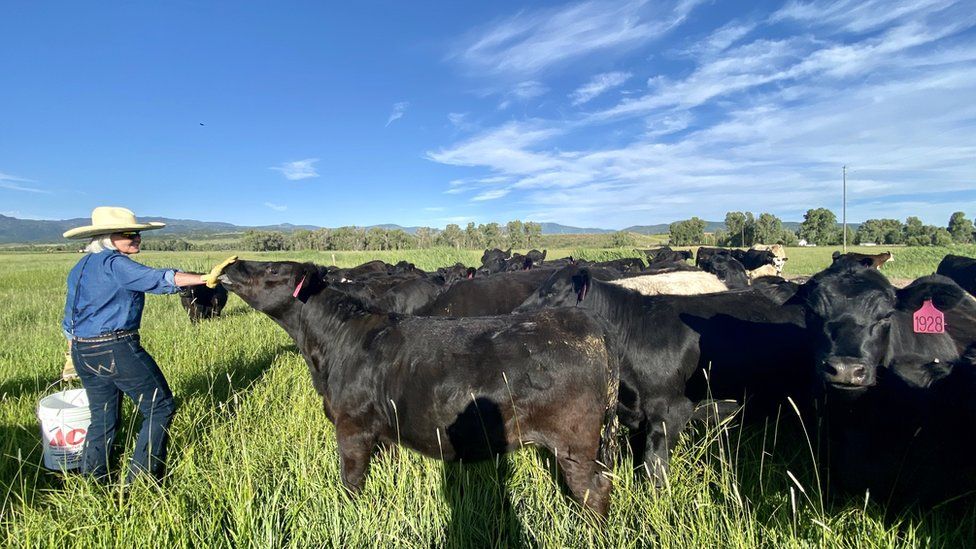
Marsha with her cattle
Marsha Daughenbaugh depends on the Colorado River to grow feed for her cattle

Scientists have been predicting for years that the Colorado River would continue to deplete due to global warming and increased water demands, but according to new studies it’s looking worse than they thought.

That worries rancher Marsha Daughenbaugh, 68, of Steamboat Springs, who relies on the water from the Colorado River to grow feed for her cattle.

“That water is our lifeblood and without it we would not have the place that we do,” says Daughenbaugh, who was raised on this ranch and is hoping to pass it down to her children and the next generation.

“Ranching is not only an economic base for us, it’s a way of life.”

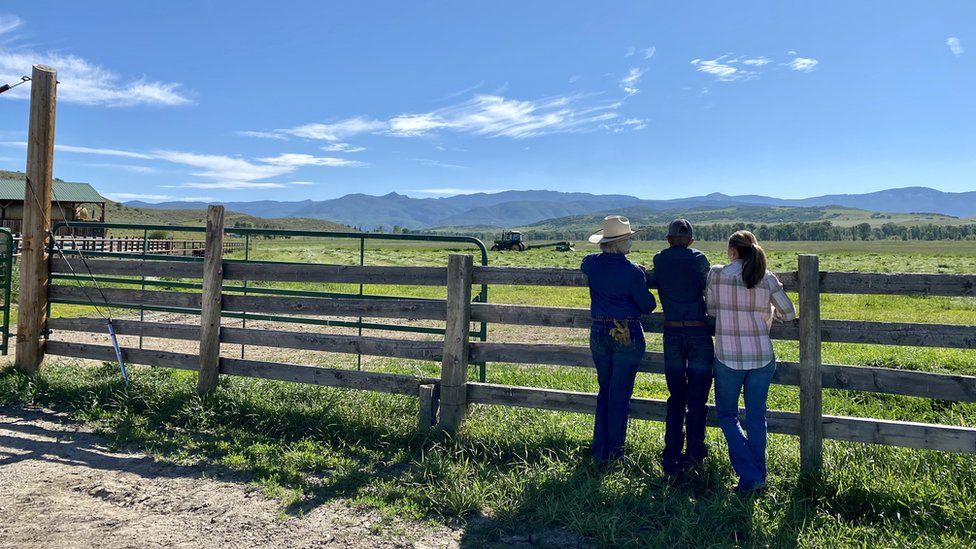
Three generations of ranchers in Steamboat Springs
Three generations of ranchers have grown up relying on water from the Colorado River to support their way of life

But with a two-decade drought in the southwestern US and record-low snowfalls, that lifestyle could be in jeopardy.

“Things seem to be happening even faster than the models or scientists were warning just a few years ago,” says Brad Udall, a water and climate scientist at Colorado State University. “If you’re not worried about all this, you’re not paying attention.”

Recent reports show that the river’s water flows were down 20% in 2000 and by 2050 that number is estimated to more than double.

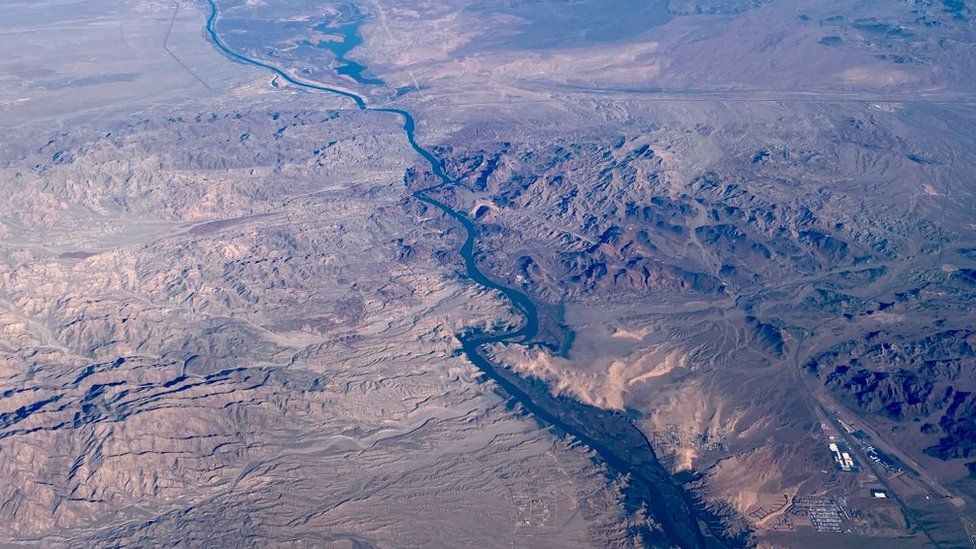
This aerial view shows the Colorado River, south of Las Vegas, on 6 February, 2020.
This aerial view shows the Colorado River, south of Las Vegas

It’s a problem we can’t engineer our way out of any longer, Udall says.

“We have massive dams on the Colorado River already. A bigger bank account with less income doesn’t do you a whole lot of good,” he warns.

Many, like Jim Lochhead, agree there is only one solution – use less water.

“Despite the complexities of how we reach the solutions, the problem is really quite simple. It’s a mass balance equation. We have too many demands and not enough water,” says Lochhead, CEO of Denver Water, Colorado’s largest water utility.

“And so at the end of the day, demands overall will need to be reduced and managed in order to keep the bank account solvent.”

Jim Lochhead poses in front of a Colorado River dam
Jim Lochhead says water use needs to go down in order to manage the deficit

But limiting water usage will be tricky.

The Colorado River provides water to more than 40 million people across seven southwestern states, 29 tribal nations and Mexico – and a lot of major cities in those states are heavily dependent on that water.

In Las Vegas, 90% of its water supply comes from the river. In Phoenix and Denver it’s 50% and in Los Angeles it’s 25%.

According to a 1922 agreement, each of these seven states have a legal right to a certain amount of the river’s water. But this compact was made under the assumption that there was more water than there actually was.

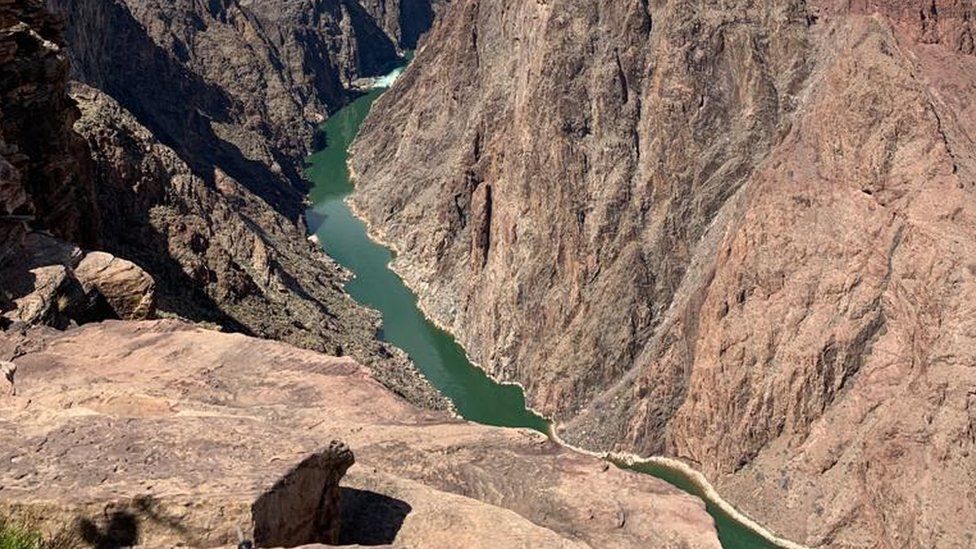
The Colorado River seen from the Grand Canyon
Here is what the Colorado River looks like from the Grand Canyon

“On paper we’ve allocated 30% more water than what’s in the river today,” says Eric Kuhn, the former General Manager of the Colorado River District.

“And the science suggests that we got a situation where climate change has impacted it even more. The river is probably a third smaller than what was anticipated when the contract was negotiated.”

That means officials will have to figure out how to share an amount of water that in reality doesn’t exist – and is shrinking.

Another factor in this equation are the various tribes who have legal rights to 20% of the river’s water, yet don’t have equal access.

Shanna Yazzie of the Navajo Nation is one such example.

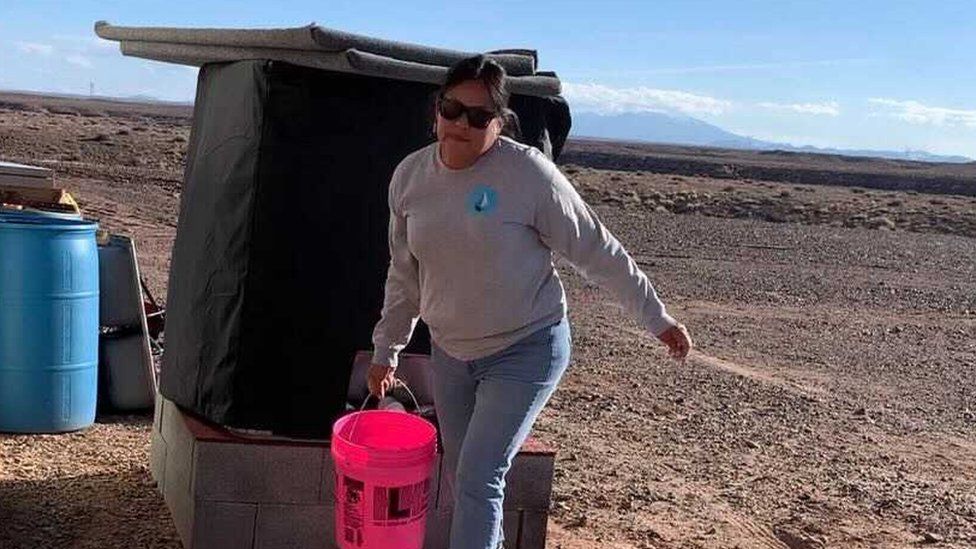
Every day, the 39-year-old has to leave her home with buckets to go get water from a local water tank. She’s not alone. One-third of the 350,000 residents on the Navajo Indian Reservation don’t have running water.

Shanna Yazzie fills a bucket of water from the local water tank
image captionShanna Yazzie has no running water at home and gets her water from a nearby water tank

“We work, I would say, eight times harder than anybody just to make sure we have water, and pre-planning throughout the day, pre-planning throughout the week. When and where am I going to get water?” says Yazzie.

And during the global pandemic, limited water access has been even more frustrating.

“My kids and myself are all at home, all the time and we are relying on that water more and more each week,” Yazzie says. “And when we go to get water we have to ask, is it going to be safe, are there lots of people out there at the water point? There are so many more factors now.”

When the 1922 agreement was signed, not a single tribe had a seat at the table. Daryl Vigil, co-director of Water and Tribes in the Colorado River Basin, calls this “the institutional theft of tribal water”.

Sadly, Vigil says, this fight for water access is still ongoing.

“Somebody is using tribal water for free and you know once again tribes are not able to utilise that on their own reservations. And what is the impact of those things?” he asks. “Tribes and tribal sovereigns are still 19 times more likely not to have indoor plumbing, I mean in 2021.”

While tribes fight for more water access, those in the agricultural community are fighting to keep the water they have.

More than 70% of the Colorado River’s flow is consumed by agriculture. But as the river dries, eventually a lot of it will have to leave these communities to sustain cities and suburbs, meaning less water for farmers and ranchers like Marsha Daughenbaugh.

Marsha Daughenbaugh and her family at her ranch
Marsha Daughenbaugh hopes to pass her ranch on to her children

But Daughenbaugh is not naive. She knows there are a lot of competing stakeholders and not enough supply to go around, so collaboration, she says, will be key.

“There are so many diverse interests against this water that we just have to work together regardless of what industry we are coming from,” she says.

One of the proposed ideas is to pay farmers and ranchers to use less water to build up reservoirs in times of crisis but at what cost is unclear.

The river’s existing management guidelines are set to expire in 2026, meaning these hard questions about conservation can’t be put off much longer.

FOR MORE INFORMATION: BBC: The water fight over the shrinking Colorado River

Water: the game changer for food systems

A Food Systems Summit will be convene as part of the Decade of Action to achieve the Sustainable Development Goals (SDGs) by 2030.

The culminating Summit gathering will take place in New York in September 2021 in conjunction with the UN General Assembly. This will be preceded by a pre-Summit gathering in Italy in July 2021.

The Food Systems Summit Dialogues will offer a powerful opportunity for people everywhere to have a seat at the table at this milestone UN Summit. Dialogues will bring together a diversity of stakeholders, including voices that are seldom heard, and provide an important opportunity for participants to debate, collaborate, and take action towards a better future.

Water: The Game Changer for Food Systems – a Global Summit Dialogue
Dr. Agnes Kalibata, UN Secretary General’s Special Envoy to the Food Systems Summit; and Gilbert F. Houngbo, UN-Water Chair and President of the International Fund for Agriculture Development, are convening an online global dialogue on water on 27 April. The dialogue will explore the fundamental inter-connections between food systems and water systems, and their relations to other areas fundamental to the Sustainable Development Goals, such as energy, climate, and the environment.

Participants will be invited to explore how water is an essential ingredient for sustainable food systems to:

  • ensure access to safe and nutritious food for all
  • shift to sustainable consumption patterns
  • boost nature-positive production
  • advance equitable livelihoods
  • and build resilience to vulnerabilities, shocks and stress

The event will also build on the learnings that are arising on water and food systems in national and regional dialogues. Major water challenges that are threatening local and international food systems will be unpacked.

  • Find more information about the Water: The Game Changer for Food Systems – a Global Summit Dialogue here.

FOR MORE INFORMATION: United Nations Water

New UNICEF publication address water insecurity

The world is in a water crisis, and children’s lives and futures are at risk. Today, over 1.42 billion people – including 450 million children – live in areas of high or extremely high water vulnerability.

Decades of water misuse, over-extraction and contamination of freshwater supplies have exacerbated water stress. Simultaneously, demand for water is rising due to rapid population growth, urbanization and increasing water needs from a range of sectors including agriculture, industry and energy. Climate change further compounds water scarcity through changing precipitation patterns and extreme weather events.

In conjunction to World Water Day, UNICEF launched Water Security for All, a programmatic and advocacy initiative to address water insecurity and the global water crisis.

FOR MORE INFORMATION: United Nations Water

Scientists develop eco-friendly pollen sponge to tackle water contaminants

A team of scientists led by Nanyang Technological University, Singapore (NTU Singapore) has created a reusable, biodegradable sponge that can readily soak up oil and other organic solvents from contaminated water sources, making it a promising alternative for tackling marine oil spills.

Made of sunflower pollen, the sponge is hydrophobic — it repels water — thanks to a coat of natural fatty acid on the sponge. In lab experiments, the scientists showed the sponge’s ability to absorb oil contaminants of various densities, such as gasoline and motor oil, at a rate comparable to that of commercial oil absorbents.

Oil spills are difficult to clean up, and result in severe long-lasting damage to the marine ecosystem. Conventional clean-up methods, including using chemical dispersants to break oil down into very small droplets, or absorbing it with expensive, unrecyclable materials, may worsen the damage.

So far, the researchers have engineered sponges that measure 5 cm in diameter. The research team, made up of scientists from NTU Singapore and Sungkyunkwan University in South Korea, believes that these sponges, when scaled up, could be an eco-friendly alternative to tackle marine oil spills.

Professor Cho Nam-Joon from the NTU School of Materials Science and Engineering, who led the study, said: “By finetuning the material properties of pollen, our team successfully developed a sponge that can selectively target oil in contaminated water sources and absorb it. Using a material that is found abundantly in nature also makes the sponge affordable, biodegradable, and eco-friendly.”

This study builds on NTU’s body of work on finding new uses for pollen, known as the diamond of the plant kingdom for its hard exterior, by transforming its tough shell into microgel particles. This soft, gel-like material is then used as a building block for a new category of environmentally sustainable materials.

Last year, Prof Cho, together with NTU President Professor Subra Suresh, led a research team to create a paper-like material from pollen as a greener alternative to paper created from trees. This ‘pollen paper’ also bends and curls in response to changing levels of environmental humidity, a trait that could be useful for soft robots, sensors, and artificial muscles.

Prof Cho, who also holds the Materials Research Society of Singapore Chair in Materials Science and Engineering, added: “Pollen that is not used for plant pollination is often considered biological waste. Through our work, we try to find new uses for this ‘waste’ and turn it into a natural resource that is renewable, affordable, and biodegradable. Pollen is also biocompatible. It does not cause an immunological, allergic or toxic reaction when exposed to body tissues, making it potentially suitable for applications such as wound dressing, prosthetics, and implantable electronics.”

The findings were published in the scientific journal Advanced Functional Materials in March.

Building a sponge from pollen

To form the sponge, the NTU team first transformed the ultra-tough pollen grains from sunflowers into a pliable, gel-like material through a chemical process akin to conventional soap-making.

This process includes removing the sticky oil-based pollen cement that coats the grain’s surface, before incubating the pollen in alkaline conditions for three days. The resulting gel-like material was then freeze-dried.

These processes resulted in the formation of pollen sponges with 3D porous architectures. The sponges were briefly heated to 200°C — a step that makes their form and structure stable after repeatedly absorbing and releasing liquids. Heating also led to a two-fold improvement in the sponge’s resistance to deformation, the scientists found.

To make sure the sponge selectively targets oil and does not absorb water, the scientists coated it with a layer of stearic acid, a type of fatty acid found commonly in animal and vegetable fat. This renders the sponge hydrophobic while maintaining its structural integrity.

The scientists performed oil-absorption tests on the pollen sponge with oils and organic solvents of varying densities, such as gasoline, pump oil, and n-hexane (a chemical found in crude oil).

They found that the sponge had an absorption capacity in the range of 9.7 to over 29.3 g/g.* This is comparable to commercial polypropylene absorbents, which are petroleum derivatives and have an absorption capacity range of 8.1 to 24.6 g/g.

They also tested the sponge for its durability and reusability by repeatedly soaking it in silicone oil, then squeezing the oil out. They found that this process could go on for at least 10 cycles.

In a final proof-of-concept experiment, the team tested the ability of a sponge 1.5cm in diameter and 5mm in height to absorb motor oil from a contaminated water sample. The sponge readily absorbed the motor oil in less than 2 minutes.

“Collectively, these results demonstrate that the pollen sponge can selectively absorb and release oil contaminants and has similar performance levels to commercial oil absorbents while demonstrating compelling properties such as low cost, biocompatibility, and sustainable production,” said Prof Cho, the corresponding author of this study.

Going forward, the researchers plan to scale up the size of pollen sponges to meet industry needs. They are also looking to collaborate with non-governmental organisations and international partners to conduct pilot tests with pollen sponges in real-life environments.

“We hope our innovative pollen materials can one day replace widely-used plastics and help to curb the global issue of plastic pollution,” said Prof Cho.

*g/gis a unit of measurementfor absorption capacity. It refers to how many grams of the contaminant can adhere to per gram of the material that absorbs

FOR MORE INFORMATION: Nanyang Technological University

New USGS Report Shows High Levels of Arsenic and Uranium in Some Connecticut Wells

Farmington River in Collinsville, Connecticut

A new U.S. Geological Survey study provides an updated, statewide estimate of high levels of naturally occurring arsenic and uranium in private well water across Connecticut. This research builds on a USGS report published in 2017, with the new study including additional groundwater samples and focusing on previously underrepresented areas.

The research, undertaken in cooperation with the Connecticut Department of Public Health, projects that approximately 3.9% of private wells across Connecticut contain water with arsenic at concentrations higher than the U.S. Environmental Protection Agency’s maximum contaminant level for public drinking-water supplies. This research also projects that 4.7% of private wells in the state have uranium concentrations higher than the EPA’s standards.

CT DPH officials urge all private well owners to have their water tested for possible arsenic and uranium.

Arsenic and uranium are naturally occurring metals in bedrock around the world. Sometimes wells drilled into bedrock aquifers can produce water containing arsenic or uranium. Unless wells are tested, there’s no way to confirm the presence or absence of these contaminants.

According to the CT DPH, Centers for Disease Control and Prevention, EPA and other health experts, there are potential health risks when concentrations of arsenic and uranium in groundwater used for drinking are higher than established human-health standards. Arsenic exposure has been related to increased cancer risk, low birth weight, decreased child intellectual development, immune system suppression and other adverse health outcomes. Ingestion of uranium, such as through drinking water, has been associated with kidney disease.

Data from this study can be used to better estimate the number of people potentially affected by high concentrations of naturally occurring arsenic and uranium in water from private wells.

An estimated 23% of Connecticut residents have private wells for their water supply. During the study, the CT DPH, with help from its state laboratory and local health officials, collected and analyzed water samples from more than 2,000 private wells throughout the state. Where high levels of arsenic or uranium were detected, state and local health officials worked with participating residents to inform and assist them with remedial measures to protect their water supply.

“This report provides essential tools to citizens, health officials, well drillers, government officials and others for better protecting their communities and the environment,” said Eliza Gross, USGS physical scientist and lead author of the study. “The previous USGS study published in 2017 identified some areas where there were high contaminant levels, and we now have a more complete statewide assessment.”

“Even though we know there are areas across our state that have higher concentrations than others, any private well in Connecticut has the potential to have elevated arsenic or uranium,” said Ryan Tetreault, CT DPH Private Well Program supervisor. “Private well owners should have their well water tested at least once for these contaminants.”

The CT DPH recommends that if tested well water has arsenic at a level greater than federal and state standards, an alternate source of water should be used or a treatment system should be installed. Also, if uranium in well water is at a concentration greater than the EPA standard of 30 micrograms per liter, the water should be treated to remove the uranium.

To ensure accuracy in the assessment, researchers separated Connecticut into grid cells for what’s called a “spatially weighted analysis”: a process that ensures areas with clusters of samples aren’t overrepresented in a statewide estimate.

The USGS also found that certain bedrock types are more likely than others to yield high concentrations of arsenic and uranium in groundwater.

“While bedrock geology is not always predictive of higher or lower concentrations of arsenic or uranium in groundwater, knowing that certain geologic settings have a high likelihood can help inform decisions, such as drilling new wells, planning for development or deciding whether to conduct additional water-quality testing,” said Gross. “This insight on geologic settings can also be applied to research in other states.”

FOR MORE INFORMATION: US Geological Survey

Study exposes global ripple effects of regional water scarcity

Study exposes global ripple effects of regional water scarcity - usnewsmail

Water scarcity is often understood as a problem for regions experiencing drought, but a new study from Cornell and Tufts universities finds that not only can localized water shortages impact the global economy, but changes in global demand send positive and negative ripple effects to water basins across the globe.

“We are looking at water scarcity as a globally connected and multi-sector phenomenon,” said Jonathan Lamontagne, M.S. ’14, Ph.D. ’15, assistant professor of civil and environmental engineering at Tufts University, who co-authored the study with Patrick Reed, the Joseph C. Ford Professor of Civil and Environmental Engineering at Cornell. Tufts graduate student Flannery Dolan is lead author of the study, which suggests water scarcity dynamics are more complicated than traditionally acknowledged.

The study, “Evaluating the economic impact of water scarcity in a changing world,” was published March 26 in Nature Communications, and uniquely captures the interdependent effects of global trade consistently with differences in regional climate policies as well as river basin-specific capacity to address water scarcity risks.

The researchers coupled physical and economic models to simulate thousands of potential climate futures for 235 major river basins – a technique known as scenario discovery – to better understand how water scarcity is a globally-connected phenomenon, with local conditions having reverberations across the globe in industries such as agriculture, energy, transportation and manufacturing.

The research found that global trade dynamics and market adaptations to regional water scarcity result in positive and negative economic outcomes for every regional river basin considered in the study.

For instance, in the lower Colorado River basin, the worst economic outcomes arise from limited groundwater availability and high population growth, but that high population growth can also prove beneficial under some climatic scenarios. In contrast, the future economic outcomes in the Indus Basin depend largely on global land-use policies.

“What is happening elsewhere in the world through differences in regional choices related to energy transitions – how land is being managed as well as different regional water demands and adaptive choices – can shape relative advantages and disadvantages of water intensive economic activities,” said Reed.

Restrictions in water availability usually lead to a negative regional economic impact, but the research revealed that some regions can experience a positive economic impact if they hold an advantage over other water basins and can become a virtual exporter of water. The Orinoco basin in Venezuela, for example, usually has a reliable supply of water and is often in a relative position that can benefit when other regions are under stress, according to the researchers.

The study also found that small differences in projections for future climate conditions can yield very large differences in the economic outcomes for water scarcity.

“Human activities and market responses can strongly amplify the economic effects of water scarcity, but the conditions that lead to this amplification vary widely from one basin to the next,” said Lamontagne.

A river basin can be considered economically robust if it is able to adapt to drought with alternative sources of water or adjust economic activity to limit usage. If a basin is unable to adapt its supply options and if prolonged water scarcity leads to persistent economic decline, then the researchers describe the loss in water basin adaptive capacity as having reached an ‘economic tipping point.’

For example, in the Indus region in South Asia, the water supply is under stress due to heavy agricultural use and irrigation leading to unsustainable consumption of groundwater, which places it close to the tipping point.

The conditions that lead to these tipping points are highly variable from basin to basin, depending on a combination of local factors and global conditions. In the Arabian Peninsula, low groundwater availability and pricing of carbon emissions are key factors. In the lower Colorado River basin, a mixture of low groundwater availability, low agricultural productivity, and strong economic demands from the U.S. and Europe lead to tipping points.

“It is noteworthy that the lower Colorado River basin has some of the most uncertain and widely divergent economic outcomes of water scarcity of the basins analyzed in this study,” said Reed. “This implies that assumed differences in regional, national and global human system conditions as well as the intensity of climate change can dramatically amplify the uncertainty in the basin’s outcomes.”

As climate change makes the physical and economic effects of water scarcity more challenging for policy makers to understand, the researchers hope their work will provide the basis for similar analyses and draw attention to the importance of expanded data collection to improve modeling and decision making.

The study was co-authored by researchers from the Joint Global Change Research Institute at the Pacific Northwest National Laboratory, and was supported by the U.S. Department of Energy’s Office of Science.

FOR MORE INFORMATION: Cornell University

Droughts Longer, Rainfall More Erratic Over the Last Five Decades in Most of the West

x

 Dry periods between rainstorms have become longer and annual rainfall has become more erratic across most of the western United States during the past 50 years, according to a study published by the U.S. Department of Agriculture’s Agricultural Research Service and the University of Arizona.

Against the backdrop of steadily warming temperatures and decreasing total yearly rainfall, rain has been falling in fewer and sometimes larger storms, with longer dry intervals between. Total yearly rainfall has decreased by an average of 0.4 inches over the last half century, while the longest dry period in each year increased from 20 to 32 days across the West, explained co-senior author Joel Biederman, a research hydrologist with the ARS Southwest Watershed Research Center in Tucson, Arizona.

“The greatest changes in drought length have taken place in the desert Southwest. The average dry period between storms in the 1970s was about 30 days; now that has grown to 45 days,” Biederman said.

Extreme droughts are also occurring more often in the majority of the West according to historical weather data as there has been an increase in the year-to-year variation of both total rainfall amounts and the duration of dry periods.


The time between rainfalls has become longer and the rains occurred more erratically in the Southwest during the last 50 years.

Biederman emphasized the growing fluctuations in drought and rain patterns as the most significant change.

“Consistency of rainfall, or the lack of it, is often more important than the total amount of rain when it comes to forage continuing to grow for livestock and wildlife, for dryland farmers to produce crops, and for the mitigation of wildfire risks,” Biederman said.

The rate of increasing variability of rainfall within each year and between years also appears to be accelerating, with greater portions of the West showing longer drought intervals since 2000 compared to previous years.

Notable exceptions to these drought patterns were seen in Washington, Oregon and Idaho and the Northern Plains region of Montana, Wyoming, and the most western parts of North and South Dakota. In these regions, the researchers found some increases in total annual rainfall and decreases in drought intervals. Together, these changes support what models have predicted as a consequence of climate change: a northward shift in the mid-latitude jet stream, which brings moisture from the Pacific Ocean to the western United States, according to Biederman.

A critical aspect of this study is the use of actual rainfall data from 337 weather stations spread across the western United States. Biederman contrasted this with the more common use of “gridded” data, which relies on interpolations between reporting stations and tends to smooth out some of the variability revealed by this work.  

“Fangyue Zhang, lead author of the manuscript and a post-doctoral researcher on our team, did the hard, painstaking work of compiling and analyzing data from more than 300 weather stations with complete daily records to reveal these changing drought and rainfall patterns,” Biederman said.

“We were surprised to find widespread changes in precipitation have already occurred across large regions of the West. For regions such as the desert Southwest, where changes clearly indicate a trend towards longer, more erratic droughts, research is urgently needed to help mitigate detrimental impacts on ecosystem carbon uptake, forage availability, wildfire activity, and water availability for people,” said co-senior author William K. Smith, assistant professor,  University of Arizona.

FOR MORE INFORMATION: US Department of Agriculture – Agricultural Research Service