New York City to eliminate nearly all untreated sewer overflows by 2060

By One Water News

New York City is in the midst of a herculean effort to reduce its combined sewer overflow (CSO) discharges by billions of gallons annually by 2045. But the city does not intend to stop there. As part of a recently released strategic climate plan, New York pledged to essentially eliminate untreated sewer overflows by 2060, an ambitious goal that will require the deployment of green and gray infrastructure on an even grander scale than is already planned.

Before 1990, New York City released more than 100 billion gallons of CSOs annually. By 2022, however, the city had decreased CSO discharges by roughly 85 percent, according to PlaNYC: Getting Sustainability Done. Released by New York City Mayor Eric Adams on April 20, the plan focuses on the city’s efforts to protect its residents from climate threats, improve their quality of life, and build the green economy. Among its goals, the plan aims to address extreme heat and flooding, increase the use of clean and reliable energy, and reduce greenhouse gas emissions associated with buildings, transportation, and food.

PlaNYC “will increase resilience, protect our infrastructure, and save lives,” Adams said in an April 20 news release. “We have so much to be proud of and so much to protect, and PlaNYC will create a cleaner, greener, more just city for all,” he said.

By 2045, New York City expects to reduce its CSOs by more than 4 billion gal/yr, following implementation of 11 ongoing long-term control plans designed to decrease the harmful effects of such discharges. Under the terms of a 2012 agreement entered into with the New York State Department of Environmental Conservation, the New York City Department of Environmental Protection (DEP) agreed to conduct the 11 long-term control plans. Ten of the plans address efforts to achieve water quality standards for individual water bodies, while the 11th concerns the entire city and the open waters around it.

All told, the DEP expects to spend $6.3 billion to implement the 11 long-term control plans, according to PlaNYC. Projects associated with the plans will reduce the release of untreated CSOs by an estimated 2 billion gal/yr and treat and release another 0.5 billion gal/yr of CSOs. 

Examples of such projects include the construction of storage tunnels to capture CSOs that otherwise would enter Flushing Bay and Newton Creek. Expected to cost $3.9 billion, the two tunnels alone will decrease CSOs by 1.4 billion gal/yr. 

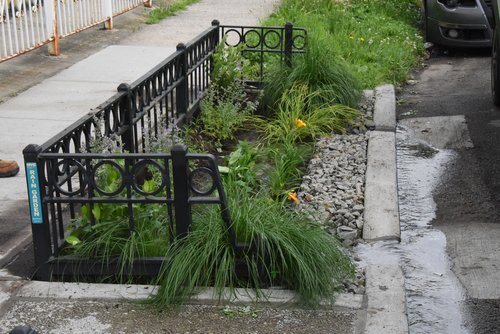
In parallel with the long-term control plans, New York will continue to expand its ongoing green infrastructure program. To date, the city has installed approximately 13,000 rain gardens and other green infrastructure assets. Additional efforts will include the installation of 300,000 feet of porous parking lanes in the boroughs of the Bronx and Brooklyn, according to PlaNYC. The DEP also will work with other city agencies “to retrofit impervious surfaces on public properties to capture stormwater at the source,” the plan states.

At the same time, New York City also has mandated that private developers do more to reduce stormwater runoff. In February 2022, the city enacted its Unified Stormwater Rule, which “requires a retention-first approach to on-site stormwater management for all new construction and redevelopment sites” and “sets new thresholds for compliance with post-construction stormwater management practices,” according to PlaNYC. All told, the city estimates that the rule’s requirements will reduce CSOs by about 360 million gal/yr by 2030.

Looking beyond 2045, New York City will develop a “strategy to end the discharge of untreated sewage into the New York Harbor by 2060,” the plan notes. To be crafted during the “next few years,” the integrated strategy will “further [drive] down CSOs and [achieve] applicable water quality standards in the harbor by 2060,” according to the plan. 

That said, the city acknowledges that CSOs may never be eliminated entirely. New York’s “physical space constraints, topography, geology, and feasible funding mean that very extreme storms could continue to overwhelm even the largest investments in the stormwater system,” according to PlaNYC.

The plan also calls for increased efforts to restore and expand wetlands and green spaces in New York. For example, the city intends to plant 30,000 native trees and shrubs across 10 sites to “restore the health of forested areas, which contributes to reduced flooding and higher quality soil, water, and air,” according to PlaNYC. “This effort, combined with maintenance of existing trees and the formation of public-private partnerships to encourage tree planting on private land, will also support our goal to achieve a 30% tree canopy cover and cool our public realm.”

CLICK HERE TO LEARN MORE: https://www.onewaternews.com/new-york-city-to-eliminate-nearly-all-untreated-sewer-overflows-by-2060
Maui water is unsafe even with filters, one of the lessons learned from fires in California

By Brittney Peterson

The language is stark: People in torched areas of Maui should not try to filter their own drinking water because there is no “way to make it safe,” Maui County posted on its Instagram account this week.

The message reached Anne Rillero and her husband Arnie in Kula, who were eating yet another meal of frozen pizza. The couple feels incredibly lucky they and their home survived the fires that raced across Maui in recent days, wiping most of Lahaina off the map. The number of confirmed fatalities was raised on Friday to 114 people.

When a neighborhood organization alerted them not to drink their water and to air out the house even if they run the tap, the couple decided to eat off paper plates to avoid exposure. No washing dishes.

“It’s alarming that it may be in the water system for awhile,” said Rillero, a retired conservation communication specialist who has lived on the island for 22 years.

Brita filters, devices connected to refrigerators or sinks and even robust, whole-home systems are unlikely to address the “extreme contamination” that can happen after a fire.

“They will remove some of it, but levels that will be acutely and immediately toxic will get through,” said Andrew Whelton, a Purdue University researcher and expert in water contamination after wildfires in urban areas.

The Maui fires damaged hundreds of drinking water pipes, resulting in a loss of pressure that can allow toxic chemicals along with metals and bacteria into water lines.

“You can pull in contaminated or dirty water from the outside, even when those lines are underground,” said David Cwiertny, a civil and environmental engineering professor at the University of Iowa.

Hundreds of families could be in the same situation as the Rilleros in the Lahaina and Upper Kula areas, where people have been told to minimize any contact with county water including showers. In Lahaina alone, aerial imagery and damage assessment data generated by Vexcel Data show 460 buildings apparently undamaged by the fires. These are places where people are returning.

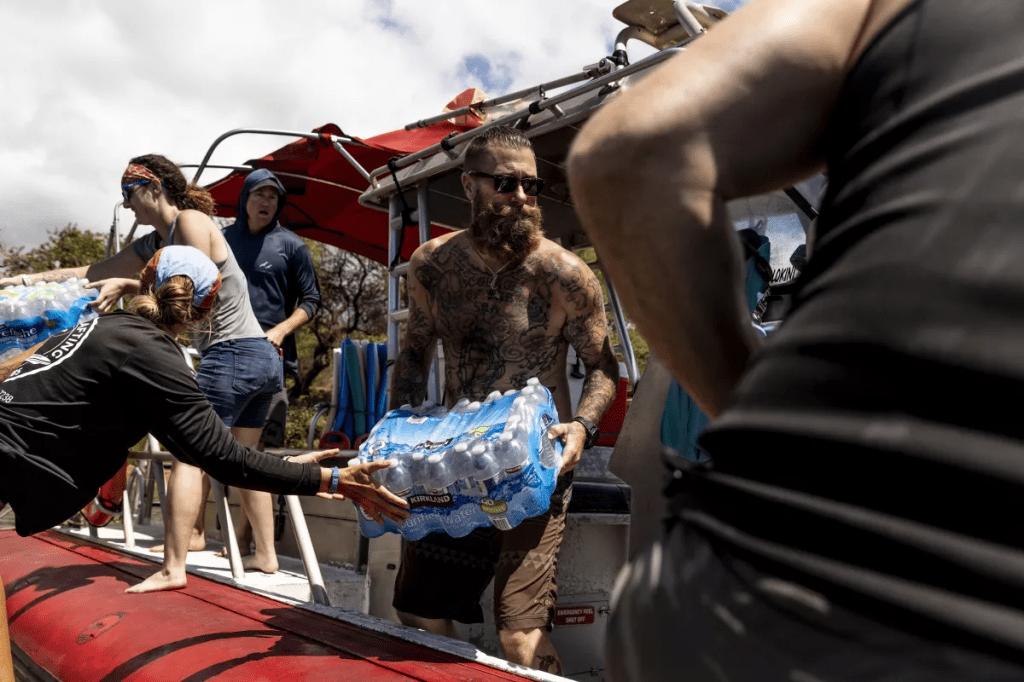
For now, the county has told people to use bottled water for all their needs or to fill jugs at tankers called water buffalos, which have been brought in near the burns.

The state health department’s environmental health division told Maui County, which operates water delivery systems for most residents, to test for 23 chemicals. Those are just the ones for which the federal government has set limits for drinking water.

These warnings reflect new science and are intended to avoid the whiplash of conflicting information received by people impacted by the 2018 Camp Fire in California, who received messages from four different agencies.

Until a few years ago, wildfire was only known to contaminate drinking water at the source, such as when ash runs into a river or reservoir. California’s Tubbs Fire in 2017 and the Camp Fire “are the first known wildfires where widespread drinking water chemical contamination was discovered in the water distribution network,” according to a recent study published by several researchers including Whelton with the American Water Works Association.

After the Camp Fire destroyed Paradise, California, officials didn’t initially understand that smoke and chemicals had leached into the water through broken and melted water pipes. So they did what was standard after other fires: they told people to boil water before use.

Concerned about benzene contamination, the Paradise Irrigation District water utility then changed the order and told people to avoid the water, district Assistant District Manager Mickey Rich said.

Four days later, the California State Water Resources Control Board announced people could drink it as long as it didn’t smell. Two and a half weeks later, that agency announced there was benzene in the water.

Two months after that, a third agency, a county health department, told the public the water was unsafe and not to attempt to treat it on their own.

“There were a lot of unknowns,” Rich said. “When the scientists came six months into the recovery, they really answered a lot of questions that we wish we would have had at the beginning.”

New contaminants also have been discovered recently. The chemicals that Hawaii’s state government told Maui County to test for are called volatile because they tend to become airborne, like gasoline that turns to vapor when it drips from the pump onto your car.

But Whelton’s new research on the Marshall Fire in Boulder County Colorado, shows a group of heavier compounds, called “semi-volatile,” can contaminate damaged water lines as well, even when benzene and other better-known chemicals are not there.

“We found SVOCs leaching from damaged water meters into drinking water,” Whelton said. “You can’t use VOCs to predict whether SVOCs are present.”

For people on Maui who get their water from private wells, now would be a good time to get it tested, said Steve Wilson, a groundwater hydrologist at the University of Illinois, Urbana-Champaign.

If fire burns near a well, it can damage the cap, which keeps out debris. Plastic in the lining can even melt, releasing hazardous fumes into the well.

“In the case of a fire, it may look fine, but it’s hard to know,” Wilson said. “It might have affected something on the inside.”

Experts caution complete restoration of safe water will take a long time.

“I would implore anybody not to make a decision about lifting the water safety order until you have repeated validation that there is no contamination that poses a health risk,” Whelton said.

CLICK HERE TO LEARN MORE: https://www.sandiegouniontribune.com/news/california/story/2023-08-19/maui-water-is-unsafe-even-with-filters-one-of-the-lessons-learned-from-fires-in-california

Tap water study detects PFAS ‘forever chemicals’ across the US

By USGS Communications and Publishing

This USGS research marks the first time anyone has tested for and compared PFAS in tap water from both private and government-regulated public water supplies on a broad scale throughout the country. Those data were used to model and estimate PFAS contamination nationwide. This USGS study can help members of the public to understand their risk of exposure and inform policy and management decisions regarding testing and treatment options for drinking water. 

PFAS are a group of synthetic chemicals used in a wide variety of common applications, from the linings of fast-food boxes and non-stick cookware to fire-fighting foams and other purposes. High concentrations of some PFAS may lead to adverse health risks in people, according to the U.S. Environmental Protection Agency. Research is still ongoing to better understand the potential health effects of PFAS exposure over long periods of time. Because they break down very slowly, PFAS are commonly called “forever chemicals.” Their persistence in the environment and prevalence across the country make them a unique water-quality concern. 

“USGS scientists tested water collected directly from people’s kitchen sinks across the nation, providing the most comprehensive study to date on PFAS in tap water from both private wells and public supplies,” said USGS research hydrologist Kelly Smalling, the study’s lead author. “The study estimates that at least one type of PFAS – of those that were monitored – could be present in nearly half of the tap water in the U.S. Furthermore, PFAS concentrations were similar between public supplies and private wells.”  

The EPA regulates public water supplies, and homeowners are responsible for the maintenance, testing and treatment of private water supplies. Those interested in testing and treating private wells should contact their local and state officials for guidance. Testing is the only way to confirm the presence of these contaminants in wells. For more information about PFAS regulations, visit the EPA’s website on addressing PFAS

The study tested for 32 individual PFAS compounds using a method developed by the USGS National Water Quality Laboratory. The most frequently detected compounds in this study were PFBS, PFHxS and PFOA. The interim health advisories released by the EPA in 2022 for PFOS and PFOA were exceeded in every sample in which they were detected in this study. 

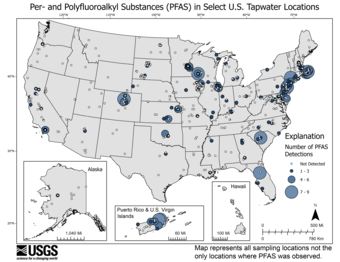
Scientists collected tap water samples from 716 locations representing a range of low, medium and high human-impacted areas. The low category includes protected lands; medium includes residential and rural areas with no known PFAS sources; and high includes urban areas and locations with reported PFAS sources such as industry or waste sites.  

Most of the exposure was observed near urban areas and potential PFAS sources. This included the Great Plains, Great Lakes, Eastern Seaboard, and Central/Southern California regions. The study’s results are in line with previous research concluding that people in urban areas have a higher likelihood of PFAS exposure. USGS scientists estimate that the probability of PFAS not being observed in tap water is about 75% in rural areas and around 25% in urban areas.  

Learn more about USGS research on PFAS by reading the USGS strategy for the study of PFAS and visiting the PFAS Integrated Science Team’s website. The new study builds upon previous research by the USGS and partners regarding human-derived contaminants, including PFAS, in drinking water and PFAS in groundwater

CLICK HERE TO LEARN MORE: https://www.usgs.gov/news/national-news-release/tap-water-study-detects-pfas-forever-chemicals-across-us

New optimization strategy boosts water quality, decreases diversion costs

By Chinese Academy of Sciences

Lakes worldwide are grappling with the effects of eutrophication, such as algal blooms, primarily due to excessive nitrogen and phosphorus. The detrimental environmental effects of anthropogenic activities and climate change further aggravate the situation, thereby necessitating improved and effective measures.

Inter-basin water diversion has emerged as a prominent solution, with projects like the South-North Water Diversion Project and the Niulan River–Dianchi Water Diversion Project in China. These projects aim to enhance the lake water quality by augmenting available water resources and accelerating water circulation. However, traditional water diversion measures have struggled with the conundrum of enhancing water quality while minimizing the volume of diverted water.

In a new study published in the journal Environmental Science and Ecotechnology, researchers from Peking University developed an innovative strategy, called Dynamic Water Diversion Optimization (DWDO), to underscore the pressing need to address the persistent challenge of improving water quality in eutrophic lakes.

This innovative strategy, which couples deep reinforcement learning with a complex water quality model, was tested in Lake Dianchi, China’s largest eutrophic freshwater lake. The DWDO model significantly reduced total nitrogen and total phosphorus concentrations by 7% and 6%, respectively, while annual water diversion saw a staggering drop of 75%.

DWDO integrates deep reinforcement learning into a comprehensive water quality model. This ground-breaking method identifies the impacts of various factors, such as meteorological indicators and the water quality of both the source and the lake, on optimal water diversion. It demonstrates the adaptability of water diversion in response to a single input variable’s specific value and multiple factors influencing real-time adjustment of water diversion.

DWDO’s efficacy lies in its robustness under different uncertainties and shorter theoretical training time compared to traditional simulation-optimization algorithms. This robustness allows it to support effective decision-making in water quality management, thereby expanding its potential for broader application. The researchers were also able to extract key insights from DWDO through interpretable machine learning. They uncovered the significant drivers behind the optimal diversion decisions and their contributions to water quality improvement.

DWDO was also rigorously tested under diverse sets of hyperparameters, confirming its robustness and flexibility.

Overall, the DWDO strategy provides a promising tool for eutrophication control. By ensuring a dynamic balance between water quality improvement and operational costs, DWDO could become an essential part of future water quality management and restoration strategies.

This innovative approach marks a significant advance in tackling the global challenge of improving water quality in eutrophic lakes. As we continue to face the twin threats of increasing anthropogenic activities and climate change, the demand for such adaptive and robust solutions will only intensify.

CLICK HERE TO LEARN MORE: https://phys.org/news/2023-07-optimization-strategy-boosts-quality-decreases.html

Out of danger because the UN said so? Hardly. The Barrier Reef is still in hot water

By Ove Hoegh-Guldberg

Today is a good day to be Environment Minister Tanya Plibersek. UNESCO, the United Nations body expected to vote on whether to list the Great Barrier Reef as “in danger,” instead deferred the decision for another year. This, an insider told French newspaper Le Monde, was largely due to the change in approach between the former Coalition government and Labor.

“It’s a bit like night and day,” the insider said—which was promptly included in Plibersek’s media release.

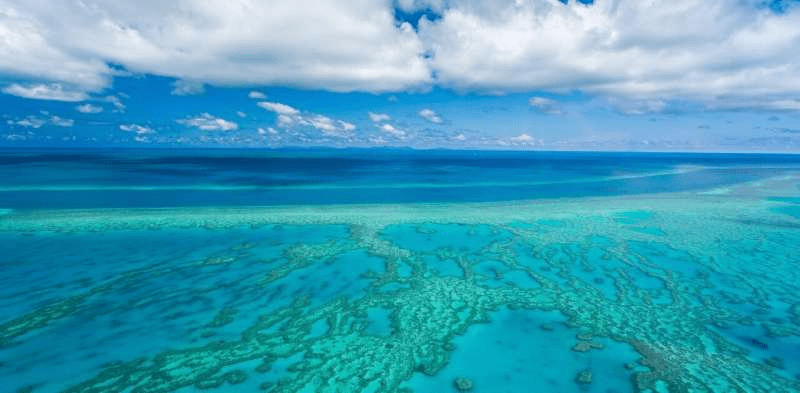
So, it’s a good day for the government. But is it a good day for the reef? No. The longstanding threats to the world’s largest coral ecosystem are still there, from agricultural runoff, to shipping pollution, to fisheries, although we have seen improvement in areas such as water quality.

But any incremental improvement will be for naught if we don’t respond to the big one—climate change—with the necessary urgency. This year has seen record-breaking heat and extreme weather, with intense heating of the oceans during the northern summer. These intense marine heatwaves have devastated efforts to regrow or protect coral in places like Florida. And our own summer is just around the corner.

It is not hyperbole to say the next two years are likely to be very bad for the Great Barrier Reef. It’s already enduring a winter marine heat wave. Background warming primes the reef for mass coral bleaching and death. We’ve already experienced this in 2016–17, which brought back-to-back global mass coral bleaching and mortality events including on the Great Barrier Reef. We can expect more as global temperatures continue to soar.

While the government may congratulate itself on not being the previous one, it’s nowhere near enough. We’re facing D-Day for the reef, as for many other ecosystems. Incrementalism and politics as usual are simply not going to be enough.

What has the government done for the reef to date?

To its credit, Labor has made some marginal improvements to the Great Barrier Reef’s prospects. The list includes: legislating net zero greenhouse emissions, with a 43% cut within seven years; improving water quality with revegetation projects and work to reduce soil erosion; and ending gillnet use in the Great Barrier Reef Marine Park by 2027.

For at least a century, cattle, sugarcane and other farmers have relied on rivers to take animal waste and fertilizer runoff away from their properties. In much of Queensland, that means the runoff heads for the Great Barrier Reef instead. We did see some improvement under the Coalition government, which put A$443 million into trying to solve the issue. Labor has put in a further $150 million. But the water quality problem is still not solved.

Ending gillnet use in the marine park is also welcome, given these nets can and do catch and kill sharks, dugongs and turtles. But challenging though these issues are, they pale in comparison to climate change.

Tinkering while the reef burns

When coral is exposed to warmer water than it has evolved to tolerate, it turns white (bleaches)—expelling its symbiotic algae. If the water stays too hot for too long, the corals simply die en masse.

You might have seen the positive reports on coral regrowth during the three recent cooler La Niña years and wonder what the issue is. Isn’t the reef resilient?

Yes—to a point. But after that point, the coral communities collapse. The world is having its hottest days on record. Coupled with a likely El Niño, the reef will likely face the hottest waters yet.

That’s because we still haven’t tackled the root cause. Greenhouse gas emissions are still going up. Year on year, we’re trapping more heat, of which 90% goes into the oceans. Antarctic sea ice is not reforming as it should after last summer. Coral restoration efforts in the United States had to literally pull their baby corals out of the sea to try to keep them alive, as the water was too hot to live in.

The North Atlantic Ocean is far warmer than it should be, amid a record-breaking northern summer. After the equinox next month, it will be our turn to face the summer sun once more.

Is the Great Barrier Reef in danger? Of course it is. We should not pretend things are normal and can be handled routinely. This year, we’re beginning to see the full force of what the climate crisis will bring. We have clearly underestimated the climate’s sensitivity to rising carbon dioxide levels, and the gloomy predictions I made more than 20 years ago are looking positively optimistic.

And still we fail to face up to the fact that the Great Barrier Reef is dying. We thought we might have had decades but it may be just years. Before 1980, no mass bleaching had ever been recorded. Since then it has only become more common.

Incremental efforts to save the reef, such as looking for heat-tolerant “supercorals”, or replanting baby coral, now look unlikely to work. We don’t have decades or the capacity to find and cultivate resilient corals at scale. And we certainly do not have the massive funding required to replant even a small coral reef.

For people like us who work in the field, it is a devastating time. I now know the feeling of having a broken heart. The pace and intensity of climate change risks rendering all our efforts over the years null and void. It’s almost impossible to look directly at what this will mean for this immense living assemblage, which first began growing more than 600,000 years ago along the Australian east coast.

Giving the government more time to show the reef is improving seems like a fool’s errand. Time is precisely what we don’t have.

CLICK HERE TO LEARN MORE: https://phys.org/news/2023-08-danger-barrier-reef-hot.html

Nitrogen runoff strategies complicated by climate change

By Carnegie Institution for Science

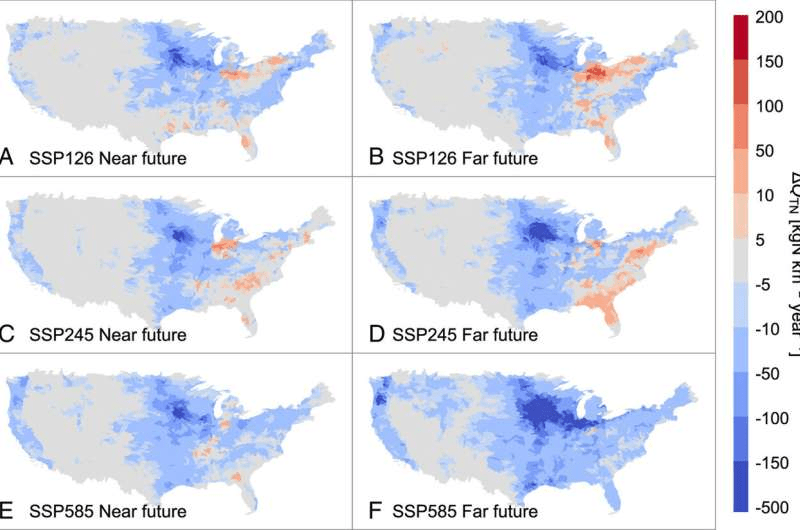
As climate change progresses, rising temperatures may impact nitrogen runoff from land to lakes and streams more than projected increases in total and extreme precipitation for most of the continental United States, according to new research from a team of Carnegie climate scientists led by Gang Zhao and Anna Michalak published in the Proceedings of the National Academy of Sciences.

The conditions predicted by these findings are opposite to recent decades, in which increasing precipitation has outpaced warming and led to more aquatic nitrogen pollution. Understanding the relative roles of changes in temperature and rainfall is critical for designing water quality management strategies that are robust to climate change while ensuring sustainable food and water supplies.

Human activity has completely altered how nitrogen moves through the planet’s aquatic, terrestrial, and atmospheric systems. Nitrogen from fertilizer washes into waterways, and in excess, can lead to toxin-producing algal blooms or low-oxygen dead zones called hypoxia. Over the past several summers, large algal blooms in lake and coastal regions across the United States have received extensive news coverage.

Carnegie’s Anna Michalak and her team have spent the last decade studying how climate change will affect nitrogen runoff and the subsequent risks posed to water quality. One of the biggest questions for those working to understand and prevent serious water quality impairments is the balance between how changes in temperature and changes in precipitation will affect nitrogen pollution’s ability to get into at-risk waterways.

“The complex soil and aquatic systems through which nitrogen travels, the chemical transformations it undergoes along the way, and the various ways in which changes in temperature and precipitation will affect these processes make nutrient management a big challenge,” Zhao explained.

For example, average and extreme precipitation affects how much nitrogen runs off the land and into waterways, as well as how long it takes for the nitrogen to reach lakes or coastal zones, where it can eventually create dangerous conditions. Temperature also indirectly impacts how much nitrogen ends up in waterways, because warming temperatures increase evaporation, preventing it from going into streams. Additionally, temperature affects how nitrogen interacts with microbial life in the soil and sediment, potentially trapping it there or altering its course.

“Although the impacts of climate change-induced shifts in precipitation patterns have been explored, the effect of temperature increases on the movement of nitrogen into rivers has not been quantified at continental scales until now due to a lack of available data,” Zhao added.

Zhao, Michalak, and their Carnegie colleagues Julian Merder and Tristan Ballard analyzed several decades of data tracking nitrogen’s movement through river systems across the continental United States and used it to project future trajectories for nitrogen movement under climate change scenarios. They determined that rising temperatures will likely offset—or even decrease—the amount of excess nitrogen flushed into rivers for the majority of the U.S., despite a predicted uptick in precipitation.

These findings are counter to recent decades, when precipitation was the dominant factor over temperature in determining the amount of nitrogen that built up in U.S. waterways. Zhao, Michalak, and their colleagues say that this work forms a critical baseline for future research on the interplay between the nitrogen cycle and climate change.

“Our research illustrates the complex and sometimes surprising ways that climate change affects our planet’s dynamic systems,” Michalak concluded. “Untangling the various factors that are altering the climate change impacts on water quality will help farmers, land managers, and policymakers to pursue the best possible strategies for ensuring that we safeguard water quality, while simultaneously ensuring sustainable food production and water supply.”

CLICK HERE TO LEARN MORE: https://phys.org/news/2023-08-nitrogen-runoff-strategies-complicated-climate.html

EPA moves to give states, tribes more power to protect water

By Michael Phillis and Suman Naishadham

WASHINGTON (AP) — The Biden administration on Thursday proposed undoing a Trump-era rule that limited the power of states and Native American tribes to block energy projects like natural gas pipelines based on their potential to pollute rivers and streams.

The Clean Water Act allows states and tribes to review what effect pipelines, dams and some other federally regulated projects might have on water quality within their borders. The Trump administration sought to streamline fossil fuel development and made it harder for local officials to block projects.

The Biden administration’s proposed rule would shift power back to states, tribes and territories.

Environmental Protection Agency Administrator Michael Regan said in a statement that the agency’s draft regulation would empower local entities to protect water bodies “while supporting much-needed infrastructure projects that create jobs.”

Thursday’s action is the latest move by the Biden administration to tighten water regulations loosened under the Trump administration.

The Trump rule required local regulators to focus their reviews on the pollution that projects might discharge into rivers, streams and wetlands. It also rigidly enforced a one-year deadline for regulators to make permitting decisions. Some states lost their authority to block certain projects based on allegations they blew the deadline.

Now, the EPA says states should have the authority to look beyond pollution discharged into waterways and “holistically evaluate” the impact of a project on local water quality. The proposal would also give local regulators more power to ensure they have the information they need before facing deadline pressure to issue or deny a permit.

The public will have an opportunity to weigh in on the EPA proposal before it is finalized. The final rule isn’t expected to go into effect until the spring of 2023.

For now, the Trump-era rule remains in effect.

Robin Rorick, a vice president at the industry group American Petroleum Institute, said the energy industry doesn’t need more “red tape.” The proposal may lead to unnecessary delays.

“We support the Clean Water Act and are concerned these actions would counteract the well-defined timeline and review process enacted by Congress,” Rorick said in a statement.

But environmental groups praised the Biden administration’s action.

“Before the Trump administration got involved, the interpretation had been the more holistic approach,” said Moneen Nasmith, a senior attorney at Earthjustice. The environmental group represented three tribes in a lawsuit that challenged the Trump administration’s rollback.

Former President Donald Trump had argued that states were improperly wielding the Clean Water Act to block needed fossil fuel projects.

New York, for example, has used its review authority to deny certain natural gas pipeline projects. Washington refused to issue a permit for a coal export terminal in 2017.

In 2020, EPA officials said the Clean Water Act shouldn’t be used to hold infrastructure projects hostage and finalized its rule that curtailed state and tribal power.

Washington state’s Attorney General Bob Ferguson applauded EPA’s move, calling it a “major improvement over the Trump administration’s rule.”

The Trump rule was challenged in federal court by a coalition of environmental groups and several states including New York and Washington. Oil and gas industry trade associations and several predominantly Republican-led states defended it.

The rule was tossed by a federal judge, but in April a divided Supreme Court reinstated it. The Supreme Court’s three liberal justices and Chief Justice John Roberts dissented, saying supporters of the rule hadn’t shown that they would be sufficiently harmed by the lower court’s ruling.

Certain energy projects like natural gas pipelines that cross state lines must be reviewed by federal agencies. The Clean Water Act says if a project discharges material into federally regulated waters, states, territories and tribes have the right to review whether those discharges are lawful.

CLICK HERE TO LEARN MORE: https://apnews.com/article/environment-climate-and-water-quality-government-politics-9057b0dbb146b6d45d364720665a67dd

Oil pipeline construction in Minnesota ruptured an aquifer. Officials say it’s the 4th time

By Unknown

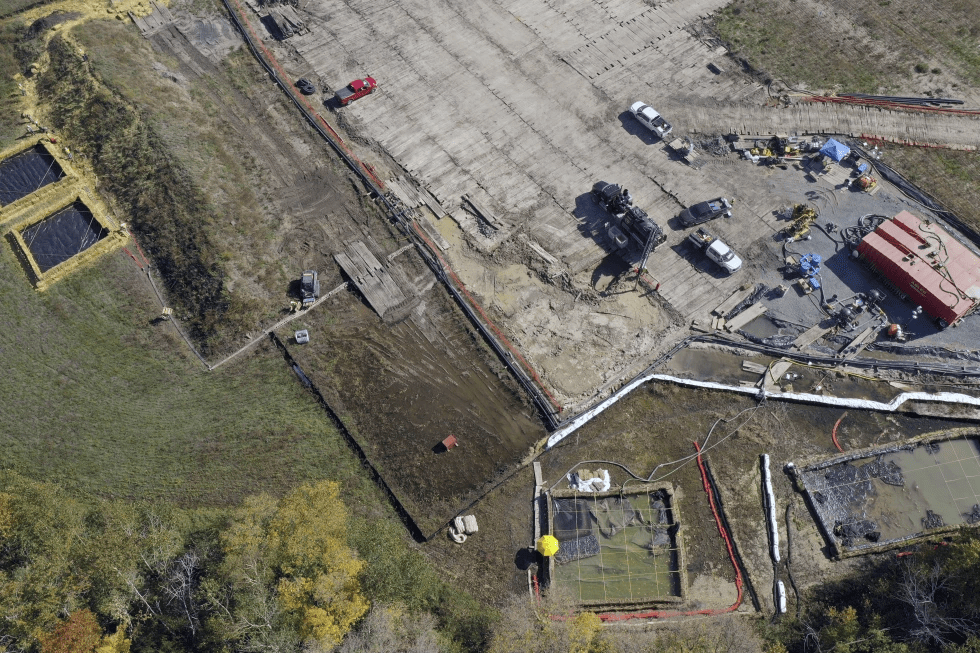
ST. PAUL, Minn. (AP) — A fourth aquifer breach has been confirmed in northern Minnesota stemming from a Canadian oil company’s construction of an oil pipeline replacement in the region, state officials said.

Officials with Enbridge Energy and the Minnesota Department of Natural Resources confirmed to the Minneapolis Star Tribune that the breach occurred near Moose Lake in Aitkin County. Officials said Enbridge is working to fix the rupture, in which the layer of earth above an aquifer is punctured, causing the water to leak to the surface and possibly introducing pollutants.

It’s the fourth confirmed breach along the Line 3 pipeline route, which started operating in the fall of 2021 and generated fierce opposition from environmental activists and Native American tribes. Last October, state regulators announced that Enbridge would pay more than $11 million for water quality violations and the three previous aquifer breaches.

An aquifer is a natural underground reserve of fresh water capable of being tapped by wells. Environmentalists say such groundwater reserves face a multitude of threats from human populations, including depletion from overuse, pollution from agriculture and septic systems and contamination from pipeline construction and spills.

Groundwater at the Moose Lake breach is flowing to the surface at about 10 to 15 gallons per minute, department officials said. That’s “considerably lower” than the rate at which groundwater initially flowed from the other three breaks, the agency said.

Enbridge will submit a plan to correct the Moose Lake area damage and will implement it when it’s approved, company spokeswoman Juli Kellner said in a statement. The aquifer breaches don’t involve the pipe itself, she said. It stems from sheet-metal piling driven into the ground used to reinforce the trenches that crews work in.

CLICK HERE TO LEARN MORE: https://apnews.com/article/enbridge-oil-pipeline-breach-minnesota-3aec2792d9a6cae11be9c7ae8179cad2

Dead fish in San Francisco Bay Area blamed on toxic red tide

By Terry Chea and Olga R. Rodriguez

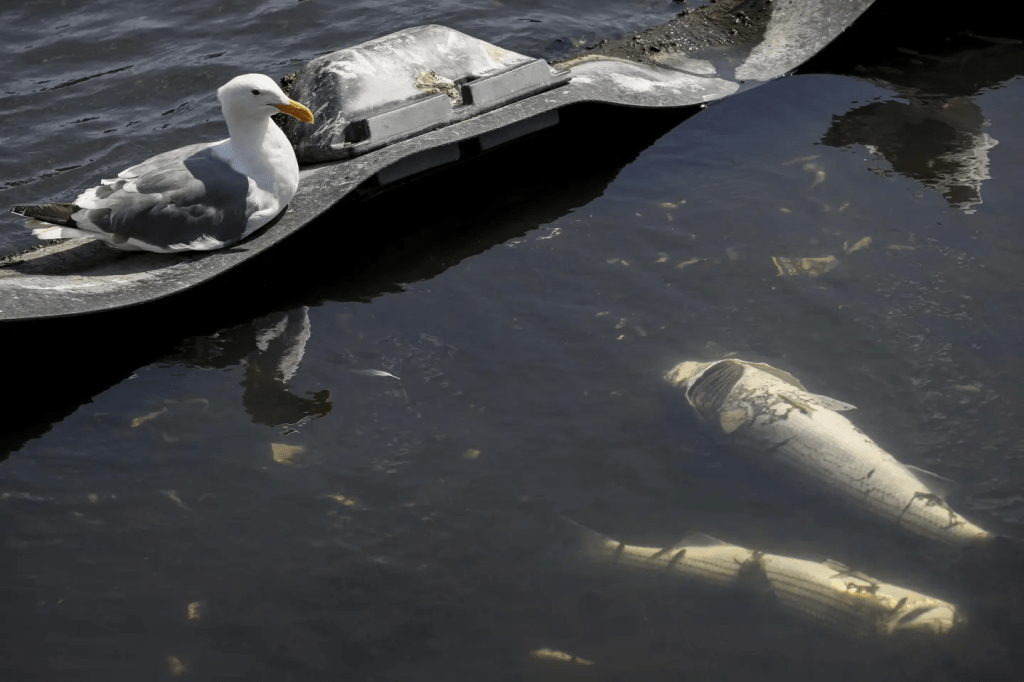
OAKLAND, Calif. (AP) — An unprecedented red tide in the San Francisco Bay Area is killing thousands of fish and other marine life whose carcasses are washing ashore, creating a foul odor that experts say could get worse during this weekend’s expected heat wave.

At Oakland’s Lake Merritt, a popular spot for joggers, walkers and those looking to be in nature, crews on Wednesday began removing dead crabs, bat rays, striped bass and other fish that began piling up on its rocky shores over the weekend.

The fish die-off at Lake Merritt and throughout the Bay Area may be due to a harmful algae bloom that has been spreading in the region since late July, said Eileen White, executive officer of San Francisco Bay Regional Water Quality Control Board.“We normally have algae blooms during the summertime. But what’s unusual about this one is how large it is and the fact that there are fish kills,” White said.

Most algae blooms end after a week or so. But a triple-digit heat wave forecast for the holiday weekend may help the Bay Area’s grow even more, White said. She said that reports of dead fish started coming in last week.

“This was a natural occurrence of Mother Nature and so, we don’t know when it’s going to end,” she said

A microorganism called Heterosigma akashiwo formed a bloom first spotted in the Alameda Estuary, White said. It is present in the bay all the time, but scientists are trying to determine what caused it to spread so far and wide and for so many weeks.

They say a years-long drought has prevented stagnant water from flowing into the ocean and unseasonably warm and sunny weather may be helping the algae spread.

Jon Rosenfield, a scientist with the San Francisco Baykeeper conservation group, said high levels of nutrients like phosphorus and nitrogen in wastewater also drive the growth of algae blooms.

“The only lever that we have to control the problem is to reduce nutrients put into the bay from the 40 wastewater treatment plants that operate around the bay,” he said.

Rosenfield said sewage treatment plants are cleaning the water of solid material and bacteria, but they’re not designed to pull out nitrogen and phosphorus.

Treating the water for nutrients would cost billions of dollars, and those costs would be passed on to residents, White said. She said water districts are funding studies to understand the effects of nutrients that have been present in the water since people settled in the area.

“The goal is to make the appropriate regulations based on sound science,” White said.

Experts are also trying to determine what exactly is killing the fish.

Algae blooms produce a toxin that is lethal to fish and other marine life, and as they spread, bacteria in the water start to consume the algae. As it decays, it depletes the water of oxygen, leading the fish to suffocate, Rosenfield said.

“Which of those mechanisms is operating here, the toxin or the low dissolved oxygen? We just don’t know yet,” he said.

Algae bloom has been reported in Contra Costa and Marin counties to the north and San Mateo County to the west. In the South Bay, concentrations of chlorophyll — an indicator of algae density —measured on Aug. 10 were the highest observed in more than 40 years, White said.

In Oakland, people turned to social media to post photos of some of the thousands of dead fish at Lake Merritt, where visitors have started complaining about the stench.

“It doesn’t smell very good right now, so it’s a bit of a nuisance,” said Graham Webster, who jogs around the lake once or twice a week.

“But the bigger question is what’s happening to the lake and the bay? And what’s causing it? Is it our fault? Can it be fixed?” he asked.

White said the algae aren’t known to be toxic to people, but they can cause skin and eye irritation. Her office is recommending people and pets stay out of any water that looks reddish-brown.

Cely Aquino said she visits Lake Merritt regularly and seeing all the dead fish was sad.

“I saw a lot of the dead fish, and I saw a couple of stingrays that were dead also. It’s pretty sad,” she said. “But I figure nature it’s going to take care of it all.”

CLICK HERE TO LEARN MORE: https://apnews.com/article/lakes-san-francisco-fish-oakland-81f90e972270abcf566549f92dedb5a9

5,350 United States Based Water Systems Are In Direct Violation Of Lead Laws

By US Water News

It is a shocking water and health and safety statistic that will leave more than just a bad metallic after taste in the mouths of most Americans this year. In fact Eighteen million Americans live in communities where the water systems are in violation of the federal laws that dictate just how much lead should sit within our drinking water. A dangerous water quality situation that could accelerate health insurance claims and increase the cost of medical cover for the many affected citizens living in towns and cities across the US.

Moreover, the federal agency in charge of making sure those water systems are safe not only knows the health and safety issues exist with the water supply, but it’s done very little to stop them, according to a new report and information provided by multiple sources and water experts from around the country.

A Farcical Water Health and Safety Situation That Must Be Stopped

Consider this scenario for a moment. “Imagine a cop sitting, watching people run stop signs, and speeding across town at 100 miles per hour in small communities and still doing absolutely nothing about it, knowing the people who are violating the law. And doing nothing. That’s unfortunately what we have now,” said Erik Olson, health program director at Natural Resources Defense Council, which analyzed the EPA’s data for its report.In this case, the “cop” is a combination of the states and the EPA. States are the first line of enforcement, but when they fail — as they did recently in Flint, Michigan — the EPA is supposed to step in. But in many cases, the agency hasn’t.

Clear Excess Lead Violation In US Water Systems

More than 5,300 water systems in America are in violation of the EPA’s lead and copper rule, a federal regulation in place to safeguard America’s drinking water from its ageing infrastructure.
Violations include failure to properly test water for lead, failure to report contamination to residents, and failure to treat water properly to avoid lead contamination.

Yet, states took action in 817 cases; the EPA took action in just 88 cases, according to NRDC’s report.
What’s worse, the report reveals that the EPA is also aware that many utilities “game the system,” using flawed or questionable testing methods in order to avoid detecting high levels of lead.
That means there could be many more communities violating the laws, exposing residents to dangerous levels of lead. And the public has no idea.

Even Flint, a city with the most notorious case of lead in water discovered, is still not listed as having violated the EPA’s lead and copper rule.
In response to the report, the EPA said it works closely with states “who are responsible for and do take the majority of the drinking water enforcement actions and are the first line of oversight of drinking water systems.”
The agency added that, “it’s important to note that many of the drinking water systems that NRDC cites in its analysis are already working to resolve past violations and return to compliance with the Safe Drinking Water Act in consultation with state regulators or EPA.”

The Philadelphia Water Quality Scandal

Experts say Philadelphia is a perfect example of the EPA unwilling to act, and having too cozy a relationship with local regulators.
The city has come under scrutiny recently for only testing less than 40 of an estimated 50,000 homes with lead service lines.

City officials say that’s all they could find after putting out 8,000 requests to residents. Seven homes had high lead levels.
After the Flint water crisis, the EPA in February issued new guidance instructing water authorities to stop pre-flushing taps and other practices that were considered “cheating.”

Our Verdict on Lead in the Water Supply

One thing is crystal clear, if the situation with excess lead in the water supply of so many US homes is going to be curbed, it will take more than just tough talk to see it done as we move into 2018. Clean lead free drinking water is what we all expect and we expect the water companies to robustly monitor the quality of water that is distributed to customers. There are no legitimate excuses for failure or gaming the system.

CLICK HERE TO LEARN MORE: https://www.uswaternews.com/5350-united-states-based-water-systems-are-in-direct-violation-of-lead-laws/