

The fifth annual SDG 6 Water Action Agenda Special Event, co-hosted by UN‑Water and the United Nations Department of Economic and Social Affairs, took place at the 2025 High‑Level Political Forum on Sustainable Development (HLPF) in New York on 22 July 2025.
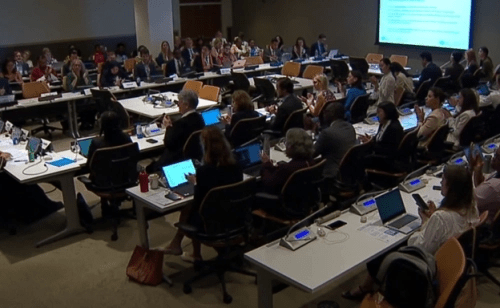
The event reviewed progress on Sustainable Development Goal 6 and its interlinkages with broader UN priorities.
UN-Water launched the fourth series of the SDG 6 Country Acceleration Case Studies, spotlighting practical examples from Bhutan, Rwanda, and Saudi Arabia, showing how targeted policy interventions and coordinated UN support helped drive results.
The event featured a fireside chat between UN-Water Chair Alvaro Lario and Bob Rae, President of the 2025 session of the UN Economic and Social Council, reflecting on the transformative potential of Artificial Intelligence (AI) for sustainable water management.
Looking ahead to the 2026 UN Water Conference, the event included a dialogue where commitment-holders and Member States explored how to sustain momentum through inclusive, collaborative processes.The fifth annual SDG 6 (clean water and sanitation) special event during the High-Level Political Forum (HLPF) launched three new SDG 6 Country acceleration case studies. The half-day event also hosted a dialogue on the interconnections and expectations for AI and water, followed by statements about countries’ commitments to water action. The Special Event took place alongside the High-Level Political Forum (HLPF), on 22 July 2025, in New York, US.
Alvaro Lario, UN-Water Chair and President of the International Fund for Agricultural Development (IFAD), opened the special event and highlighted the recent launch of the Collaborative Implementation Plan (CIP) for the UN System-wide Strategy for Water and Sanitation. He also looked forward to discussions on the 2026 UN Water Conference, which will be co-hosted by the United Arab Emirates (UAE) and Senegal and will take place in the UAE, and the 2028 UN Water Conference, which will take place in Dushanbe, Tajikistan.
Li Junhua, Under-Secretary-General for Economic and Social Affairs, noted that the following themes for the 2026 UN Water Conference had been agreed on 9 July: Water for people, Water for prosperity, Water for planet, Water for cooperation, Water in multilateral processes, and Investments for water.
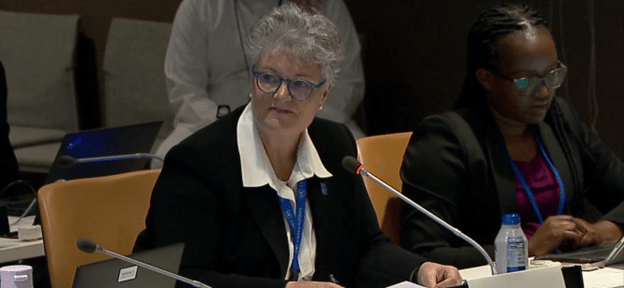
Launch of the SDG 6 Country Acceleration Case Studies
Mary Matthews, UNDP and UN-Water Senior Programme Manager, presented the three country case studies and highlighted recommendations and lessons learned in each country. Leaders from the three countries then commented on their national experiences.
In the Bhutan case study, Matthews highlighted that drivers of progress were identified as: the national prioritization of water; the establishment of a legal and policy framework; progressive implementation of plans and programmes; empowerment of local authorities to lead WASH initiatives; diversified sources of financing; and a low level of corruption.
In the Rwanda case study, Matthews noted the report indicates progress has been made due to the intersectoral coordination of policy under the Office of the Prime Minister and scaling planning and evaluation down to the district level, among others.
In the Saudi Arabia case study, Matthews noted the country’s Vision 2030 has inspired reform in all sectors, its National Water Strategy 2030 has provided a policy framework, and the government began purchasing desalinated water from the private sector.
Across the case studies, Matthews noted that: people and businesses were major sources of the solutions; non-conventional water is playing a key role; public investment has been critical in almost all case studies; and political leadership is essential.
Tshering Tobgay, Prime Minister, Bhutan, highlighted that his country has:
- prioritized governance and let it be people centered, with its water vision based on consultations and governance not just focusing on policies, but listening to people;
- financed “boldly and intelligently” by combining international loans, development grants, and user fees that help regulate demand;
- built institutions and human capacity;
- let data speak; and
- trusted and empowered youth and let them lead.
He said climate change is Bhutan’s next challenge, with 21.4% of its water sources drying up. He concluded by recommending that other leaders “Listen to your people, back vision with values, empower youth, and never take water for granted.”
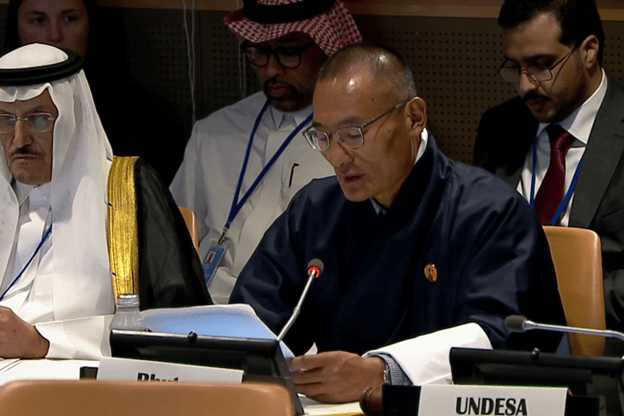
Abdulaziz Al-Shaibani, Deputy Minister for Water, Saudi Arabia, and Tshering Tobgay, Prime Minister, Bhutan
Abdulaziz Al-Shaibani, Deputy Minister for Water, Saudi Arabia, highlighted the following lessons:
- secure high-level political will and commitment;
- set goals, indicators, and assign responsibilities across the value chain;
- engage the private sector as a partner in service delivery and infrastructure;
- leverage data and innovation to improve delivery; and
- forge partnerships and international cooperation, such as with G20 and UN-Water, and convene global events, such as Saudi Water Week.
He invited participants to participate in the 2027 World Water Forum, which will take place in Saudi Arabia.
Gemma Maniraruta, Director General of Water and Sanitation, Ministry of Infrastructure, Rwanda, noted the benefits of intersectoral coordination, including by ensuring that water-related policies and decisions align with Rwanda’s broader development priorities. Efforts on transboundary water resources cooperation have also been undertaken, and noted that cooperative transboundary river management is a contribution to regional integration and diplomacy, builds trust, and ensures equitable resource use. She highlighted efforts to invest in human resources, including through support for the education and training of Rwandan nationals in internationally accredited institutions.
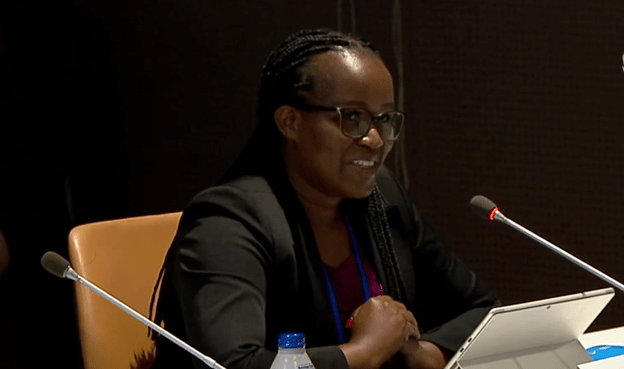
Gemma Maniraruta, Director General of Water and Sanitation, Ministry of Infrastructure, Rwanda
Ligia Noronha, Assistant Secretary-General and Head of the New York Office of the UN Environment Programme (UNEP), offered closing remarks for the session, highlighting that SDG 6 is not a stand alone goal but is central to achieving the other goals. She noted links between the strategies and the environment, and noted in particular Bhutan’s efforts to protect forests and adopt nature-based solutions, Saudi Arabia’s efforts to integrate governance, and Rwanda’s efforts to link its efforts to global objectives. She noted that UNEP develops tools to support countries.
During a discussion, a representative from the Children and Youth major group noted that water security is linked to biodiversity, food and climate. Other speakers noted that water is a human right and asked how synergies between the UN Water Conferences and other multilateral environmental agreements could be built.
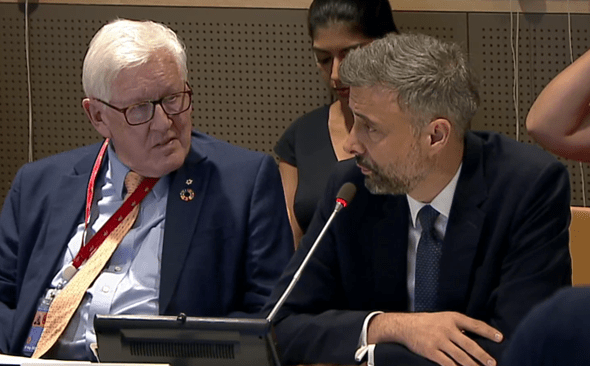
Bob Rae, President of the 2025 session of the Economic and Social Council, and Alvaro Lario, UN-Water Chair and President of IFAD
Fireside chat: Water and Artificial Intelligence
Aarathi Krishnan, founder of AI firm RAKSHA, moderated a conversation between Bob Rae, President of the 2025 session of the Economic and Social Council, and Alvaro Lario, UN-Water Chair and President of IFAD, on questions related to water and AI.
Rae recalled that AI is a tremendous user of energy, which he said represents a serious problem. He also noted that utilities have been assuming energy use would decline. Rae highlighted that AI has been expected to help us use water more efficiently, for example by informing us when leaks occur. He said AI should be seen as a tool that can be helpful in using a scarce resource more efficiently, but added that whether that happens is a political question that involves money, resources, and financing.
Alvaro said we need some guardrails for the technology, and its clear and present harms need to be addressed. He said water utilities need capacity and expertise to use AI, and that such capacity should not only be available to the private sector.
In closing, speakers noted that AI brings unprecedented potential along with profound responsibilities.
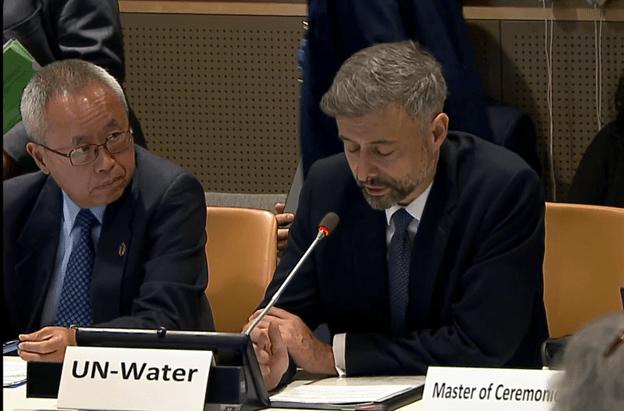
Li Junhua, Under-Secretary-General for Economic and Social Affairs, and Alvaro Lario, UN-Water Chair and President of the International Fund for Agricultural Development (IFAD)
Sustaining Momentum: Building toward the 2026 UN Water Conference
Representatives from the 2023 UN Water Conference host countries offered reflections on lessons from the 2023 conference.
Jonibek Hikmat, Permanent Representative of Tajikistan to the UN, noted that the Water Action Agenda gathered over 800 commitments. He recalled that the 2023 UN Water Conference led to the appointment of a Special Envoy on Water and the UN System-Wide Strategy on Water and Sanitation.
Anna Pot, Ministry of Foreign Affairs, the Netherlands, noted that Voluntary National Reviews (VNRs) are one area in which countries can share their experiences on water. She said the water conferences need to evolve into a platform for action and impact.
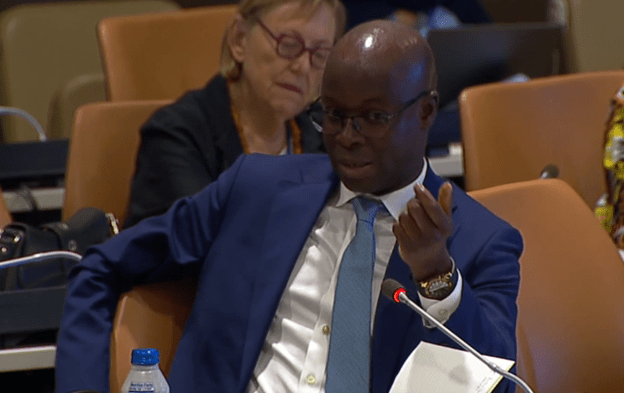
Diamane Diome, Deputy Permanent Representative of Senegal to the UN
Water Action Agenda Commitment Holders: Rapid Progress Pitches
Representatives from a number of countries and organizations then discussed their commitments and progress. They noted the importance of water diplomacy and the need to focus on implementation. Germany and Finland indicated their interest in co-chairing an interactive dialogue during the 2026 Water Conference.
Efforts of 10 multilateral development banks (MDBs) to collaborate on water funding was discussed, as was the recent launch of the first joint MDB report on water. The World Bank Group reported it has a new global water strategy.
A representative from UNDRR noted that water connects 90% of disasters worldwide, either because of too much or too little water. She said UNDRR is working to improve the data on hazardous events. The need to change behaviors was mentioned, with a call for reaching people through their faith traditions.
During the discussion, representatives from youth cautioned against the commodification of water and called for including them in decision making. Speakers also suggested developing case studies on tribal and First Nations water policies.
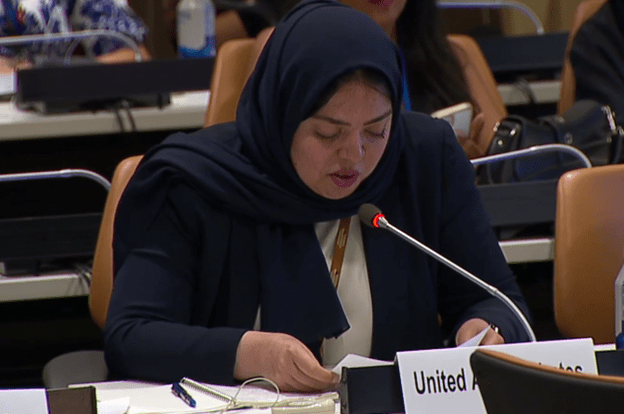
Fatema Yousuf, Deputy Permanent Representative of the UAE to the UN
2026 UN Water Conference Co-hosts Closing Remarks
Fatema Yousuf, UAE Deputy Permanent Representative to the UN, said the next step for the 2026 Conference will be the selection of co-chairs for the interactive dialogues. She said the co-hosts will work with stakeholder groups in the lead up to conference.
Diamane Diome, Deputy Permanent Representative of Senegal to the UN, said his country wants to make water be at the heart of the UN, including through regular meetings on water.
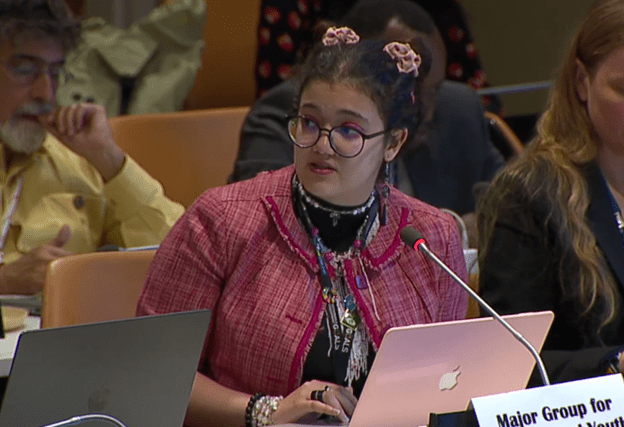
Representative of the Major Group for Children and Youth
CLICK HERE FOR MORE INFORMATION
https://enb.iisd.org/sdg-6-water-action-agenda-special-event
 GET WET!