

By Max Chesnes
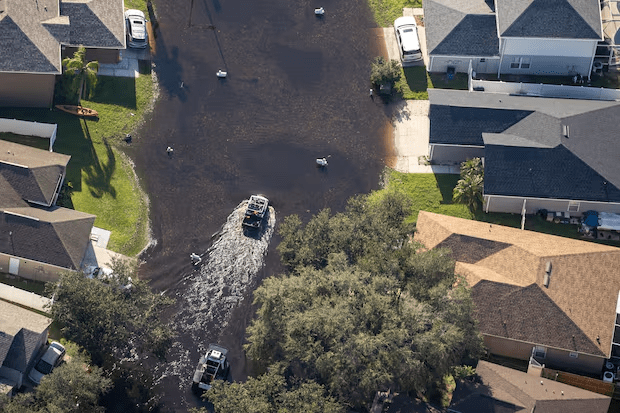
For Michael Rogal, those first few days back on the water after two hurricanes were memorable.
The professional Tampa Bay fishing charter captain recalls finding a dumpster wedged deep into a mangrove forest. He remembers a portable toilet toppled on its side, submerged in the bay. He noticed the water, still flooded from days of runoff, was a deep brownish hue.
“It was like a super dark sweet tea,” said Rogal, a third generation Floridian and owner of Bay Native Fishing. “You couldn’t see through it.”
Anecdotally, the initial reports from those who spend their careers on the water — anglers, scientists, tour guides — remarked that Tampa Bay’s waters were in rough shape in the first few weeks after hurricanes Helene and Milton. Early notices, warning of spilled pollution, began to paint a clearer picture of the unfolding environmental toll.
Perhaps the most detailed description yet of Tampa Bay’s ecological health was unveiled earlier this week. The stories told by Rogal and others appear backed by the data in the most recent “State of the Bay” report presented Wednesday by the Tampa Bay Estuary Program.
The takeaway: Florida’s largest open-water estuary, which was on a healthy streak, took a major water quality hit from back-to-back hurricanes.
Sewage spills from overloaded wastewater facilities were a big culprit. In 2023, for instance, less than 5 million gallons of dirty wastewater dumped into the Tampa Bay estuary from sewage system overflows.
But last year, because of Milton and Helene, that number ballooned to nearly 90 million gallons — or enough pollution to fill more than 100 Olympic swimming pools.
Most of the reported spills last year affected the Manatee River, the winding waterway south of Pinellas County that empties into the southern edge of the Tampa Bay watershed. In Boca Ciega Bay to the north, which borders the hard-hit Gulfport area, nearly 17 million gallons of wastewater spilled last year, according to the estuary program’s analysis.
It’s not all bad news, though. Tampa Bay’s health had been bolstered by a streak of drier years. That means the amount of pollution it can endure — what scientists call its “adaptive capacity” — was high. Taken together, researchers are still on track with projects to restore the bay.
“That’s kind of the story: the water quality was good, then we had the storms come in, and then it sort of tanked,” said Marcus Beck, a senior scientist with the estuary program.
“We’re in this state now where we’re really hopeful that (2025) will continue to have good water quality, but we can’t say for certain that it will because we just sort of whittled away at the capacity of the bay to assimilate.”
Stormwater an issue, too
It’s hard enough for scientists to pinpoint specific sources of pollution after one hurricane let alone two.
While sewage spills were a big polluter during Helene and Milton, they weren’t the only problem. Another big culprit for declining water quality last year was the rainwater that fell, mixed with pollutants on the ground like fertilizer and gasoline, and ultimately emptied into Tampa Bay through pipes and rivers.
That stormwater runoff turned the water in the Hillsborough and Alafia rivers to a murky brown color, Beck said.
Across the bay, there was a noticeable spike in chlorophyll, a pigment used by plants to photosynthesize. When there’s too much chlorophyll in the water, it’s usually a sign of excess algal blooms. Algae feeds on the nutrient pollution siphoned into the bay during hurricanes — and too much of it usually means the ecosystem is out of balance, Beck said.
In October, chlorophyll levels in Tampa Bay south of Safety Harbor spiked to 71 micrograms per liter of water. That’s nearly five times the annual average for that part of the bay, according to the estuary program’s data.
While there’s still some data to parse, the early take home messages from the most recent “State of the Bay” report underscore the importance of continuing to improve waste and stormwater infrastructure, Beck said.
Each year, the estuary program funds community-led initiatives for education and restoration in the Tampa Bay watershed. Past $5,000 grants have planted oyster gardens, tracked wildlife with cameras and studied seagrass habitats. A new round of applications will be accepted in the spring, according to the program.
For those wanting to help the bay, “there are some real local things you can do,” Beck said. Among them: avoid heavy fertilizing, create a rain garden in your yard and get engaged with local clean-water advocacy.
CLICK HERE FOR MORE INFORMATION: https://www.tampabay.com/news/environment/2025/01/17/tampa-bay-water-pollution-hurricane-milton-helene/
 GET WET!